Shopify development for teams who are accountable for revenue
If your role lives somewhere between growth targets, ROAS, and margin, you cannot afford a store that looks good in a screenshot but quietly kills profit. You need a Shopify setup that converts cold traffic, stays stable on big campaign days, and lets your team move fast without breaking core flows.
BYBOWU is a senior Shopify development partner based in Phoenix, AZ and working with ecommerce brands across the US and internationally. We design, build, and optimize Shopify stores for founders, marketing leads, and operations teams who want a store that is fast, predictable, and built around real numbers, not just theme demos.

Shopify problems that usually bring us in
Most merchants call us after wrestling with one or more of these issues:
- Mobile shoppers get a clunky, slow experience, so add-to-cart and checkout rates lag far behind desktop.
- The theme has been patched by multiple teams, so every update risks breaking layouts, carts, or app connections.
- Paid traffic is expensive, but product pages, bundles, and upsells are not set up to raise AOV or conversion.
- Inventory, fulfillment, and returns sit in different systems, so staff spend hours on manual reconciliation.
- Reporting is messy, so it is hard to see which channels, products, or offers actually drive profit.
- Expanding into new regions, subscription models, or B2B pricing feels blocked by the current setup.
Our job is to replace that fragile stack with a clean, predictable Shopify environment where marketing can push hard, operations stay sane, and finance trusts the numbers.
How we approach your Shopify project
We treat your store as a product that has to earn its keep. That means clear goals, realistic tradeoffs, and a build that does not collapse every time you change a headline or run a new offer.
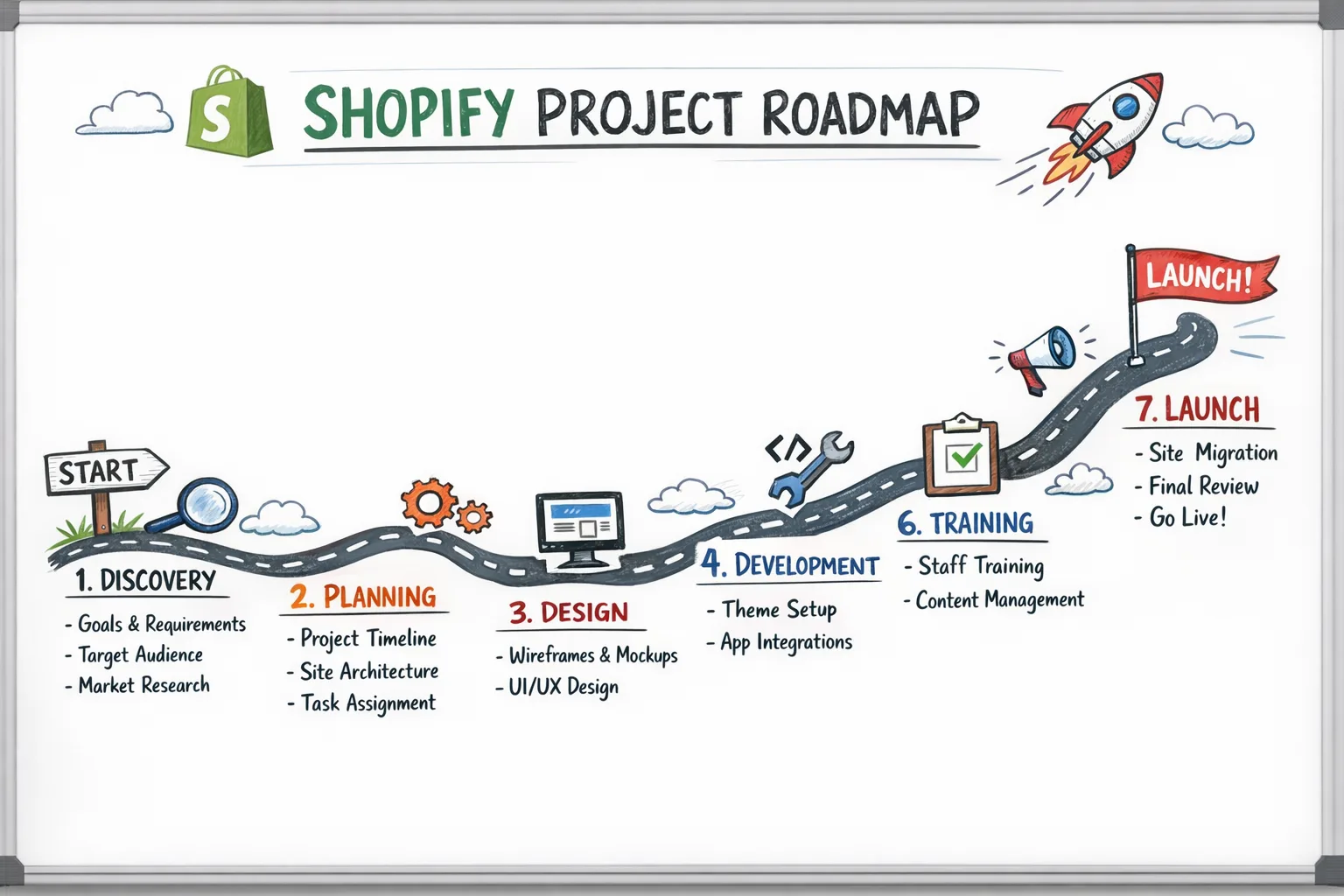
- Discovery around your numbers. We review analytics, ad accounts, and your current Shopify setup. Together we define target conversion rate, AOV, contribution margin, and any operational limits so we are clear on what success looks like and where to focus first.
- Customer journey and UX design. We map how shoppers move from ad or search result to purchase. Then we design navigation, collections, product pages, cart, and key content blocks so it is obvious why they should buy from you now. When needed, we pull in our E-commerce UI/UX Design or broader UI/UX & Branding Design team.
- Theme development and customization. Depending on your roadmap, we either start from a proven theme or build a custom one. We implement UX, tune Liquid templates, and keep code modular so new layouts, content blocks, and campaigns are safe to ship without rewriting everything.
- Apps, integrations, and automation. We configure or integrate the tools you actually use: email, reviews, loyalty, subscriptions, payments, shipping, and more. For deeper work with ERP, CRM, or 3PLs, we bring in our Integrations & API Development, Shopify Apps & Integrations, and Payment Integrations specialists.
- Performance, QA, and launch. Before launch we test critical flows across devices and browsers, optimize load speed, validate tracking and pixels, and cover security basics. Larger projects can tap our QA & Testing and Web Performance Optimization services.
- Ongoing support and optimization. After launch, we can stay on through Support & Maintenance to iterate on UX, run experiments, and keep the store stable as traffic and catalog complexity grow.
What you get as concrete deliverables
You do not get a black box handoff. You get assets your team can actually build on.
- UX flows and design files (typically in Figma) for home, collection, product detail, cart, and key landing templates.
- A production-ready Shopify theme with clean, commented Liquid, CSS, and JS that your team is not afraid to touch.
- Configured apps and integrations for payments, shipping, email, reviews, analytics, and any agreed third-party tools.
- Technical SEO foundations, including sensible URL patterns, metadata structures, sitemaps, and performance tuned toward Core Web Vitals.
- Event and conversion tracking for analytics and ad platforms, often with support from our GTM Conversion Tracking Setup and GA4 + Search Console Setup services.
- Short admin training sessions and basic documentation so non-technical staff can manage products, content, discounts, and landing pages without waiting on developers.
What you can order
- New Shopify Store Build — End-to-end setup of a new store, including theme configuration, product structure, payments and shipping, essential apps, tracking, and launch support. Often paired with our Shopify Store Build or D2C Store Build (Shopify) services.
- Conversion-focused Shopify Redesign — A full UX and visual refresh of an existing store, with improved product and collection pages, faster performance, tighter cart and checkout flows, and cleaner tracking, without changing your underlying platform.
- Theme Customization Sprint — A focused 1 to 3 week engagement to adapt or extend your current theme: new homepage sections, PDP layouts, navigation changes, or custom landing templates for campaigns. Typically delivered via our Shopify Theme Customization services.
- Shopify Apps & Integrations Setup — Selection, configuration, or custom development of apps and integrations for CRM, ERP, 3PL, subscriptions, or loyalty programs, using our Shopify Apps & Integrations and Integrations & API Development teams.
- International or B2B Shopify Configuration — Setup for multiple markets, currencies, languages, or B2B-specific catalogs and pricing rules, often combined with B2B E-commerce Portal Development and International SEO Services.
- Shopify Performance & UX Audit — A compact review of store speed, theme code, UX, tracking, and app usage, delivered as a prioritized action list and implementation roadmap, with the option for our team to execute the fixes.
Why choose BYBOWU for Shopify development
- Revenue-first, not theme-first. We start with AOV, conversion rate, and margin, then design store flows, content blocks, and offers that support those numbers. Theme choices follow the strategy, not the other way around.
- Design, engineering, and marketing in one team. UX, theme work, apps, and analytics are handled together, so you do not end up with a beautiful but slow store, or a fast store that undermines brand and SEO.
- Senior communication and honest tradeoffs. You work with people who can talk CAC, LTV, and fulfillment constraints in the same conversation as Liquid, performance budgets, and integration limits.
- Stable foundations for growth. We keep themes lean, control app sprawl, and bring in services like Web Performance Optimization and Website Security & Vulnerability Assessment when needed.
- A partner beyond the storefront. As your brand grows, we can support you with E-commerce Development, E-commerce SEO, E-commerce Ads Management, or Mobile App Development when you are ready for dedicated mobile commerce.
Proof it works in the real world
Fashion marketplace going modern
We helped a modern apparel marketplace move onto a scalable ecommerce platform with faster catalog browsing and a smoother checkout. The team now has a storefront they can extend as new brands and collections come on board. See project details.
Tactical apparel ecommerce
For a niche tactical clothing marketplace, we delivered a store that handles detailed product data and intuitive category navigation, helping turn specialized visitors into repeat buyers. See project details.
B2B dropshipping operations
We built a web platform that streamlines ordering between wholesalers and resellers for a dropshipping business, showing how we manage complex catalogs and integrations that often sit alongside a Shopify storefront. See project details.
Questions founders usually ask
What budgets do you typically work with for Shopify projects?
Budgets depend on complexity. Focused theme changes and audits sit at the lower end, full store builds and redesigns are in the middle, and setups with custom apps or deep integrations land higher. If you share your constraints, we can usually shape a phase 1 that fits. Typical ranges are outlined on our Prices page.
How long does a Shopify build or redesign take?
As a rough guide, theme customization sprints are often 1–3 weeks, full Shopify builds 3–6 weeks, and more advanced setups with integrations or custom apps 6–12 weeks. We confirm timelines and milestones before we start, then keep you updated as we go.
Can you migrate my existing store to Shopify without losing data or SEO?
In most cases, yes. We build the new Shopify store in a private environment, migrate products and customers as appropriate, plan redirects, and only switch DNS once everything is tested. For complex cases we involve our Shopify Migration Services and Technical SEO Audit teams.
Will the store be ready for SEO and paid ads?
We handle technical SEO basics, speed, and tracking as part of our standard builds. That includes clean HTML, metadata structures, sitemaps, redirects, and properly configured pixels and events. If you want deeper strategy and campaigns, our SEO & Digital Marketing and Advertising Services teams can support you.
Can our non-technical team manage the store after launch?
Yes. We structure sections, templates, and content areas so marketing and operations can safely manage collections, content, pricing, and promotions. We also provide training and documentation, and if you want an ongoing partner, you can use our Monthly Support Retainer.
Do you only work with local ecommerce brands?
No. While our headquarters are in the US, we work comfortably with teams across time zones. If you are nearby we are happy to run workshops in person. If your team is distributed, we run projects over structured video calls and async tools.
Talk through your Shopify store or migration
If you already have a specific Shopify project in mind, we can usually outline an initial plan, budget range, and timeline within one business day once we understand your goals.
If you are still weighing options, we can review your current ecommerce setup, highlight quick wins, and suggest a realistic path forward, whether that means improving your existing store or moving to Shopify.
Contact us for a 24-hour Shopify estimate or request a local ecommerce audit.