Integrations and APIs that keep your business in sync
If you are responsible for revenue, operations, or product, broken or manual data flows are not a minor nuisance. They create lead leaks, invoicing mistakes, bad reporting, and support issues that show up directly in your numbers.
BYBOWU is a web and software team based in Phoenix, AZ, partnering with companies across the US and worldwide. We design and build integrations and APIs so your CRM, site, apps, billing, analytics, and internal tools behave like one platform, instead of a pile of scripts nobody wants to touch.
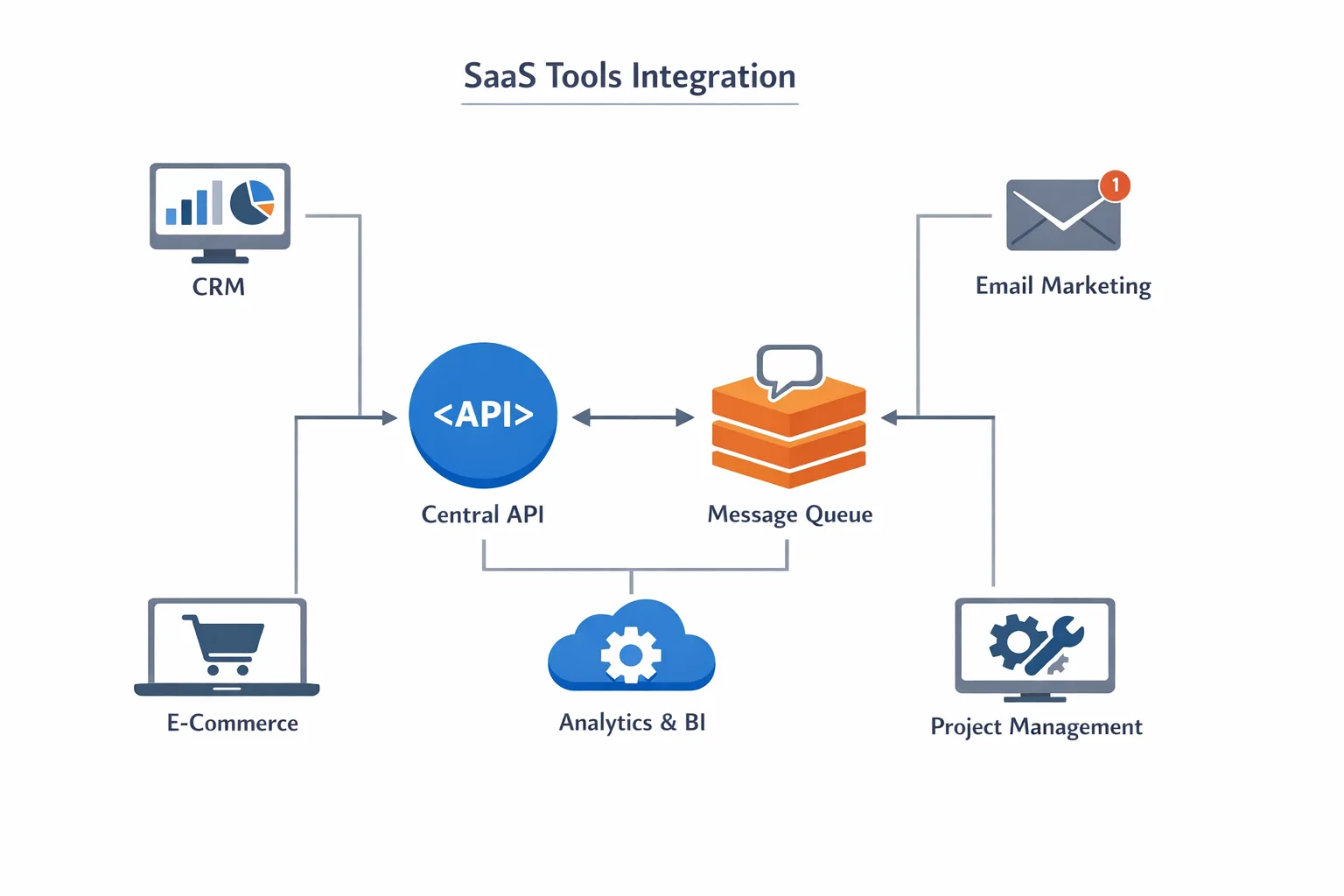
Where integrations are usually hurting you
Most clients reach out after a homegrown fix, plugin, or Zapier flow has already started to creak. Typical symptoms:
- Leads, signups, or orders do not always reach the CRM, email platform, or analytics tools.
- Customer records are duplicated or out of sync between CRM, billing, support, and product databases.
- Finance and ops teams live in spreadsheets because reporting requires constant CSV exports and cleanup.
- Legacy, undocumented integrations block a new website, app, or ecommerce rollout.
- Third-party APIs change or rate-limit you, and nobody feels safe changing the existing code.
- Internal or partner APIs expose more data than they should, or have no clear access model at all.
Our job is to replace that mess with a stable integration layer you can trust when traffic and data volume grow, not just on a quiet Tuesday.
How we design and build integrations and APIs
We treat integrations as core infrastructure, not glue code. Clear contracts, proper error handling, and observability are non-negotiable, because they are what keep you out of fire drills later.

- Discovery and system mapping. We inventory your stack (CRM, marketing, ecommerce, ERP, billing, analytics, custom apps) and map how data should move between them. Together we define success: fewer manual steps, more accurate reports, faster onboarding, cleaner customer views, or all of the above.
- Integration and API design. We design data flows, event triggers, and failure paths before writing code. For APIs, we define endpoints, payloads, versioning, rate limits, and auth so internal teams and partners get a predictable interface instead of tribal knowledge.
- Build and configuration. We implement integrations using stable patterns: direct API calls, webhooks, middleware services, queues, or custom connectors where needed. When we build your own API, we align with your existing stack and, when useful, coordinate with our Web Development and Custom Software Development teams.
- Testing, monitoring, and resilience. We test both happy paths and failure scenarios in staging, then add logging and alerts around critical flows. Your team gets visibility when something misbehaves, instead of discovering issues from missing revenue or angry customers.
- Launch, documentation, and handover. We roll out in a controlled way, monitor production closely, and document endpoints, data flows, and operating procedures. If you want a long-term partner, our Support & Maintenance options keep integrations healthy as your stack evolves.
What you get as concrete deliverables
You are not buying magic. You are buying a set of assets your team can operate and extend, even if we are not in the room.
- System and data-flow diagrams that show which tools connect, what moves where, and on which triggers.
- Production-ready integration code or configurations aligned with your tech stack and hosting setup.
- REST API endpoints or webhooks documented with request and response examples for developers.
- Authentication and authorization setup for internal, partner, or public APIs, following least-privilege access.
- Error handling, retry logic, and idempotency around critical flows like orders, invoices, and subscriptions.
- Deployment notes, environment configuration details, and short training for your engineering or ops team.
What you can order
- CRM integration setup — Connect your website, landing pages, and product to your CRM or marketing platform so leads, signups, and events sync reliably. Often combined with our focused CRM Integrations service.
- Payment and subscription integration — Wire your product, checkout, or booking flow to payment providers and subscription billing with proper error handling and reconciliation. Commonly paired with Payment Integrations, Stripe Payments Integration, and Billing & Subscriptions.
- Third-party app integration — A focused project to connect support desks, logistics, accounting, or AI tools to your web or mobile product. See also our Third-Party Integrations offer.
- Custom API for your product — Design and build a documented REST API or webhook layer so partners, mobile apps, and internal tools can work against a stable interface. Often layered with API Development and API-first Backend Development.
- Data sync and reporting pipeline — Consolidate data from multiple systems into a central store for analytics and reporting, together with Data Engineering & BI, ETL & Data Pipelines, and Dashboards & Reporting.
- Integration audit and stabilization — Review existing integrations, identify risks, and replace brittle scripts with maintainable solutions. A common first step before bigger Web Development or SaaS Product Development work.
Why choose BYBOWU for integrations and APIs
- We think in systems, not scripts. We design around your whole stack and business process so the fix for this quarter's pain does not block next year's roadmap.
- Business and tech fluency. You work with senior people who can talk LTV, churn, and funnel metrics in the same breath as endpoints, payloads, and auth flows.
- Stable foundations for growth. We build with security, performance, and observability in mind, which means fewer silent failures and faster debugging when issues appear.
- End-to-end capability. Because we also build web apps, mobile apps, and AI & Automation solutions, we design integrations for how they are used day to day, not just how they look in a diagram.
- Flexible engagement models. Some clients need a one-time project, others keep us as a long-term partner to maintain and extend their platform. Our Monthly Support Retainer fits teams that want ongoing help without hiring full-time.
Proof it works in the real world
Marketplace catalog, payments, and marketing
For a modern clothing marketplace, we connected product catalogs, payment providers, and marketing tools so the team manages inventory in one place while customers see accurate stock and smooth checkout. See an example in our SixZeros project.
B2B dropshipping platform flows
For a wholesaler and dropshipping platform, we tied supplier data, reseller portals, and order management into a single web app, cutting manual coordination and reducing order errors. Explore highlights from MonoDrop.
Roommate matching product API
On a roommate finder product, we implemented integrations for accounts, messaging, and matching logic, giving the team an API layer they can extend with mobile apps and new features. Learn more in the Roome case.
Automation with chat and bots
For bot-based solutions, we connected messaging platforms with internal systems and CRMs so automated conversations trigger real actions like lead creation, order updates, and notifications. See examples in our Telegram Bots work.
How engagement works with BYBOWU
You are busy, so we keep collaboration predictable and focused on decisions only you can make.
- 1. Intro call. We review your current systems, pain points, and constraints. If there is a clear way to help, we move into a short discovery phase.
- 2. Scope and estimate. You get a structured proposal with options, phases, and budget ranges. Smaller integrations can often be scoped as fixed-price projects. Typical ranges are outlined on our Prices page.
- 3. Build in focused iterations. We implement integrations or APIs in short sprints, show progress regularly, and refine based on feedback from your team.
- 4. Launch, monitor, and tune. We roll out in a controlled way, watch logs and metrics, and adjust error handling or performance where it moves the needle.
- 5. Iterate or hand over. We can stay on as your integration partner or hand over to your internal team with documentation, training, and optional QA & Testing support.
We are comfortable working fully remotely across time zones or pairing with your team on deeper workshops when that makes decisions faster.
Questions founders usually ask
What budgets do you typically work with for integrations?
It depends on how many systems are involved and how critical the flows are. A single, well-defined integration lands at the lower end, while multi-system projects or new API layers are more substantial. Share your stack and constraints and we can usually outline realistic options quickly. You can also review guidance on our Prices page.
How long does an integration or API project take?
Simple single-tool integrations often take a few weeks from discovery to production. Multi-system workflows or APIs that several teams will use can run from a few weeks to a few months depending on scope, testing depth, and vendor dependencies. We agree on milestones and launch windows before we start building.
Can you work with our existing tech stack?
In most cases yes. We regularly integrate with common CRMs, ecommerce engines, marketing tools, analytics platforms, and custom backends built with frameworks such as Laravel, Node, and Python-based stacks. If something is proprietary or closed, we will flag that early and suggest realistic alternatives.
How do you handle security and access control?
We follow fundamentals like least-privilege access, secure credential storage, encryption in transit, and proper input validation. For APIs, we implement authentication and authorization appropriate to your use case. If you have compliance needs, we align with your internal policies and any existing audits.
Will new integrations break when vendors update their APIs?
Vendor changes are a reality, so we design with that in mind. Where possible we depend on stable, versioned endpoints, monitor deprecation notices, and add alerts around critical calls. Our ongoing Support & Maintenance plans can include periodic checks for vendor changes and proactive updates.
What happens if something fails after launch?
We aim to catch issues early with staging environments, tests, and logging. If something shows up in production, we use those tools to pinpoint and fix it quickly. During an agreed warranty period, we address defects in the delivered scope, and many clients extend into an ongoing support engagement for additional peace of mind.
Talk through your integration or API roadmap
If you already know which systems need to talk, we can usually outline an approach, rough budget, and timeline within one business day once we see your stack.
If you are still mapping your tools, we can review what you have, point out quick wins, and suggest a phased plan that removes the biggest pain first.
Contact us for a 24-hour integration estimate or request a local platform audit.