Custom software development for teams that have outgrown generic tools
Your business is more complex than a spreadsheet and more nuanced than a SaaS template. At some point, copy-pasting data between tools stops working, and every new process feels like a workaround.
BYBOWU designs and builds custom web and mobile software that fits your workflows, your customers, and your team. Based in Phoenix, AZ and working with clients across the US and globally, we act as a senior product and engineering partner, not just extra hands writing tickets.
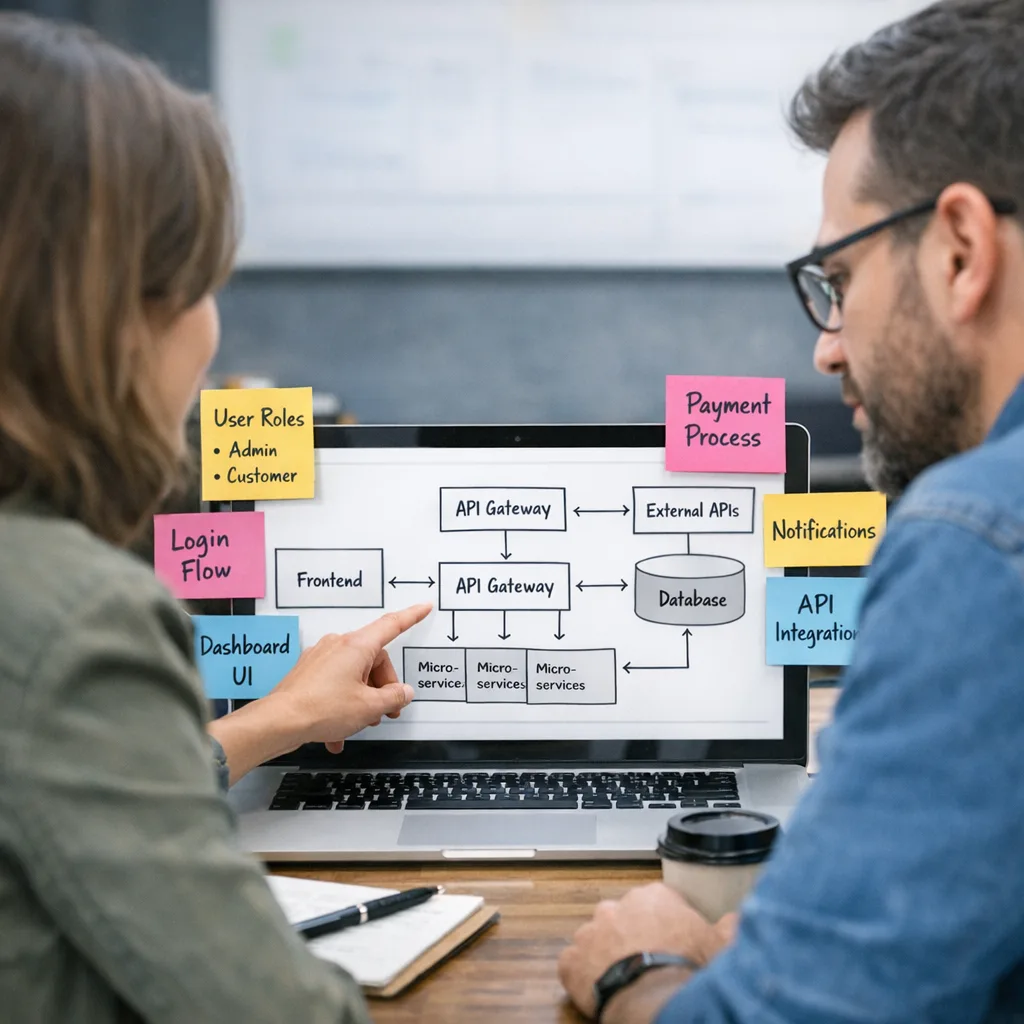
The problems we are usually brought in to fix
If you recognize a few of these, you are probably trying to run a serious operation on tools that were never designed for it:
- Disconnected systems: customer, order, and billing data scattered across CRM, spreadsheets, and chat so nobody fully trusts the numbers.
- Manual, error-prone workflows: the same information re-entered in three or four places, leading to delays, mistakes, and frustrated customers.
- Legacy or slow internal tools: outdated applications only one person understands, and everyone else avoids until something breaks.
- Off-the-shelf limitations: the platform does 80% of what you need, but the missing 20% is where margin and customer experience are decided.
- No real visibility: leaders making decisions from stale exports instead of live dashboards and clear reporting.
- Missed opportunities: leads not followed up, orders delayed, or customers churning because your process is too hard to navigate.
Our job is to find where time, money, and opportunities leak out of your process, then design software that quietly closes those gaps and keeps working as you grow.
How we approach custom software projects
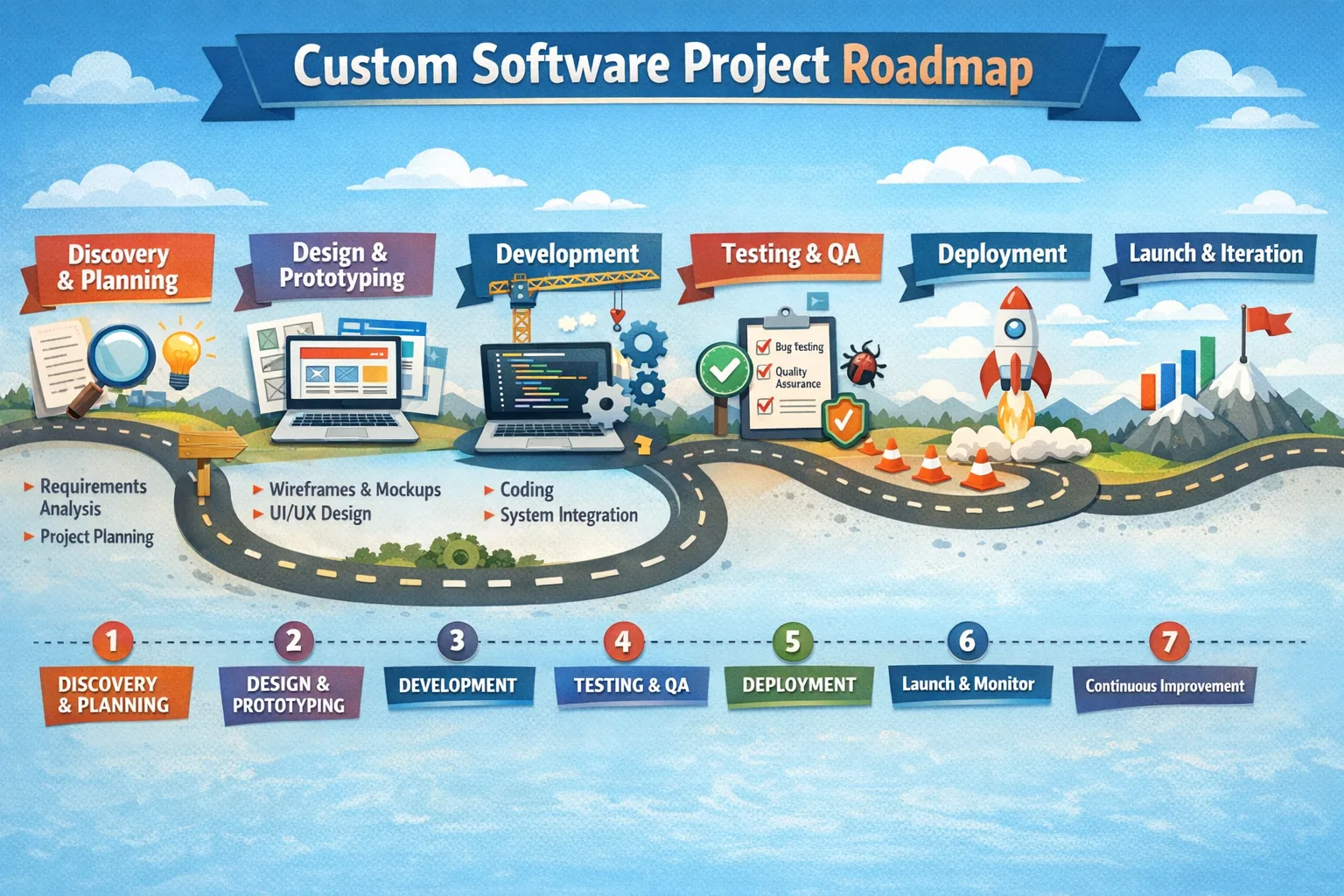
We treat custom software like a product that has to earn its keep. Clear goals, short feedback loops, and an architecture that will not trap you later.
-
Discovery and alignment
We start with focused conversations and, when useful, short workshops with your team. We map business goals, user roles, existing systems, and constraints. You get a clear problem statement, success metrics, and a realistic roadmap for a phase 1 that can launch quickly.
-
Product and UX design
Our product and design team maps user journeys and drafts wireframes for core flows like onboarding, quoting, ordering, approvals, and support. You see how the system will work before we write production code. For complex interfaces we often pair this with our UI/UX & Branding Design and Dashboard & Web App Design services.
-
Architecture and development
We define an architecture that fits your scale and risk profile. Many projects use Laravel or similar frameworks on the backend and modern JavaScript frameworks on the frontend, similar to our Web Development work. We build in iterations with short sprints, demos, and visible progress so you can react before anything drifts.
-
Integrations and data migration
Most useful software does not live alone. Using our Integrations & API Development services, we connect CRMs, ERPs, payment providers, marketing tools, and internal APIs. For existing data, we plan migrations carefully so you do not lose history or interrupt day-to-day work.
-
Testing, launch, and adoption
Before launch we run through real-world scenarios across user roles and devices. When needed we involve our QA & Testing team for deeper coverage. After go-live we monitor behavior, fix edge cases, and help your team adopt the new workflows with documentation and targeted training.
Need a grounded ballpark in the next 24 hours?
Share what you are trying to fix or build, and we will respond within one business day with a rough plan, options, and a realistic budget range.
What you get as concrete deliverables
Every engagement ends with assets your team can actually run, not a black box that only we understand.
- Product and requirements brief: a clear description of what we are building, for whom, and why, written so business and technical teams can stay aligned.
- UX flows and interface designs: key screens and journeys mapped out before development, usually delivered as clickable prototypes and design files.
- Custom web or mobile application: production-ready code with clean architecture and APIs that can support future features, integrations, or mobile apps via our Mobile App Development services.
- Integrations and automation: connections to your CRM, billing, analytics, internal systems, and other tools so teams stop copying data around manually.
- Admin tools and reporting: dashboards, exports, and configuration screens so your team can operate day to day without waiting on developers.
- Documentation and training: practical guides for admins and users, plus short onboarding sessions when needed.
- Post-launch support: a defined stabilization window for fixes and tuning, with the option to extend into a Support & Maintenance retainer.
We aim for measurable outcomes like faster response times, fewer manual touches per order, smoother onboarding, higher conversion on key flows, and more confident decisions based on reliable data.
What you can order
- Operations workflow system — an internal web app that replaces spreadsheets and long email threads with structured pipelines, task tracking, SLAs, and role-based access. Often combined with our Workflow Automation Software services.
- Custom CRM or deal desk — a sales or partner management tool tuned to your stages, pricing rules, approvals, and handoffs, with reporting your team will actually read, related to our CRM/ERP System Development offers.
- Customer or partner portal — secure self-service access for customers, resellers, or vendors to manage orders, subscriptions, inventory, or tickets, often built with our Portal Development expertise.
- Booking or ordering platform — web and mobile interfaces for scheduling, ordering, and payments, synced with your back office and, when useful, our Booking & Delivery Platform Development services.
- Legacy tool rebuild — modernization of an outdated internal or customer-facing application using a contemporary stack, while preserving key business rules and historical data, often supported by our Architecture Review service.
- MVP for a new SaaS or marketplace — a lean but solid first version of your product, ready for real users and investors, typically combined with our Startup MVP Development or SaaS Product Development services.
Proof it works in the real world
Marketplace operations platform
For a modern apparel marketplace, we built custom tools that simplified vendor onboarding and catalog management, giving the team capacity to handle more orders with the same headcount. See project details.
Roommate matching workflow
A roommate finder platform needed smoother flows for profiles and matching. We streamlined the experience so users could create profiles faster and connect with compatible housemates with fewer support requests. See project details.
Wholesale ordering automation
For a B2B wholesaler and dropshipping business, we implemented a web app that centralizes pricing, catalog updates, and orders, cutting down manual coordination between suppliers and resellers. See project details.
Custom bots and lightweight tools
We delivered bots and small internal tools that automate repetitive chat and order-related tasks, helping lean teams respond faster without building a full call center from day one. See project details.
Why choose BYBOWU for custom software development
- Senior-led from day one — your project is run by people who have shipped production systems before and who can talk business and tech in the same conversation.
- Product thinking, not just features — we question requirements, propose simpler paths when possible, and design around adoption and ROI, not just launch day.
- Pragmatic technology choices — we favor stable, well-supported stacks that your in-house team or another vendor can maintain, and we document decisions clearly.
- End-to-end capability — when needed we bring in specialists from DevOps & Cloud, Data Engineering & BI, or AI & Automation so the solution holds up under real usage.
- Transparent communication — you get milestones, demos, and plain-language updates so you always know what is done, what is next, and where the risks are.
How engagement works
We keep the engagement model straightforward so you can make decisions quickly and stay in control of scope.
-
Initial consultation (no cost)
A 30 to 45 minute call to understand your goals, constraints, and timelines. If we are not the right fit, we will say so and suggest alternatives.
-
Discovery and scoping
For most projects we recommend a short paid discovery. You get tangible outputs you can use with us or any vendor, including a prioritized backlog, architecture sketch, and estimates. If you prefer, we can align this with our Product Discovery Workshop or Architecture Review services.
-
Fixed-scope or phased build
Depending on complexity, we either agree a fixed scope and price or define a phased roadmap such as MVP, pilot, and scale-up with clear expectations for each phase.
-
Ongoing support and iteration
After launch we can stay on for maintenance, improvements, monitoring, and new features through our Support & Maintenance offers, or hand over to your internal team with documentation and optional training.
Questions founders usually ask
What budget range do we need for custom software?
Budgets depend on scope, complexity, and integrations. Focused internal tools are typically in the low five figures, while multi-module platforms are higher. After a short call we can usually share a grounded range within 24 hours. You can also review typical ranges on our Prices page.
How long will it take to launch a first version?
A focused MVP or internal tool often takes 6 to 10 weeks from confirmed scope. Larger platforms with multiple user types and integrations may run 3 to 6 months. During discovery we map specific milestones so you know what is coming when.
What technologies do you typically use?
We use modern, well-supported stacks similar to those in our Web Development and Mobile App work. Many backends are built with Laravel or comparable frameworks, frontends with popular JavaScript frameworks, and integrations handled through clean APIs so your ecosystem stays flexible.
Can you integrate with our CRM, ERP, or payment providers?
In most cases yes, as long as those systems expose APIs or export options. During discovery we review your current stack and suggest the cleanest integration paths, including any risks or limitations before we commit them into scope.
What happens if our requirements change mid-project?
Change is normal. We handle it explicitly. New requests are estimated and prioritized with you, then either swapped into the current phase or placed into a future phase so budget and deadlines remain under control.
Will you support the software after launch?
Yes. Every build includes a stabilization period for bug fixes and small adjustments. Many clients then continue with a tailored maintenance and improvement plan through our Support & Maintenance services.
Discuss your custom software roadmap
Whether you are replacing a legacy tool, streamlining operations, or planning a new customer-facing platform, we can help you shape a realistic next step.