
GitHub Actions Node 24: What Breaks on March 4
On March 4, 2026, GitHub Actions flips its default JavaScript runtime to Node 24. If you maintain custom JavaScript actions or run a large CI fleet, treat this as a live-fire change window. The primary keyword here is GitHub Actions Node 24, and it’s the one decision that will silently turn green pipelines red if you ignore it.
Here’s the thing: March isn’t just a runtime switch. It’s a compound change across runners, costs, and downstream toolchains. Node 24 becomes the default on March 4, 2026; minimum self-hosted runner version enforcement lands March 16, 2026; and Apple’s Xcode 26 submission requirement begins April 28, 2026. If you connect the dots now, you can ship confidently while everyone else scrambles.
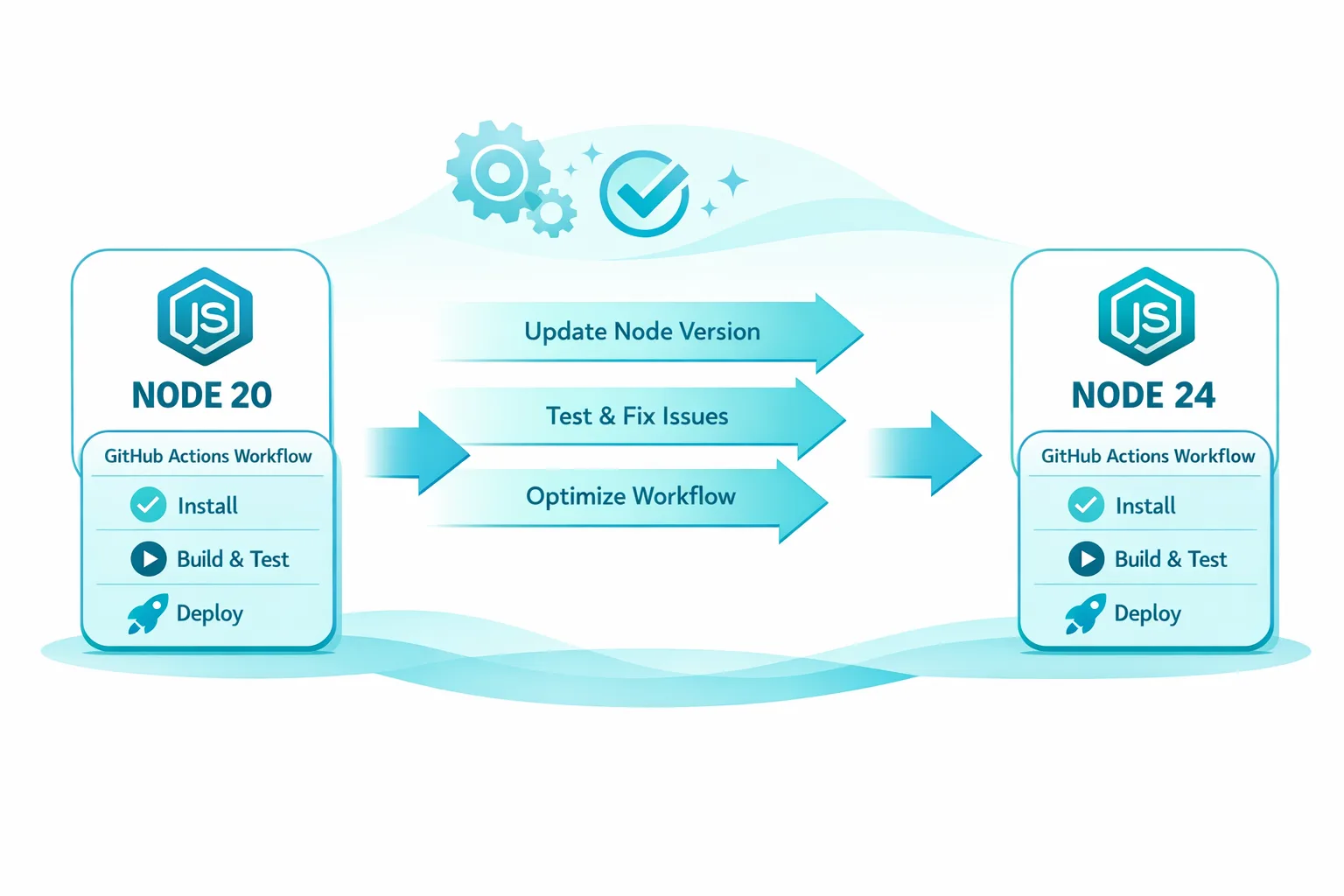
Why GitHub Actions Node 24 is a forcing function
Node 20 reaches end of life in April 2026, so GitHub is setting Node 24 as the default engine for JavaScript actions ahead of that. That default flip means any action authored with Node that you call from your workflows runs under Node 24 unless it explicitly pins otherwise. Most marketplace actions have already published Node 24 builds. The risky ones are your internal or long-tail actions that still declare runs.using: node20 or haven’t been rebuilt since last year.
Two more mechanics to understand: there’s an opt-in flag to test early and an opt-out flag to buy time. To test your entire repo under Node 24 before March 4, set FORCE_JAVASCRIPT_ACTIONS_TO_NODE24=true in your workflow env or runner environment. After March 4, if you absolutely must keep Node 20 for a short period, you can set ACTIONS_ALLOW_USE_UNSECURE_NODE_VERSION=true. I don’t recommend leaning on that longer than a temporary triage, but it’s a useful safety valve when you’re burning down a risk list.
Key dates and what they mean for your pipeline
Lock these into your change calendar. They’re tightly coupled, even if they look like separate initiatives at first glance.
- March 4, 2026: Default switch to GitHub Actions Node 24. Workflows start executing JavaScript actions on Node 24 automatically unless you’ve pinned otherwise.
- March 16, 2026: Minimum version enforcement for self-hosted runners. Runners older than the required version will be blocked at configuration time. Plan upgrades and brownout tests before this date.
- April 28, 2026: Apple’s App Store submission rule requires Xcode 26+ and the 26 SDKs. Your macOS runner images, toolchains, and cached simulators must align or your mobile lanes fail late in the release cycle.
If you own both CI and mobile release engineering, coordinate these windows now. The overlap is real: Node 24 compatibility plus new macOS images for Xcode 26 can surface subtle path, certificate, and SDK cache issues.
What actually breaks when Node 24 takes over?
Breakage falls into three buckets.
1) Actions authored against Node 20 APIs
Any custom action with runs.using: node20 in action.yml must be rebuilt for Node 24. Common gotchas include:
- Older
@actions/*packages that rely on Node 20 behaviors (update to the latest majors). - Native modules that need a rebuild for a newer V8 and
node-gyptoolchain. - ESM/CJS mismatches made worse by stricter runtime semantics.
2) Marketplace actions pinned to stale majors
If you’re still on actions/checkout@v2 or actions/setup-node@v3, expect surprises. Upgrade to the newest major for each critical action, then run a full matrix of your most expensive jobs with the Node 24 test flag flipped on.
3) Self-hosted runners behind on versions or OS
Node 24 support requires runner upgrades. If your fleet uses older macOS images or ARM32 hardware, you’ll hit hard incompatibilities. This is precisely why March 16’s enforcement matters. Don’t leave it to chance: automate detection and upgrades across your fleet a week early.
A practical 7-step upgrade framework (works in a day)
Use this when you need low drama in a busy sprint. It’s designed for maintainers, platform teams, and product squads who don’t want to turn CI into a multi-week migration project.
Step 1 — Inventory your exposure
Find every place you might be relying on Node 20 implicitly or explicitly.
# Find actions you author that still target Node 20
git grep -n "runs.using: node20" -- '**/action.yml' '**/action.yaml'

# Find older majors with higher risk
git grep -n "actions/checkout@v2\|setup-node@v3\|cache@v2" -- '**/.github/workflows/*.yml'
Flag anything with node20 and any action major older than current. Build a short list you can burn down in a single PR train.
Step 2 — Flip the early test switch
Create a one-off branch that sets env: FORCE_JAVASCRIPT_ACTIONS_TO_NODE24: true at the workflow or job level. Run your normal test suites and release jobs there. The point isn’t perfection; it’s surfacing stack traces and module rebuild needs while you can still schedule a fix.
Step 3 — Bump action majors and rebuild your own
Upgrade actions/checkout, actions/setup-node, actions/cache, actions/upload-artifact, and any security-critical actions to their latest majors. For in-house actions:
- Change
runs.usingtonode24. - Rebuild with the latest
@actions/coreand@actions/github. - Regenerate the
distfolder and commit it (don’t rely on transpiling at runtime).
Step 4 — Pin by commit SHA for high-trust actions
For security-sensitive workflows (deploy, signing, provenance, infra), pin actions by commit SHA rather than a floating tag. Maintain a small internal catalog of vetted SHAs and update it on a monthly cadence.
Step 5 — Update runners and images
Target at least the enforced runner version ahead of March 16. For macOS, prepare images that can run GitHub Actions Node 24 and Xcode 26 together. Replace older macOS baselines, and purge incompatible SDK caches to avoid toolchain drift.
Step 6 — Run a brownout day
Before March 4, schedule a four-hour window where you force Node 24 on your default branch. Monitor error rates and job durations. Roll back by removing the environment flag if you uncover a blocker. The muscle memory you build here makes the real flip a non-event.
Step 7 — Remove the test flag and watch for regressions
Once green, merge the Node 24 changes and stop relying on FORCE_JAVASCRIPT_ACTIONS_TO_NODE24. Capture regressions in a follow-up issue labeled node24-migration. If you’re truly stuck on March 4, use the opt-out flag for a few days, but set an expiration date for yourself.
People also ask: quick answers you can use
How do I force GitHub Actions to use Node 24 today?
Add env: FORCE_JAVASCRIPT_ACTIONS_TO_NODE24: true at the workflow or job level. That forces all JavaScript actions to execute under Node 24 for that run.
Will my workflows stop working on March 4, 2026?
Most won’t, because popular marketplace actions already ship Node 24 builds. The usual failures are in-house actions still declaring node20 and third-party actions pinned to outdated majors. Run the early test to be sure.
What runner versions do I need?
Plan to upgrade fleet-wide to the enforced minimum (or newer) before March 16, 2026. Treat any runner that can’t auto-update as tech debt—especially macOS images used for mobile signing and builds.
Are self-hosted runners affected differently?
They are, because you own the upgrade path. Configuration-time blocks after March 16 will strand outdated runners. Bake upgrades into your autoscaling flow or golden image pipeline.
Cost signals you shouldn’t ignore
Starting January 1, 2026, GitHub adjusted Actions pricing with lower per-minute rates for GitHub-hosted runners and a small platform charge applied to all workflows. For most teams, the net effect is neutral to positive. But self-hosted-heavy orgs can see the platform charge in aggregate. If you run big monorepo matrices, consider rebalancing which jobs run on GitHub-hosted runners (now cheaper) versus your own fleet. This can also be a nudge to consolidate bloated test matrices that no longer pay back.
Mobile teams: connect Node 24 to Apple’s April 28 rule
If you ship iOS, your CI has another ticking clock: starting April 28, 2026, App Store submissions must be built with Xcode 26 and the 26 SDKs. That means:
- Your macOS runner images need Xcode 26, updated simulators, and fresh codesigning assets.
- Any Node-backed build steps (Fastlane lanes that call JavaScript tooling, React Native Metro, Yarn/PNPM caches) should be validated under Node 24 to avoid mismatches during archive or symbol upload.
- Plan disk space. Xcode 26 plus additional SDKs and simulators will inflate image sizes and cold-start times.
If you haven’t scoped this yet, our April-focused iOS articles dig deeper into the scheduling and risk trade-offs. See the practical guidance in ship confident by April 28 and the earlier contingency planning in what teams must do now.
Security and reliability guardrails while you migrate
Runtime flips are when latent supply-chain issues surface. Tighten these guardrails while you’re here:
- Pin critical actions by commit SHA; review diffs before updating.
- Scope OIDC and PAT permissions to least privilege; rotate secrets that touch release or infrastructure flows.
- Disable automatic dependency caching in security-sensitive repos unless you’ve audited the cache path and keys.
- Set explicit
node-versionviaactions/setup-nodefor app-level Node (tooling) so your build steps don’t drift with image updates.
CI maintainers’ checklist for the next 14 days
If you lead platform engineering, this is your punch list. Copy, paste, and assign owners.
- Repo sweep: Grep for
runs.using: node20. Open a single umbrella ticket with a subtask per action. - Enable a canary branch: Flip
FORCE_JAVASCRIPT_ACTIONS_TO_NODE24there. Run your top 10 workflows by cost and duration. - Upgrade core actions: Checkout, setup-node, cache, artifact—move to current majors. Re-pin by SHA for deploy lanes.
- Runner fleet audit: List versions; auto-upgrade to meet March 16 enforcement. Refresh macOS images for Xcode 26.
- Pipelines as product: Add SLOs for median queued time and success rate; watch them during the March window.
- Cost sanity check: Rebalance jobs between GitHub-hosted and self-hosted based on the 2026 pricing changes.
- Rollback plan: Document the opt-out flag for emergencies, with a sunset date and who can use it.
What to do next
Let’s get practical. You can knock out the risky 20% in an afternoon:
- Open a PR updating your internal actions to
runs.using: node24and bump marketplace action majors. - Create a temporary workflow that sets
FORCE_JAVASCRIPT_ACTIONS_TO_NODE24=true; run it on your busiest repo. - Schedule runner upgrades now so March 16 isn’t a surprise outage.
- For iOS teams, stage a macOS image with Xcode 26 this week and run a full archive to catch signing and SDK path issues.
If you want a deeper playbook—self-hosted autoscaling patterns, image building, or artifact retention tuning—grab our March plan for runners and our Node EOL upgrade guide. Both are written to be executed by a small team under deadline pressure.
Examples: minimal diffs that de-risk the flip
Two tiny diffs move you a long way.
1) Authoring action switch
# action.yml before
name: "my-internal-action"
runs:
  using: node20
  main: dist/index.js

# after
name: "my-internal-action"
runs:
  using: node24
  main: dist/index.js
Rebuild the dist bundle after bumping @actions/* and any native deps. Commit the generated artifacts.
2) Workflow-level safety
# .github/workflows/ci.yml snippet
jobs:
  test:
    runs-on: ubuntu-latest
    env:
      FORCE_JAVASCRIPT_ACTIONS_TO_NODE24: true
    steps:
      - uses: actions/checkout@v4
      - uses: actions/setup-node@v6
        with:
          node-version: 24
      - run: npm ci && npm test
This isolates action runtime (Node 24) from your app’s Node version (also 24 here, but you could set 22 or LTS if your app needs it). Explicit beats implicit when your image base is moving.
How we can help
We’ve guided teams through similar runtime turns—Python 3.12 upgrades, Xcode image churns, and Node LTS handoffs—under tight release calendars. If you need a short engagement to harden your CI, we can step in with a focused plan. Start with our services overview, browse relevant case notes on the blog, and see our GitHub Actions self-hosted runner plan and Node.js EOL 2026 playbook for deeper dives.
Zooming out: why this deadline matters beyond March
The platform shift to GitHub Actions Node 24 is a preview of how modern CI will keep moving: faster flips, stronger minimums, and image updates that assume you can roll with them. Teams that treat CI as shared infrastructure—with versioned golden images, pinned dependencies, and rehearsal windows—ship more often with less drama. Those are the habits that turn a noisy month like March into just another Wednesday.
Ship the diffs, schedule the runner upgrades, and give your mobile lanes a head start on Xcode 26. When March 4 arrives, you’ll already be done.









Comments
Be the first to comment.