
The primary keyword here is App Store external links, and after the Ninth Circuit’s December 11, 2025 decision in Epic v. Apple, the ground shifted again—this time in ways developers can actually plan around. External payment links in U.S. iOS apps remain lawful and must be usable, but the appeals court opened the door for Apple to collect a reasonable commission later and spelled out what “usable” means for design and copy.

What the December 11 ruling actually changed
Here’s the thing: the court affirmed that Apple violated the 2021 injunction by making external links practically pointless—its 27% fee was deemed prohibitive, and its “plain button” and flow restrictions undercut real choice. But the court said the lower court went too far by banning any commission forever. Instead, it sent the case back with instructions for a reasonable, non‑prohibitive fee tied to specific costs. Until the district court sets that number, Apple cannot start charging a commission for linked‑out purchases.
Two more concrete clarifications now govern your product work:
• Link prominence: If your app offers both Apple IAP and an external link, Apple may stop you from making the external link more prominent than its own IAP control (e.g., bigger fonts, larger buttons, more placements). But Apple must allow you to place external links in at least the same font size, quantity, and positions as its own IAP controls.
• Messaging: Neutral “you’re leaving the app” alerts are allowed; deterrent copy that effectively scares users off is not. Apple can enforce its general content standards, but not in ways that defeat the injunction’s purpose.
Why this matters to your roadmap in Q1
Developers finally have guardrails that are actionable. You can design parity with confidence, test price funnels without fear of a surprise 27% rake, and prepare for a court‑approved commission that’s based on Apple’s necessary coordination costs plus some IP compensation—excluding security and privacy costs for external links.
Translation for leadership: acquisition and conversion modeling for iOS paid products in the U.S. is back on the table. If you paused testing external links because economics were murky, the window to learn before the fee lands is open.
Designing external links without getting flagged
Let’s get practical. The appeals court rejected Apple’s prior “plain button” approach. That means your external purchase link can be a real button in your flow, not ghost text. But you can’t upstage Apple’s IAP if both appear together.
A simple link parity checklist
Use this in your design reviews to avoid rejections and hit the right side of the line:
• Placement parity: If your IAP button appears on a paywall and in the checkout modal, your external link can be on both screens too—no fewer, no more.
• Size parity: Match the IAP control’s height and width within a narrow tolerance (e.g., ±4 px). Don’t make the external button larger or bolder.
• Typeface parity: Same font family and weight as the IAP control. If the IAP is semibold, your external link shouldn’t be bold or outlined.
• Color treatment: You can use your brand colors, but avoid higher‑contrast, animated, or attention‑grabbing treatments that the IAP control doesn’t use.
• Copy clarity: “Buy on our website” or “Pay on example.com” is fine. Avoid language that disparages IAP or implies extra risk either way.
• Flow integrity: Dynamic links and modern deep links are allowed; Apple previously tried to force static links, and the court rejected that logic.
Pair the checklist with accessibility passes (WCAG 2.2 AA) so parity doesn’t degrade usability. If the IAP control has a11y labels and focus order, mirror them.
How to model the coming commission—before it lands
The court told the district judge to base any commission on Apple’s necessary costs to coordinate external links and allow some compensation for IP use—explicitly excluding security and privacy costs. That’s unusual clarity. While no percentage exists yet, you can scenario plan with a range and watch your churn and LTV impact.
Work a base case, downside, and upside for your U.S. iOS revenue:
• Monthly sub at $12.99: Run 0%, 5%, 8%, and 12% fee scenarios post‑remand. Treat the fee as a platform tax on linked‑out transactions only.
• Take rate on creator payouts: If you run a marketplace and move payouts or credits off‑app, test fee pass‑through versus absorbing the cost. Model elasticity.
• Free trial + intro price: If your intro price lives off‑app but upgrades occur in‑app, segment cohorts. The fee would only touch linked‑out events.
Instrument the funnel now with clean attribution. You’ll want a time series that shows conversion, average order value, and refund rates for in‑app vs. linked‑out cohorts during the period when no commission can be charged—so when a fee arrives, you can isolate the delta.

People also ask: common questions from teams
Can Apple still warn users when they leave the app?
Yes—neutral “you’re leaving” prompts are fair game. Heavy‑handed warnings that deter purchases violate the injunction’s spirit and won’t fly. Keep your own language factual and symmetrical with IAP copy.
Will Apple bring back the 27% commission?
No. The court called 27% prohibitive given its chilling effect. Any future commission must be justified by necessary coordination costs and limited IP compensation, and it can’t include security/privacy overhead for external links.
Does this apply outside the United States?
The injunction and the contempt order have been litigated in U.S. courts and Apple implemented link entitlements for the U.S. storefront. If you operate globally, keep rulesets per region; don’t assume parity with the U.S.
Can Apple restrict certain developers from using links?
The appeals court said Apple isn’t specifically barred from excluding some program participants (like VPP/NPP) while the lower court re‑examines the issue. If you rely on special programs, expect policy updates and be ready to appeal decisions with evidence of parity compliance.
Product and engineering: a two‑sprint “remand‑ready” plan
Week 1: hardening and parity
• Audit paywalls and checkout flows. Ensure external link parity on placement, size, typeface, and color treatment. Remove any attention hacks (animations, pulsing).
• Implement a neutral leave‑app interstitial. Keep it one step, succinct, and reversible. Mirror any IAP disclaimer language for tone parity.
• Add deep link resilience. Use universal links with graceful fallback to HTTPS. Log failed opens and measure time‑to‑purchase off‑app.
• Instrumentation: create in‑app vs. linked‑out cohort flags. Capture view → click → purchase with server‑side events to survive client blockers.
Week 2: economics and ops
• Set up fee scenarios (0–12%) in your RevOps model. Tag SKUs that are commonly purchased off‑app.
• Pricing guardrails: decide upfront whether you’ll maintain price parity across IAP and web during the fee‑free window. Document rationale.
• Customer support playbooks: write short, neutral guidance for customers who ask “Where do I manage my subscription?” Don’t disparage IAP.
• Legal/policy watch: assign one owner to track Apple’s developer updates and the district court’s next moves. Prepare a diff‑friendly SOP.
Copy you can ship today (templates)
Leaving the app (neutral): “You’re about to purchase on example.com. Your account and payment are handled on our website.”
Web paywall CTA (parity tone): “Buy on example.com” or “Subscribe on our website.” Avoid “Avoid Apple fees” or “Cheaper here”—besides policy risk, it invites user distrust.
Manage subscription help text: “Subscriptions purchased on our website are managed on example.com/account. App Store purchases are managed in iOS Settings.”
Executive view: the strategy call behind the UI
Zooming out, this ruling tilts the balance back toward genuinely competitive purchase flows on iOS without eliminating Apple’s ability to be paid later. For subscription apps with strong web funnels—music, news, fitness, productivity—the next few months are the best opportunity since 2021 to run controlled experiments on acquisition, churn, and upgrade paths. For marketplace and creator platforms, the off‑app path can reduce friction for payouts and bundled value, but you’ll need clear governance to keep parity while you optimize.
There’s a catch: when the district court sets a commission, it may be non‑trivial. If your external funnel depends on striking price deltas versus IAP, build resilience now—annual plans, add‑on packs, or account‑level value that’s easier to sell via web.
Engineering details that usually bite
• Purchase attribution: use a server‑side event bus to tie app session IDs to web purchase IDs. Store a short‑lived token in the link querystring and clear it post‑purchase.
• Fraud and refunds: align policies across IAP and web. The court said Apple can’t count security/privacy costs toward any fee for external links, so don’t depend on Apple’s fraud stack here—own your chargeback playbooks.
• A/B testing: don’t A/B test into non‑parity. If variant B makes the external button bigger than IAP, you’re courting rejection. Instead, test copy clarity, timing of the web redirection, and the interstitial’s design within neutral bounds.
What to do next
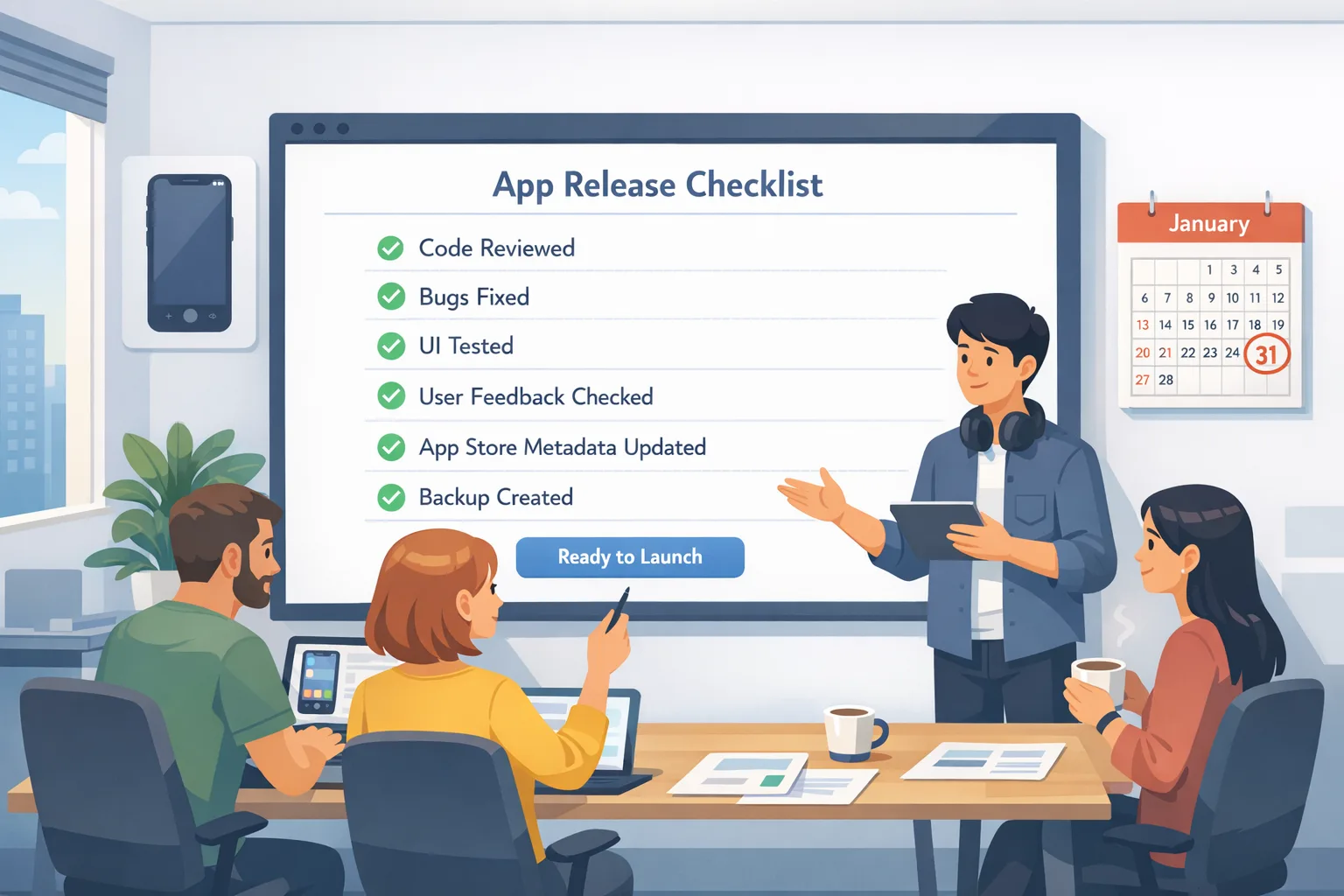
• Ship parity updates now. Treat it like a compliance feature: documented, tested, and defensible.
• Turn on the external funnel for a statistically meaningful slice of U.S. users. Get a clean baseline while the commission is at 0%.
• Build a commission toggle in your billing service. You should be able to flip a fee on linked‑out transactions the day a rate is approved.
• Prepare stakeholder FAQs. Your support, marketing, and finance teams need the same answers about price parity and where purchases are managed.
• Watch for Apple’s developer policy updates and the district court’s fee order. Expect short implementation windows; keep your release train warm.
Related guidance and deeper dives
If you’re evaluating tradeoffs between payment paths and platform rules, our earlier notes on Apple’s linking policies still help with the fundamentals. Start with what the ruling changes for external links and the tactical advice in what developers change now. If you need a partner to design compliant payment flows and ship safely under time pressure, see what we do for mobile teams or reach out via contacts.
Bottom line
App Store external links aren’t going away; the appeals court made them more concrete. You can’t shout down Apple’s IAP inside your UI, but you can put a real, equally prominent web path in front of users and learn fast while no commission is chargeable. Use these weeks to tighten parity, capture clean data, and model a fee so your business stays steady when the number lands. That’s how you turn a legal headline into a product advantage.


Comments
Be the first to comment.