
The Node.js security releases many teams expected on December 18 didn’t land. On December 17, the Node.js Project moved the drop to Wednesday, January 7, 2026, to finish a challenging patch without wrecking holiday freeze windows. That’s the right call—but it changes how you should spend the next three weeks. Here’s a pragmatic plan to reduce risk now and hit Jan 7 ready to ship without breaking prod. (nodejs.org)
What changed on December 17—and why it matters

The Node.js team updated its advisory to shift the target to January 7, 2026. The pre‑announcement says fixes are planned for the 25.x, 24.x, 22.x, and 20.x lines, addressing three high‑severity issues plus one medium and one low. Translation: a meaningful security payload is coming, and you’ll want fast, confident rollouts across multiple major versions. (nodejs.org)
Here’s the thing: the delay doesn’t pause attacker timelines elsewhere. The React Server Components RCE (“React2Shell,” CVE‑2025‑55182) is a real, pre‑auth exploit with a CVSS 10 score. Next.js tracked its downstream impact as CVE‑2025‑66478 and shipped specific fixed versions. If you run Next.js with the App Router, that’s your immediate fire. (react.dev)
First, shrink exposure this week (72‑hour checklist)
You don’t need clairvoyance about the Node release notes to make December count. Focus on the attack surface you can close today.
1) Patch React/Next.js now
React’s advisory covers RSC packages (react-server-dom-*) in 19.0, 19.1.0, 19.1.1, and 19.2.0, with fixes in 19.0.1, 19.1.2, and 19.2.1. Next.js published patched releases (for 15.x and 16.x lines) and an npx fix-react2shell-next helper to deterministically bump safe versions. If you were online and unpatched as of December 4 at 1:00 PM PT, rotate secrets after upgrading. (react.dev)
If you’re on Next.js canaries to enable PPR, use the patched canary noted in their bulletin; otherwise, stick to the stable fixed versions and redeploy. Don’t count on host mitigations; they were intended as temporary stopgaps while you patch. (nextjs.org)
2) Assume credentials were touched—rotate and re‑scope
Microsoft observed real exploitation attempts after December 5, including credential harvesting and coin miner drops. Rotate cloud keys, database passwords, and third‑party API secrets. Scope new tokens tightly; prefer short lifetimes and workload identities for deploys. (microsoft.com)
3) Fix CI auth before it bites you
npm classic tokens are dead. GitHub completed the revocation December 9 and introduced session‑based auth (extended from 2 hours to 12 hours for local workflows) plus CLI management for granular tokens. If your pipelines still depend on classic tokens, they’re already failing—or dangerously over‑privileged. Move to granular tokens or, better, OIDC trusted publishing. (github.com)
Need a quick blueprint? We published a practical CI migration in npm classic tokens CI fix that shows how to swap tokens for OIDC without stalling releases.
4) Put a seatbelt on your edge
Even after patching, keep a thin WAF rule set to throttle suspicious POSTs to RSC endpoints and block obviously malicious payload patterns. Monitor for spikes in 5xx/timeout rates and outbound connections to unusual hosts—exactly what Microsoft saw during React2Shell exploitation. (microsoft.com)
5) Inventory Node across fleet
Map which services run 25.x current, 24.x LTS, 22.x LTS, and 20.x maintenance. Note build chains that embed Node (SSR renderers, workers, CLIs). That inventory drives your Jan 7 rollout order and dry‑run coverage. (nodejs.org)
The January 7 window: a holiday‑safe rollout plan
When the Node.js security releases drop, you want a fast, low‑risk path from tarballs to production. Use this staged plan; I’ve used variations of it in regulated environments with tight change freezes.
Stage 0 (this week): get the scaffolding in place
- Pre‑provision ephemeral, production‑like envs (same Node major, same libc/OpenSSL, same CPU flags). If you containerize, lock the base image digest.
- Capture a “golden” request corpus: 10–20 minutes of live traffic sampled per service, plus your heaviest SSR paths.
- Build a synthetic harness: canary replay, latency/error diffs, and a small chaos budget (timeouts, memory pressure) to catch edge regressions.
- Codify rollback: one command to revert runtime images and configuration; capture DB migration posture (forward‑compatible or not).
For more on proving changes safely, see our Node patch & prove playbook.
Stage 1 (T‑24h to release): dry‑run with “near” builds
Even without final Node bits, you can shake out integration risks by bumping to the latest patch in your current major (for example, 24.x to the latest 24.x) and re‑running your replay + chaos harness. You’re not forecasting CVEs—you’re validating your packaging, native modules, and startup flags under change. If that’s noisy, fix it now, not on Jan 7. (nodejs.org)

Stage 2 (Release day): patch order and blast radius
When the advisories land, triage by blast radius and internet exposure:
- Edge SSR and API gateways first (public ingress, high QPS).
- Background workers and queues second (often broad IAM on secrets).
- Internal tools last, unless they bridge prod credentials.
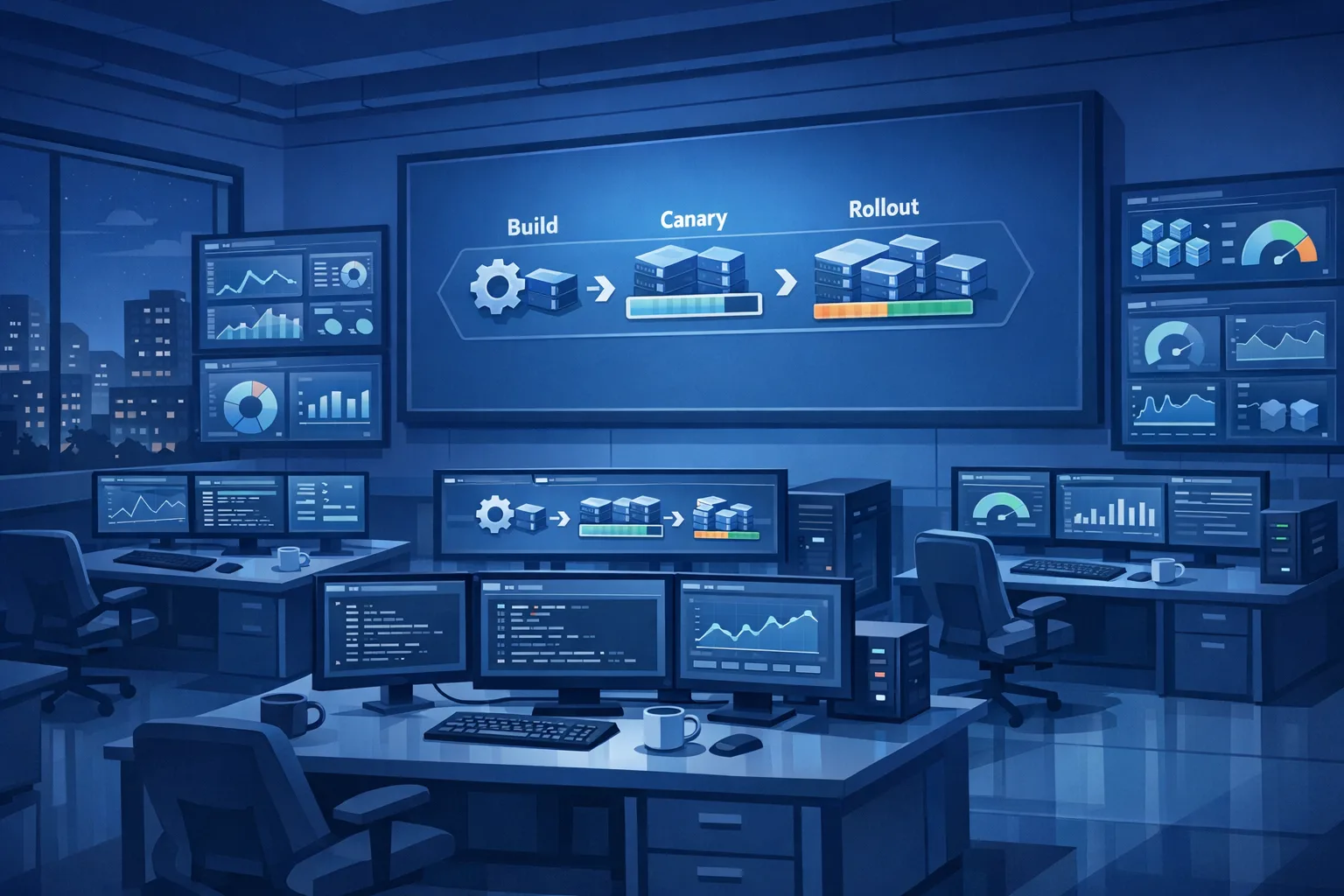
Deploy to a single AZ or a single pod set, bake for 30–60 minutes with SLO and error‑budget alarms, then expand. If your org needs a prescriptive order, we published a what to patch first guide you can adapt.
Stage 3 (48 hours after): prove and document
Security updates deserve receipts. Export build provenance (SBOM + attestation), capture exploit‑class tests if disclosed, and store evidence with the change ticket. If you need a template, our 48‑hour patch plan breaks it down step‑by‑step.
People also ask: fast answers for busy teams
Which Node versions will receive fixes?
The Node.js team signaled updates for 25.x, 24.x, 22.x, and 20.x. Treat all supported lines as affected until final notes land; EOL versions are always considered affected. Build your rollout to cover each line you run. (nodejs.org)
Should we pause deployments until January 7?
No. Ship the high‑value risk reducers now: React/Next.js patches, secret rotation, CI token migration, and edge throttles. These mitigate active exploitation classes and remove brittle auth paths before the Node drop. (react.dev)
Is React2Shell related to Node core?
React2Shell is in React Server Components and downstream frameworks. Exploitation often results in server‑side code execution in Node runtimes because many RSC apps run on Node, but the bug isn’t a Node core vulnerability. Patch your framework now; then be ready for the Node core updates on Jan 7. (react.dev)
What about managed platforms—are we covered?
Cloud providers and edge hosts pushed mitigations, but both the React and Next.js advisories say you must still update. Providers can blunt some payloads; they can’t retroactively secure your app or secrets. Upgrade first, then keep WAF rules as defense‑in‑depth. (react.dev)
Proof‑oriented playbook you can copy
If you’ve ever had a “we patched; revenue dipped” post‑mortem, you know the fix isn’t more meetings—it’s better proof. Use this frame on every security upgrade:
1) Define “safe” in numbers
Pick three signals per service: P95 latency, error rate, and a domain metric (checkout success, emails sent, render time). Document their healthy ranges. Bake alerts that compare canary vs baseline and block rollout on deltas beyond your budget.
2) Rehearse failure
Blow a fuse before prod does. In staging, force a CPU spike and a memory ceiling near your container limits; record what the Node patch does to startup time and RSS. If you load native modules (sharp, bcrypt, grpc), rebuild them against the nearest Node minor now to catch ABI surprises early.
3) Treat secrets like blast caps
Put dangerous privileges behind short‑lived, workload‑issued identities (OIDC in CI, cloud IAM roles in prod). Log every secret read; alert on unusual spikes after patch windows. If React2Shell hit you before December 4, rotate everything that could bridge environments. (nextjs.org)
4) Keep a rollback that actually works
Test the rollback once. A rollback that hasn’t been rehearsed is a fantasy. Snapshot DBs, keep blue/green images warm, and ensure feature flags can decouple the runtime patch from risky code changes.
Data and dates leaders care about
• December 17, 2025: Node.js targets January 7, 2026 for security releases across 25.x/24.x/22.x/20.x (three high, one medium, one low).
• December 3, 2025: React discloses CVE‑2025‑55182 (CVSS 10) in RSC; patches shipped the same day.
• December 3–6, 2025: Next.js publishes CVE‑2025‑66478 with fixed versions and a guided fixer; advises secret rotation if unpatched by Dec 4 1:00 PM PT.
• December 5–15, 2025: Exploitation observed in the wild; credential theft and coin miners common.
• December 9, 2025: npm classic tokens revoked; session tokens and CLI for granular tokens live (later extended to 12‑hour sessions for local dev). (nodejs.org)
Angle for web teams on Next.js and Node
If you run Next.js App Router on Node, the order is simple: patch the framework today, prove it with replay + canary, then prepare your Node lanes for Jan 7. If you’ve got multi‑runtime edges (Node + Bun + Deno), standardize your proof harness so results are comparable. Don’t let a runtime diversity story turn into an incident response story.
We’ve been publishing deep dives you can adapt: our Next.js December 2025 patch playbook and our Node.js patch playbook are both written to minimize blast radius while keeping velocity.
What to do next (developers)
- Today: Patch React/Next.js; run
npx fix-react2shell-next. Rotate secrets if you were online and unpatched on Dec 4 1:00 PM PT. - Tomorrow: Migrate CI to granular tokens or OIDC; delete any lingering classic token refs. Lock base images.
- This week: Build the replay + chaos harness and canary pipeline. Inventory Node versions per service.
- Week of Jan 6: Dry‑run with the latest patch in your major. Verify native module rebuilds. Set change windows.
- Jan 7: Roll Node patches in waves with canaries, bake times, and documented rollback. Capture evidence.
What to do next (engineering leaders)
- Fund the proof harness now. It pays back every security release.
- Set a company‑wide Jan 7 patch window with clear freeze exceptions.
- Ask for two artifacts on each rollout: SBOM + attestation and a canary diff report.
- Revisit secret lifetimes and rotation SLAs. Shorten them.
Zooming out
Security work always arrives at awkward times. This month, you get a gift: a few extra weeks to line up a clean, reversible rollout of the Node.js security releases while you close the front door that React2Shell blew open. Patch what’s exploitable, prove what you change, and keep your rollback boring. Do that, and Jan 7 will feel like just another Wednesday.
If you want help stress‑testing your plan or need a sparring partner on rollout sequencing, talk to our team. We’ll meet you where you are—freeze window and all.




Comments
Be the first to comment.