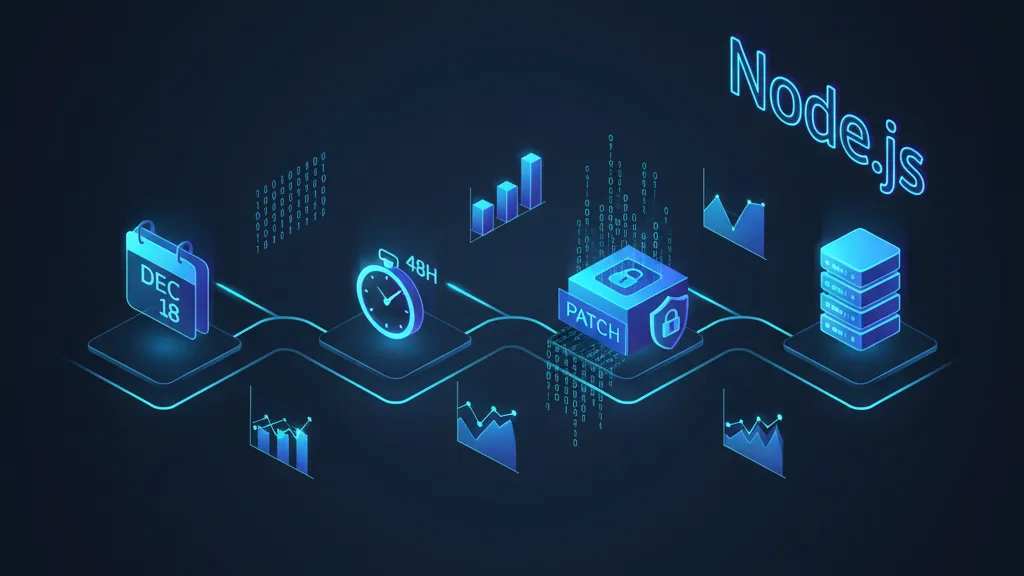
The Node.js security releases landing on December 18 cover the 25.x, 24.x, 22.x, and 20.x lines with three high‑severity issues plus medium and low defects. That’s enough risk to justify an emergency change window. If you run Next.js on React Server Components, this sits on top of recent React2Shell and follow‑on advisories. Here’s a clear, fast path to patch and prove—without breaking your week before the holidays.

What’s actually shipping on Dec 18—and why you should care
Node’s security team announced fixes across active release lines (25.x, 24.x, 22.x, 20.x) with three high‑severity issues, one medium, and one low. The drop was originally targeted for December 15 and moved to Thursday, December 18 to finish a challenging patch. Translation: these aren’t cosmetic bumps. Expect updates that touch core runtime behavior and transitive dependencies.
If you maintain a mixed fleet, assume that every supported line gets a patched point release and that unsupported, end‑of‑life versions are implicitly affected. The safest posture is to move workloads to the newest patched point in your current major line, not to jump majors this week unless you already planned a migration.
How Node interacts with the recent React/Next.js wave
December has been noisy. React2Shell (CVE‑2025‑55182) introduced unauthenticated RCE risk in React Server Components, with patches in React 19.0.1, 19.1.2, and 19.2.1. Then came additional RSC flaws reported December 11 (DoS and source exposure), prompting further patches and downstream Next.js updates (for example, 14.2.35, 15.0.7, 16.0.10 within their lines). None of that replaces Node patching; it stacks with it. Your app’s risk is the combination of the framework, your RSC usage, your Next.js version, and the Node runtime under it. If you patched React and Next.js but leave a vulnerable Node runtime, you haven’t finished the job.
If your incident timeline shows suspicious activity since December 3–6 (when exploitation attempts began to spike), include Node upgrades in your containment and rebuild procedures alongside the React/Next.js patches.
The 48‑hour Node.js security releases plan
Here’s a pragmatic, two‑day flow we’ve used on real fleets. Adjust to your org’s change policy, but keep the cadence.
T‑12 to T‑0: Pre‑release prep (you can start now)
Before the tarballs drop, do this to remove friction:
1) Inventory and blast radius.
• Enumerate all Node runtimes by major/minor in production, staging, CI, and build images. Don’t forget cron workers and one‑off jobs. Pull versions via node -v from containers and hosts. Export results into a sheet with columns: service, environment, Node version, image digest, rollout owner.
• Tag EOL versions for immediate retirement or vendor‑backed extended support. If you’re still running a pre‑20 line, route those workloads to a dedicated fix queue with strong isolation.
2) Prep images and runners.
• Clone your production Dockerfiles. Replace FROM lines (for example, node:22‑alpine) with ARG‑driven tags so you can lift the exact patched point quickly. If you use distroless or custom base images, ensure the Node layer is a separate build stage you can bump without rebuilding the universe.
• For CI, pre‑create matrix entries for the anticipated patched points (20, 22, 24, 25) so your pipelines can switch by variable.
3) Wire up smoke tests that catch the usual runtime regressions.
• Crypto: TLS handshakes to your upstreams, JWT sign/verify, JWK rotation.
• HTTP/Proxy: keep‑alive behavior, proxy headers, URL parsing, fetch/undici quirks.
• Native deps: compile one representative build with node‑gyp and verify musl/glibc compatibility if you ship on Alpine vs Debian‑slim.
• Observability: confirm OpenTelemetry initialization and context propagation, especially async hooks and diagnostics channel subscribers.
4) Lock a change window and owners.
• Assign a rollout owner per service and a comms lead. Pre‑write your status updates. Create a decision log template (Issue title, Runtime, Environment, Version from → to, Tests run, Rollback plan, Evidence links).
Day 1: Pull, build, and stage
• Pull the patched Node release for your line as soon as it’s available. Use official installers or your existing channel, but pin exact versions in package managers and container tags so you can prove what you shipped.
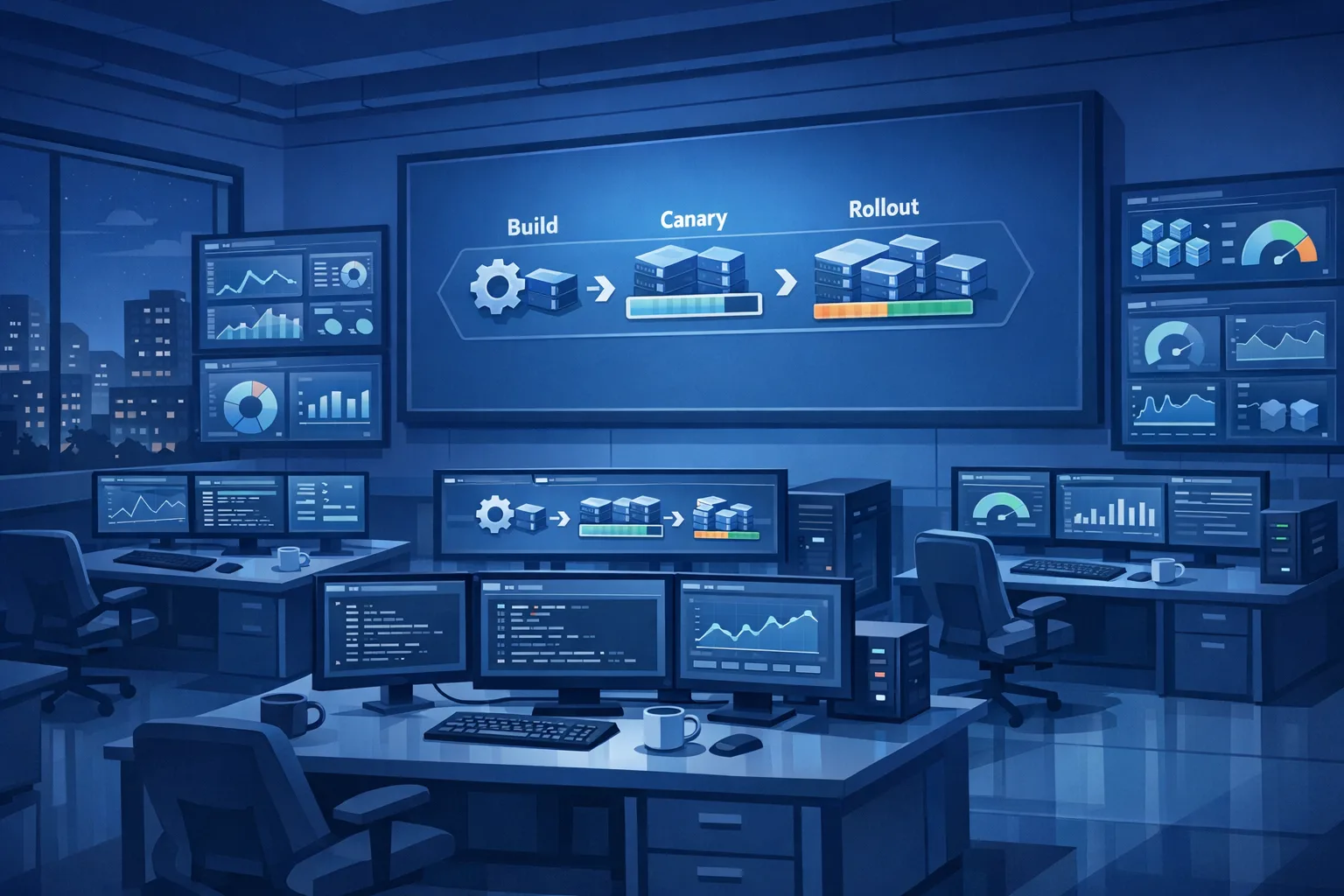
• Build canary images for each service: app:x.y.z-node25.?.?. Canary traffic should mirror peak code paths: SSR pages, server actions, API endpoints, and queue consumers. If you use Next.js with React Server Components, direct some canary to heavy RSC routes and server functions.
• Run smoke and integration suites. Watch for flaky test clusters related to timing, HTTP/2, or TLS. Record any transient failures and re‑run to separate noise from real breakage.
• Roll canaries to 5–10% of production traffic behind a feature flag or a service mesh subset. Monitor p95 latency, error rate, and memory over 30–60 minutes of steady load.
Day 2: Production rollout and proof
• Promote from canary to 50% when metrics stay within your SLO guardrails (for example, error budget burn rate under 2x normal). Then go to 100% within the change window.
• Capture immutable evidence: image digests, Node version strings from startup logs, and SBOMs if you generate them. Archive to your change ticket.
• Run a targeted pen test script or WAF replay to validate exploit protections if you added any virtual patches during React2Shell. Confirm the patched runtime and app version are live at the edge and origin.
Quick compatibility checks that save hours
Node point releases often update bundled dependencies (like undici) and may tweak runtime flags. These checks reduce surprises:
• Native add‑ons: Rebuild node‑gyp modules against the new headers. If you rely on prebuilds, verify they exist for the new ABI; otherwise fall back to source builds in CI.
• OpenSSL: Verify TLS ciphers and minimum versions if your org enforces strict policies. Some Node updates change defaults or harden parsing.
• Fetch/undici: Confirm streaming responses and abort behavior. SSR pipelines and file uploads are common pain points.
• Timers and async hooks: Watch for subtle tracing changes. If you use AsyncLocalStorage for multi‑tenant context, parity test before and after.
React2Shell and Next.js: don’t ignore the app layer
This Node release doesn’t reduce React2Shell risk by itself. Ensure you’ve already:
• Upgraded React RSC packages to patched versions (19.0.1, 19.1.2, 19.2.1 or newer) and, after the December 11 disclosures, to the latest backports addressing DoS and source exposure.
• Upgraded Next.js to a patched point in your line (for example, 14.2.35 in 14.x; 15.0.7, 15.1.11, 15.2.8, 15.3.8, 15.4.10, 15.5.9 in 15.x; or 16.0.10 in 16.x), particularly if you use the App Router and Server Actions.
• Rotated secrets if your app was exposed prior to early December, and reviewed logs for suspicious multipart requests targeting server functions.
For a deeper runbook on the RSC fallout and verifiable fix evidence, our team published tactical guides you can reuse. See a practical, week‑by‑week approach in Fix, Verify, Fortify, and an immediate triage workflow in Patch, Prove, and Monitor This Week.
People also ask: the fast answers
Which Node.js versions are getting patches on Dec 18?
The security team is shipping patched points for 25.x, 24.x, 22.x, and 20.x. Treat EOL majors as implicitly affected and plan migrations or extended support coverage.
Do these Node updates fix React2Shell?
No. React2Shell lives in React Server Components and downstream frameworks. You must apply the React and Next.js patches independently, then upgrade Node. Do both.
Is Pages Router in Next.js affected by the recent RSC CVEs?
The primary blast radius is App Router with Server Components and Server Actions. Pages Router isn’t the focus of the advisories, but upgrading to the patched Next.js point is still recommended for consistency and to pull in framework‑level mitigations.
Can I rely on WAF rules while I wait?
WAFs are a short‑term safety net, not a fix. Apply vendor virtual patches where they exist, but still upgrade React/Next.js and the Node runtime during a controlled window.
A lightweight verification framework you can reuse
When your CFO asks “Are we safe yet?” you need more than “we think so.” Use this five‑artifact proof pack for every service you patch:
1) Version attestations.
• Node: a startup log line (for example, Node 22.6.1) scraped by your log pipeline and stored with a retention policy. Bonus: export node -v via a /healthz detail endpoint restricted to internal IPs.
• App: framework and key package versions emitted on boot (Next.js, react‑server‑dom‑*, undici). Hash and sign a small JSON manifest and ship it to your SIEM.
2) Image digests.
• Capture immutable image SHA256 digests from your registry. Store them on the change ticket with a link to the SBOM.
3) SBOM and diff.
• Generate an SBOM (CycloneDX or SPDX) pre‑ and post‑upgrade. Attach a simple diff that highlights Node, OpenSSL, and framework bumps.
4) Canary metrics.
• Include charts showing error rates and p95/99 latency across the canary window, with annotations marking the cutovers.
5) Synthetic checks.
• Preserve the logs from a synthetic test run that hits SSR routes, server actions, API endpoints, file uploads, and queue consumers with representative payloads.
Risk‑based rollout: not all services deserve equal attention
Prioritize in this order:
• Internet‑facing SSR and API workloads using RSC or complex SSR, especially those with file uploads and multipart forms.
• Services holding tokens or secrets in memory (auth, payment, admin panels), even if they’re not internet‑exposed.
• Background workers processing untrusted content (webhooks, user‑generated files) that could trigger deserialization paths.
• Internal dashboards and low‑risk services last, unless they bridge critical backends.
Bundle low‑risk services into a single rollout where possible to reduce coordination overhead.
Operational gotchas and how to dodge them
• Alpine vs Debian‑slim. If you’re on Alpine, ensure any native add‑ons compile cleanly with musl. When time is tight, consider pinning a Debian‑slim variant for critical services to avoid build churn, then revisit Alpine later for size.
• Lambda/Functions runtimes. If you run serverless, check when the provider bakes the patched Node into managed runtimes. In the meantime, use a custom runtime layer or container image and verify Node -v at cold start.
• Node source maps and memory. A point release can change memory behavior under load. Watch heap growth and GC pauses. If you see regressions, snapshot heap profiles before rolling back.
• Private registries and air‑gapped builds. Mirror the patched Node artifacts inside your enclave early. Pre‑compute checksums and store them with your approvals to avoid a stalled deploy.
Where this intersects with budget and policy
Emergency security releases are when your change management policy must enable speed with proof, not slow you down. Set a 48‑hour SLA for highly exposed apps and a one‑week SLA for everything else. Fund the automation that makes this realistic: SBOM generation, version manifest logging, and canary orchestration. These investments pay for themselves on the next zero‑day week.
Node.js security releases: how to communicate the change
Make your exec update short and numeric: “On December 18 we upgraded Node 20/22/24/25 across 41 services. 100% production adoption completed within 36 hours. No SLO regression. Evidence: version manifests, SBOMs, and canary charts attached.” That’s how you turn a scary advisory into a confidence event.
What to do next (developers)
• Upgrade Node to the patched point in your current major line. Pin the exact version in your Docker base and runtime config.
• Rebuild and redeploy canaries, then promote to full traffic when metrics are clean.
• Verify React/Next.js are on the patched versions addressing React2Shell and the Dec 11 follow‑ups. Rotate secrets if you were exposed in early December.
• Generate and archive SBOM + version manifests per service. Enable a /version or /healthz detail endpoint for internal proof.
• Capture before/after performance snapshots to spot regressions early.
What to do next (business owners and PMs)
• Approve a short emergency window and suppress non‑essential deploy freezes for security patches through December 20.
• Ask each team for a one‑page proof pack showing versions, digests, and canary charts.
• Budget for persistent automation: SBOMs, runtime manifests, and canary workflows. It reduces risk and shrinks future patch windows.
Resources and further reading
For a focused Node runbook tailored to this release window, see our guide Node.js Security Releases Dec 18: Your Patch Runbook. If you’re on Next.js, cross‑check our notes on the December 11 updates in Next.js Security Update Dec 11: Patch Map + Proof Plan and the follow‑up Patch and Prove Now. And if you need a hand coordinating a fleet‑wide rollout with proof artifacts, our team’s scope and engagement model is outlined on What We Do.

Zooming out: build a routine, not a one‑off fire drill
Holiday‑season patch sprints aren’t going away. The teams that sleep at night treat patching as a repeatable product: a version manifest on boot, a canary lane with default queries, SBOMs by default, and a 24–48 hour security SLA backed by automation. This week’s Node drop is another chance to institutionalize that muscle.
Ship the patch. Prove it with evidence. Then make it automatic.




Comments
Be the first to comment.