
The latest Next.js security update on December 11 introduced two additional React Server Components (RSC) fixes and clarified what’s genuinely safe to run in production. If you maintain an App Router app, this week is about patching precisely, validating aggressively, and documenting proof of remediation. Here’s what changed, what versions to install, how to verify, and when rotating secrets isn’t optional. (nextjs.org)

What changed on December 11?
Vercel’s Dec 11 advisory added two upstream RSC issues—one causing a denial of service via an infinite loop during deserialization and another that could expose compiled server function code—alongside an addendum acknowledging that the first fix required a follow‑up, now tracked as CVE‑2025‑67779. Critically, these aren’t remote code execution (RCE); the earlier React2Shell RCE remains separately mitigated by prior patches. (nextjs.org)
The scope is App Router projects using RSC. The Pages Router isn’t affected by these two new issues, though upgrading to the latest patched release line is still recommended. (nextjs.org)
The exact versions you should run
Here’s the short list that matters this week. If you’re on:
• 14.x: install 14.2.35
• 15.0.x: install 15.0.7
• 15.1.x: install 15.1.11
• 15.2.x: install 15.2.8
• 15.3.x: install 15.3.8
• 15.4.x: install 15.4.10
• 15.5.x: install 15.5.9
• 16.0.x: install 16.0.10
• Canary tracks: 15.6.0‑canary.60, 16.1.0‑canary.19
Run the interactive updater to avoid manual drift: npx fix-react2shell-next. It validates dependency trees and performs deterministic bumps to the recommended targets. There isn’t a reliable workaround; upgrade and redeploy. (nextjs.org)
Quick answers developers keep asking
Does this affect the Pages Router?
No for the two Dec 11 issues; they target the RSC protocol used by the App Router. That said, staying on a patched release line is still advised for consistency across your fleet. (nextjs.org)
Do I need to rotate secrets?
If your app was online and unpatched on or before December 4, 2025 at 1:00 PM PT, rotate secrets starting with your most critical ones. Treat this as a high‑confidence recommendation, not a suggestion. (nextjs.org)
What about React2Shell (the RCE) versus the Dec 11 issues?
Different layers. React2Shell is the earlier CVE‑2025‑55182 RCE with downstream tracking as CVE‑2025‑66478. The Dec 11 items are a DoS (now fully fixed under CVE‑2025‑67779) and a source code exposure risk. Your patch set needs to cover all of them. (nextjs.org)
Patch and Prove: a five‑phase plan you can run today
I’ve been on both sides of the pager. The goal isn’t just to upgrade—it’s to be able to prove to your CTO, auditor, or client that you’re safe. Use this five‑phase plan and log each step.
Phase 1 — Triage and freeze
Freeze deploys for 60–90 minutes while you confirm whether the running commit includes a patched Next.js version. If not, raise a security incident in your tracker and assign an on‑call engineer plus a release manager. Document environment versions and traffic patterns so you can later correlate error rates and request spikes.
Phase 2 — Deterministic upgrade
Use npx fix-react2shell-next to bump to the exact recommended version in your line. Commit the lockfile. In CI, cache warms often mask dependency drift—force a clean install step and ensure your lockfile hash is part of your build cache key. For canary users enabling Partial Prerendering, install the specified canary that includes the fix, or move to the corresponding stable line if features permit. (nextjs.org)
Phase 3 — Build‑time and runtime checks
On your build agent, assert the resolved next version at runtime with a preflight script. In staging, run a synthetic smoke test that renders an RSC page with server actions, stream responses, and edge cases (large payloads, slow clients). Capture server logs and confirm no suspicious deserialization traces. Keep this as an artifact in your incident record.
Phase 4 — Deploy with guardrails
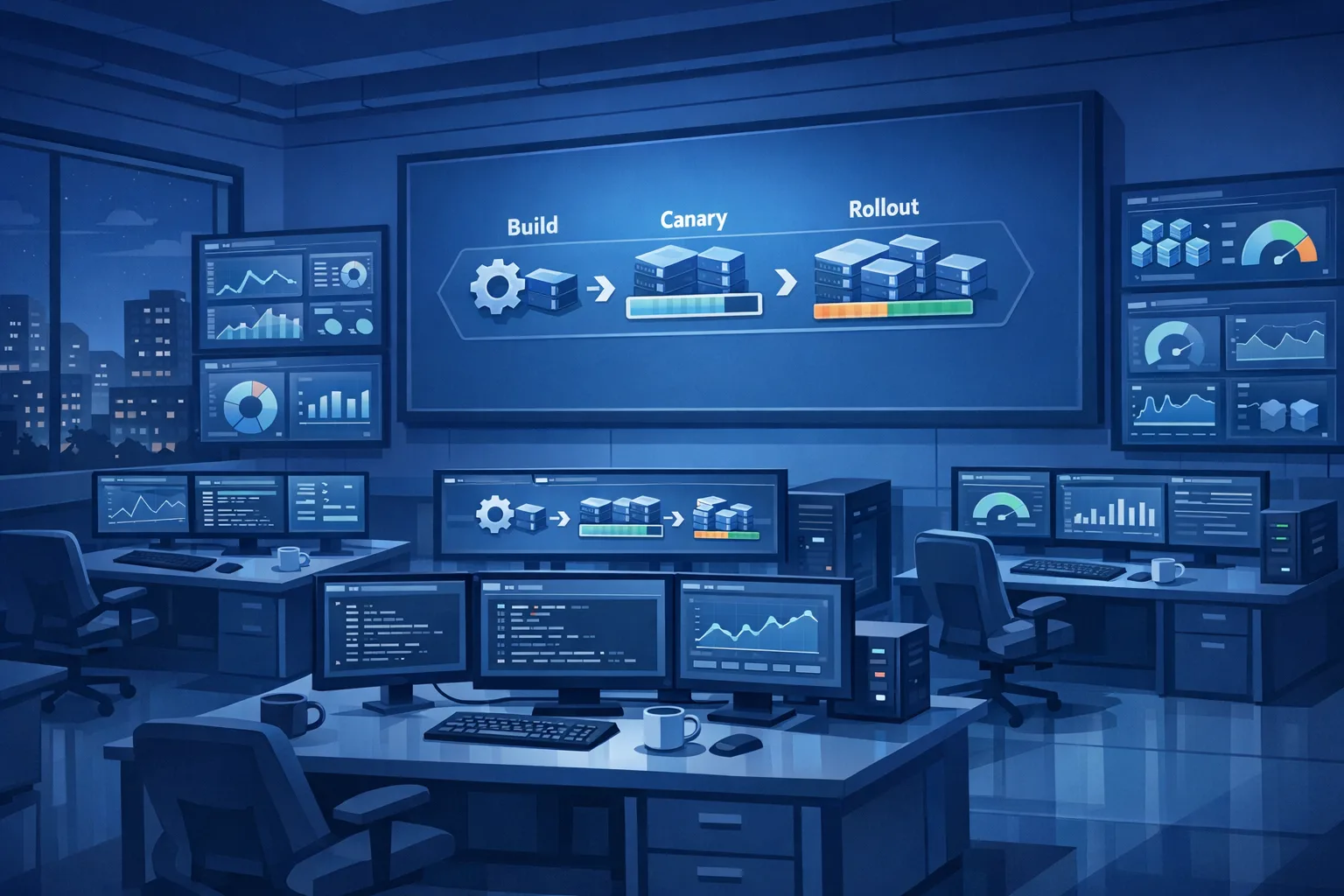
Roll out progressively. If you’re on a cloud edge, deploy to a small region ring first. Enable extra telemetry for malformed RSC requests and queue depths. If you front your app with a CDN or WAF, temporarily rate‑limit obviously abusive patterns and add a rule to restrict unexpected RSC endpoints from unauthenticated origins, then remove once baseline normalizes. This protects you during the first minutes after flipping traffic.
Phase 5 — Prove it
Attach the following to your incident ticket: the package diff, a CI artifact proving the patched Next.js version, the staged smoke test results, and a Grafana (or vendor) snapshot of request/latency/error bands pre‑ and post‑deploy. That’s your minimal proof pack. If you’re a vendor or agency working on behalf of clients, this pack is what gets you paid.
When rotation matters: a pragmatic call
Secret rotation isn’t free. But if your app was live and unpatched during the early disclosure window, rotate now. Start with cloud credentials that can move money or data—payment keys, database users with write access, OAuth client secrets, and webhook tokens. Plan a second pass for long‑lived JWT signing keys and anything that was inlined into server code. Vercel’s advisory explicitly recommends rotation for apps exposed as of December 4, 2025, 1:00 PM PT. (nextjs.org)
What’s the real risk window?
Here’s the timeline you can copy into your post‑mortem:
• Dec 3, 2025: React2Shell (CVE‑2025‑55182) disclosed, Next.js downstream advisory opens as CVE‑2025‑66478.
• Dec 6, 2025: Secret rotation guidance and an updater CLI ship.
• Dec 11, 2025: Two additional RSC issues disclosed (DoS and source exposure), with a follow‑up complete fix under CVE‑2025‑67779. (nextjs.org)
If you were unpatched and public during this window, assume automated scanning. Whether it turned into compromise depends on logs and blast radius, which is why your verification runs and rotation plan matter.
Operational gotchas most teams miss
• Background jobs: If you render or stream RSC output from workers or queues, those runtimes need the same next version as your web process.
• Serverless cold starts: Some platforms cache the server bundle between invocations—ensure the cold start trace shows the new version upon first hit after deploy.
• Split monorepos: Don’t patch one workspace and forget another package that also bundles Next.js for a marketing microsite.
• Canary mismatches: Mixing stable and canary across services can re‑introduce the vulnerable protocol boundary in internal calls. Align versions or constrain traffic.
Security leader’s checklist (copy/paste)
Use this as your one‑page control list for an internal audit or client update:
1) Asset scope: list every internet‑exposed Next.js service and whether it runs App Router/RSC.
2) Version proof: link to the CI artifact showing the patched version.
3) Traffic baseline: snapshot of 24‑hour request, latency, error rates before and after patch.
4) Secret rotation: note which credentials rotated and when, plus validation steps.
5) Log review: search for malformed RSC requests, unusual 5xx patterns, serialization errors.
6) WAF/CDN rules: temporary rate limits and any exceptions, with timestamps.
7) Customer comms: for B2B, one paragraph sent to customers with what changed and user action required (usually none).
8) Regression plan: the specific canary or staged rollback path if issues appear.
How this interacts with your Node.js patch cadence
Don’t let a framework patch lull you into ignoring the runtime. The Node.js team announced December security releases across 25.x, 24.x, 22.x, and 20.x lines; after a delay for a harder fix, they targeted Thursday, December 18 for availability. If you’re scheduling change windows, pair your Next.js update with the Node bump and test together under load. (nodejs.org)
Coordinating framework and runtime upgrades reduces double change windows and avoids the classic “works in dev, fails in prod” when TLS, OpenSSL, or URL parser patches alter behavior.
Will this hit our SEO or conversion funnels?
If you’re running server actions for core conversion flows, a DoS would hurt revenue more than any deploy risk this week. Patch now, then re‑run your Web Vitals and A/B variants. For most sites, the fixed builds won’t materially impact performance. If you see layout shifts from regenerated assets, clear stale caches at the CDN layer and prewarm the top 20 routes by traffic.
For leaders: budget and messaging
Your engineering manager needs two things: time on the calendar and cover for a fast patch. Allocate a small budget for emergency rotation work with your payments and cloud providers. Then ask for the proof pack—version evidence, test validation, and log review notes—so you have a single artifact for auditors or clients.
How we’re advising clients
At Bybowu, we track security advisories and ship clear plans. If your team wants a hands‑on assist, our security and web operations services include emergency patch runs and verification. For background on this cycle, review our earlier breakdown of the React2Shell patch and what a clean posture looks like in practice in React2Shell Patch: What Safe Looks Like This Week, and the Dec 11 Next.js Patch Map + Proof Plan article with example runbooks. If your stack includes Node backends beyond Next.js, grab our December Node.js upgrade plan to line up runtime updates this week.

People also ask
How do I know if we’re actually safe after updating?
Prove it: assert the resolved next version at runtime, run an RSC smoke test that exercises server actions and streaming, and capture logs for malformed requests. Keep those artifacts. If you were exposed pre‑patch, rotate secrets and monitor access patterns to high‑risk stores for at least seven days.
We’re on 14.x—do we have to jump to 15 or 16?
No. Install 14.2.35 and ship. It’s a targeted fix release line for the Dec 11 issues. Teams planning a major upgrade can still do it later; right now is about safety and uptime. (nextjs.org)
Are canary builds safe to run in production?
If you were already using canaries for features like Partial Prerendering, the advisory lists specific canary versions that carry the fixes. Lock to those exact numbers and apply the same verification pack you’d use for stable. Otherwise stick with the patched stable line. (nextjs.org)
Edge cases and nuanced risks
• Multi‑tenant SaaS: A single noisy tenant can amplify DoS‑style behavior. Rate‑limit by tenant ID and isolate worker pools where possible.
• Self‑hosted proxies: If you’ve placed a custom proxy in front of RSC endpoints, ensure it doesn’t reintroduce vulnerable serialization behavior or drop headers required by the patched protocol.
• Inlined secrets: If you compile secrets into code (don’t), the source exposure bug could have leaked them. Treat those as compromised and rotate now. (nextjs.org)
Zooming out: why these patches landed fast
Coordinated disclosures and upstream/downstream fixes mean the React core and Next.js teams have been shipping in tight succession. The initial RCE advisory (React2Shell) triggered hardening across frameworks; the Dec 11 follow‑ups closed remaining gaps and ensured the DoS fix was complete under a new CVE. This cadence is normal when researchers keep pressure on newly patched surfaces. If you’re seeing rapid version bumps, that’s a sign the process is working, not that things are unstable. (nextjs.org)
What to do next (today and this week)
Today:
• Confirm whether your production build runs a patched Next.js version from the list above.
• If unpatched during the early window, rotate critical secrets now.
• Deploy with progressive rollout and enable extra telemetry on malformed RSC requests.
This week:
• Run the five‑phase proof plan and file the artifact pack.
• Align your Node.js runtime with the upcoming December security releases and test under load.
• Review your RSC usage: server actions, streaming, and any proxies. Remove or gate risky patterns.
• Create a one‑page internal SOP for the next advisory so your patch cycle is hours, not days. (nodejs.org)
If you want a second set of eyes on your verification pack or a rapid incident posture review, reach out via our contact page. Your future self—and your on‑call rotation—will thank you.




Comments
Be the first to comment.