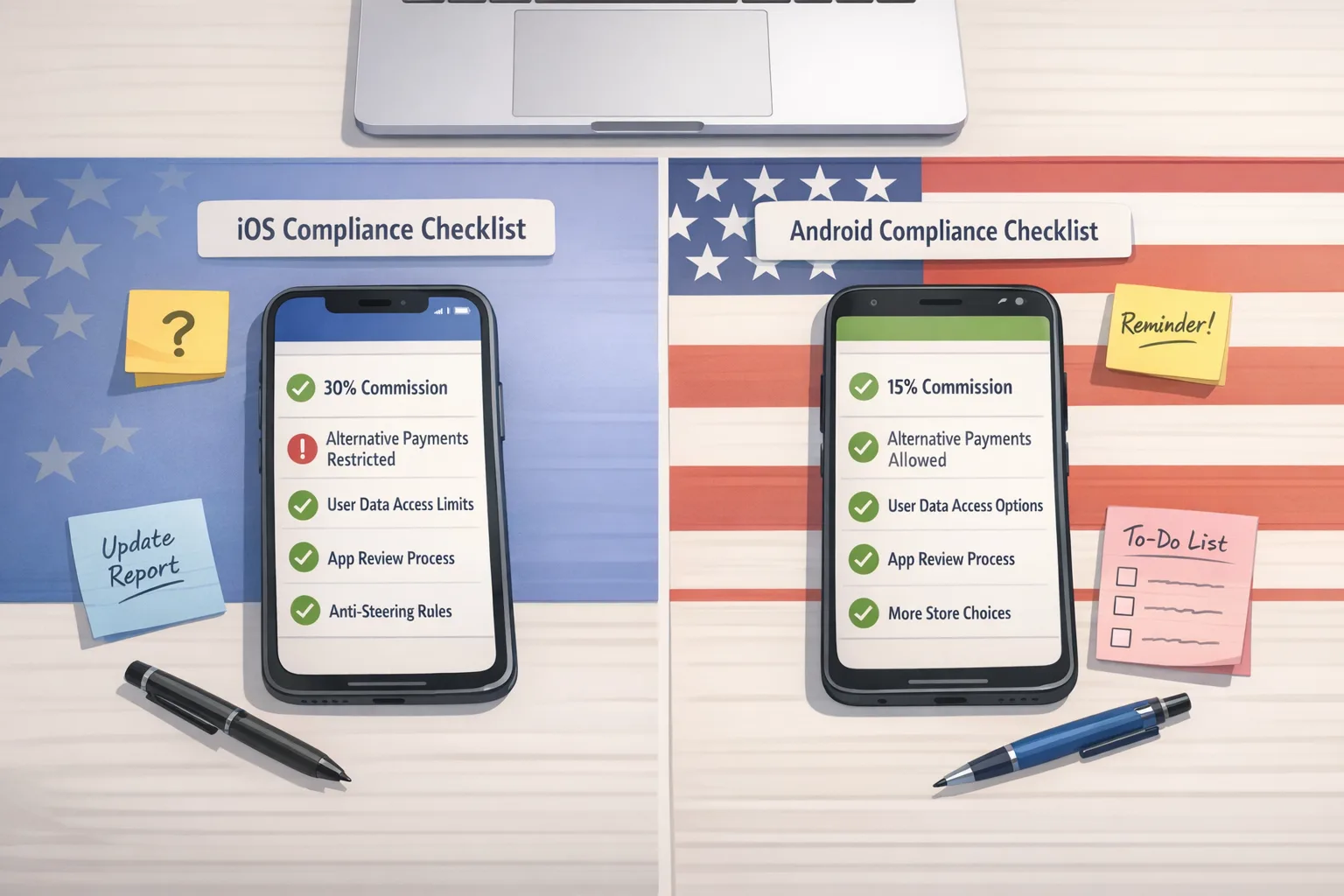
App Store Policy Changes 2026: What to Ship Now
If you sell digital goods, the App Store policy changes 2026 aren’t abstract—they alter your funnel, fees, and release trains this month. Two timelines matter: Apple’s EU business model shift that began January 1, 2026, and Google Play’s United States deadline on January 28, 2026 for alternative billing and external links enrollment. Here’s what changed, how the math works, and a step‑by‑step plan to deploy without breaking growth or compliance.
What Apple changed in the EU on January 1, 2026
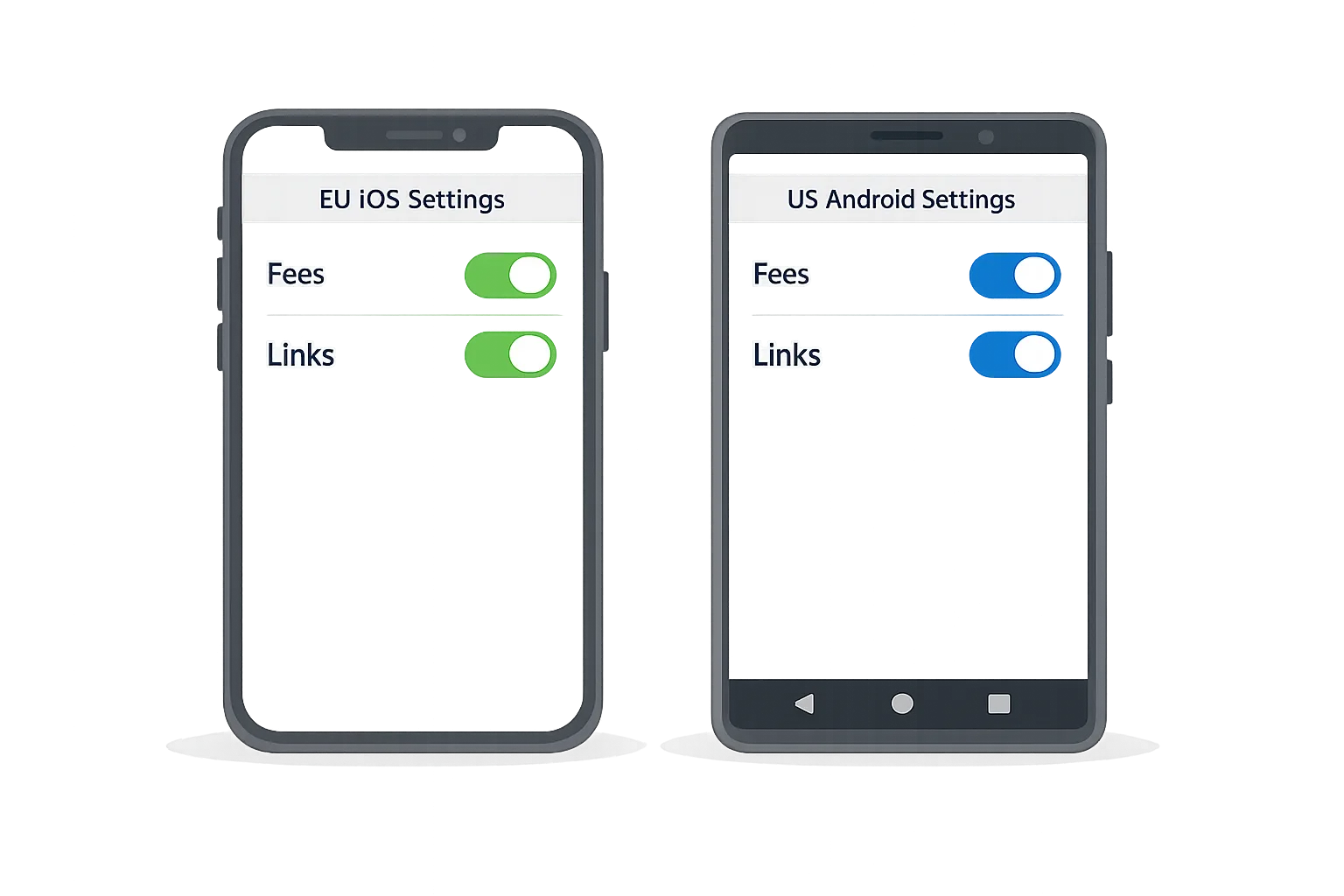
Apple is transitioning EU developers to a unified model centered on a Core Technology Commission (CTC) rather than the older per‑install Core Technology Fee. The CTC is 5% on sales of digital goods and services that your app communicates and promotes and can be used in an app on Apple’s platforms. Alongside CTC, Apple now splits “Store Services” into two tiers:
• Tier 1: 5% store services fee (mandatory services only).
• Tier 2: 13% store services fee (10% for Small Business Program or subscription year two+), with fuller App Store features like automatic updates, discovery surfaces, ratings/reviews presence, analytics, and developer marketing tools.
There’s also a 2% Initial Acquisition Fee on sales to new users within six months of their first install (waived for small‑business participants). Put differently: on EU iOS, a purchase can carry three Apple components—Initial Acquisition (2% for new users in the first six months), Store Services (5% or 13%), and the 5% CTC—depending on your terms and which services you use.
Two caveats teams miss: first, Apple’s fees are tied to install and activity windows—reinstalls and updates can reset fee windows. Second, if you merely reference an offer without an actionable link, different rules can apply than if you provide a tappable link or in‑app alternative checkout. Read your exact entitlement and addendum; the language matters when Finance forecasts margin.
How this shows up in your P&L
Consider a €10 sale promoted inside your EU iOS app. If the user is within six months of first install and you rely on Tier 2 Store Services, your Apple take could be: 2% (Initial Acquisition) + 13% (Store Services) + 5% (CTC) = 20% before your PSP/Merchant of Record fees. Add 3–4% for payments and your effective take rate lands around 23–24%. If the same sale occurs after month six, drop the 2% acquisition fee and you’re closer to 21–22%. On Tier 1, you could shave eight points but lose auto‑updates, discovery, and analytics many growth teams consider table stakes.
Outside the EU, watch the trajectory: Apple announced similar constructs in Japan (a 5% CTC and separate store‑services commission), which signals this model isn’t a one‑off. Global product owners should plan for more geographies to adopt variants of this structure over 2026–2027.
Google Play: Your January 28, 2026 deadline and what “external links” really mean
For U.S. users, Google has formal programs you must enroll in if you want to offer alternative billing in‑app or link out to external content (including downloads and checkouts). The headline: enroll and integrate by January 28, 2026 if you intend to keep offering these paths.
Practically, there are two tracks:
• Alternative Billing (in‑app): lets you present a non‑Google checkout. You must enroll and integrate the alternative billing APIs (Play Billing Library 6.2.1+).
• External Content Links: lets you point users to an external web page for a digital purchase or even an app download. You must register each link and integrate the External Offers APIs, which require Play Billing Library 8.2.1+ and display Google’s information screen before the user exits your app.
Both tracks require transaction reporting via Google’s APIs (including zero‑dollar trials), customer support commitments, and adherence to parental controls. Links and landing pages need approval in Play Console. If you don’t wire the APIs and disclosures correctly, expect rejections or policy strikes.
About fees Google intends to apply
Google has published a fee structure it intends to charge for external links and non‑Google transactions. Highlights: a per‑install fee for app/game downloads completed within 24 hours of a Play‑originating link click (roughly $2.85 for apps and $3.65 for games), plus service fees on non‑Google checkouts (commonly cited at 20% for purchases and 10% for auto‑renewing subscriptions under the external‑link program). For in‑app alternative billing, Google has floated a small discount off standard service fees rather than a full waiver. Here’s the thing: parts of this structure are tied to ongoing court approvals, so timing and exact rates could still shift. Treat them as real for modeling, but keep them behind a feature flag in your pricing engine.
A practical compliance checklist you can ship this sprint
This is the shortest path I’ve used to get teams production‑ready without derailing other roadmap items:
- Inventory flows and SKUs. List every in‑app paywall, deep link, and external checkout URL by platform and country. Note who sees it (new vs returning users) and which SKUs are subscriptions.
- Pick your Apple Store Services tier per app. Many apps will stay on Tier 2 for growth and ops reasons; if you can truly live without automatic updates, discovery, and analytics, Tier 1 saves margin.
- Decide on EU iOS entitlements. If you’re adding actionable links or using in‑app alternative checkout, ensure the correct entitlement is in place and matched to your legal addendum.
- Version‑gate Apple fee windows. Add server‑side flags for new‑user (first six months) logic so your pricing/promo engine can reflect the 2% Initial Acquisition Fee period.
- Update Google Play Billing Libraries. Use 8.2.1+ for external content links and 6.2.1+ for alternative billing. Don’t mix versions across modules—QA the info screen on every device class.
- Register and test external links in Play Console. Every link and download path must be declared and approved. Keep audit notes that tie Console IDs to code commits.
- Implement transaction reporting. Wire external transaction tokens and IDs; ensure retries and idempotency so you don’t double‑report (or under‑report) purchases.
- UX decisions: one button or two. If you offer both Google and non‑Google checkout, test a one‑screen chooser vs. a “More ways to pay” secondary path. The default chooser can crater conversion if you don’t tune copy.
- Receipts and refunds. Align your PSP/Merchant of Record receipts with App Store and Play acknowledgement rules. Build a refund router that respects platform policies and your SLA.
- Finance dashboards. Expose gross revenue, platform fees by component, PSP costs, and net margin by country and SKU. If Finance can’t see fee components, product will guess wrong on pricing.
Pricing strategy under the new rules
These policies push you to design differently rather than just “pay less.” A few lived‑in tactics:
• Move trial starts outside the six‑month window. On EU iOS, nudging high‑intent users to subscribe after month six reduces your 2% Initial Acquisition Fee exposure without killing early retention. Use content gating and milestone emails rather than 7‑day free trials for brand‑new installs.
• Route low‑AOV items to the platform checkout. If your median checkout is under $5, the operational drag of alternative billing plus PSP costs can outweigh margin gains. Keep consumables on-platform and reserve alternative routes for annual plans or high‑AOV bundles.
• Time‑box external link prompts. On Android, present the external link option after the user hits a soft paywall twice. That places the Google info screen later in the session when intent is high and the interruption is less harmful.
• Separate “engagement” from “entitlement.” If a purchase materially advances gameplay, expect higher fees in the Play ecosystem proposals. Cosmetics or non‑progress items may qualify for lower tiers in certain proposals—tag your catalog now so you can switch fee mappings later without a code freeze.
People also ask
Do I still need Apple IAP anywhere?
No—if you adopt the communication/promotion entitlement for alternative payments or link‑outs, you can’t mix Apple IAP in the same app. It’s an either‑or decision per app bundle. Teams often spin a “Pay” companion app when they truly need both, but that has UX and review implications.
Can I avoid the CTC by posting prices with no link?
Apple differentiates between mere references and actionable links. If you show a tappable path or an in‑app alternative checkout, CTC applies under the unified model. If you only reference offers without an actionable link, the treatment can differ, but you’ll also lose conversion. Be explicit about your risk tolerance and margins.
What if I only ship to the United States?
You’re still on the clock for Google Play’s January 28, 2026 enrollment if you use alternative billing or external links for U.S. users. Apple’s EU model won’t hit your U.S. iOS app today, but the Japan announcement suggests similar terms may appear in other regions. Global portfolios should build a configurable fee model by country now.
Does the Android settlement kill the 30% fee?
Not outright. Google’s published plans swap one set of economics for another: per‑install link fees and service fees on non‑Google checkouts instead of pure waivers. It expands your routing options but doesn’t erase platform economics. Model both states and keep the switch behind a remote flag).
The engineering gotchas that bite teams
• Play info screens and parental controls: they’re mandatory for external links. If you fork the UI for tablets and forget to wire the exit dialog, policy review will catch it.
• Transaction mismatches: if your webhook retries aren’t idempotent, you’ll over‑report to Google’s API and invite reconciliation headaches.
• Apple window resets: some reinstalls and restores can restart fee windows; your attribution logic needs to map Apple’s definitions, not just your MMP’s.
Model the money before you refactor the funnel
Finance and product should pressure‑test three scenarios per SKU: (1) on‑platform only, (2) alternative billing in‑app, (3) external link. Use country‑level weights, new vs returning user mix, and subscription tenure. In many cases, the EU iOS Tier 2 + CTC math yields a 21–24% effective platform + payments take on high‑AOV plans; Google Play external links with proposed fees can net similarly once you add PSP and compliance costs. Chasing headline percentages without modeling the full stack is how teams ship negative‑margin promos.

A 14‑day deployment plan your team can reuse
Day 1–2: Audit entitlements, addendums, and SDK versions; file any Apple entitlement requests; enroll in Google’s programs.
Day 3–5: Implement Play info screens and external transaction reporting; wire Apple fee‑window flags server‑side; build pricing toggles by country.
Day 6–8: QA device matrices (phones/tablets, dark mode), link approvals in Play Console, and purchase flows with downgraded connectivity; write refunds/chargeback SOPs.
Day 9–10: Instrument revenue and fee components in your BI; add alerts for API failures and reporting gaps; load test your receipts pipeline.
Day 11–12: Launch to 5–10% with geography filters; monitor conversion lift/drop on chooser screens; tune copy.
Day 13–14: Ramp to 50–100%; lock a post‑mortem and roll learnings into your shared playbook.
When to pick Apple Tier 1 vs Tier 2
Pick Tier 1 (5%) if: your app’s growth is driven primarily by owned channels, you can live without App Store discovery and auto‑updates, and you’ve got an in‑house analytics stack. Pick Tier 2 (13% or 10% program rate) if: your category relies on ratings/reviews and search placement, your ops team needs automatic updates and phased releases, or you’re early in market and value App Store marketing surfaces.
What to do next
• Book a monetization review this week to choose Apple tiering and finalize Android routing. If you want a second set of eyes, our team outlines the tradeoffs in our 60‑day App Store plan for 2026.
• If Android drives a large share of revenue, align dev and finance around the Jan 28 Google Play plan and build your fee calculator with the proposed rates toggled on/off.
• Need help shipping? See our mobile monetization and compliance services and review similar launches in our portfolio. Then grab a slot via contact.
Zooming out
The platform wars aren’t over—they’re getting procedural. Apple is pricing distribution and core tools separately; Google is shifting enforcement and economics to API‑verified links and reporting. Your advantage comes from treating monetization like any other core feature: versioned, instrumented, and tested behind flags. Ship the compliance you need now, but keep your pricing and routing flexible. The teams that win in 2026 will be the ones that made their fee model a config file, not a rewrite.




Comments
Be the first to comment.