GitHub Actions Pricing 2026: The No‑Surprise Playbook
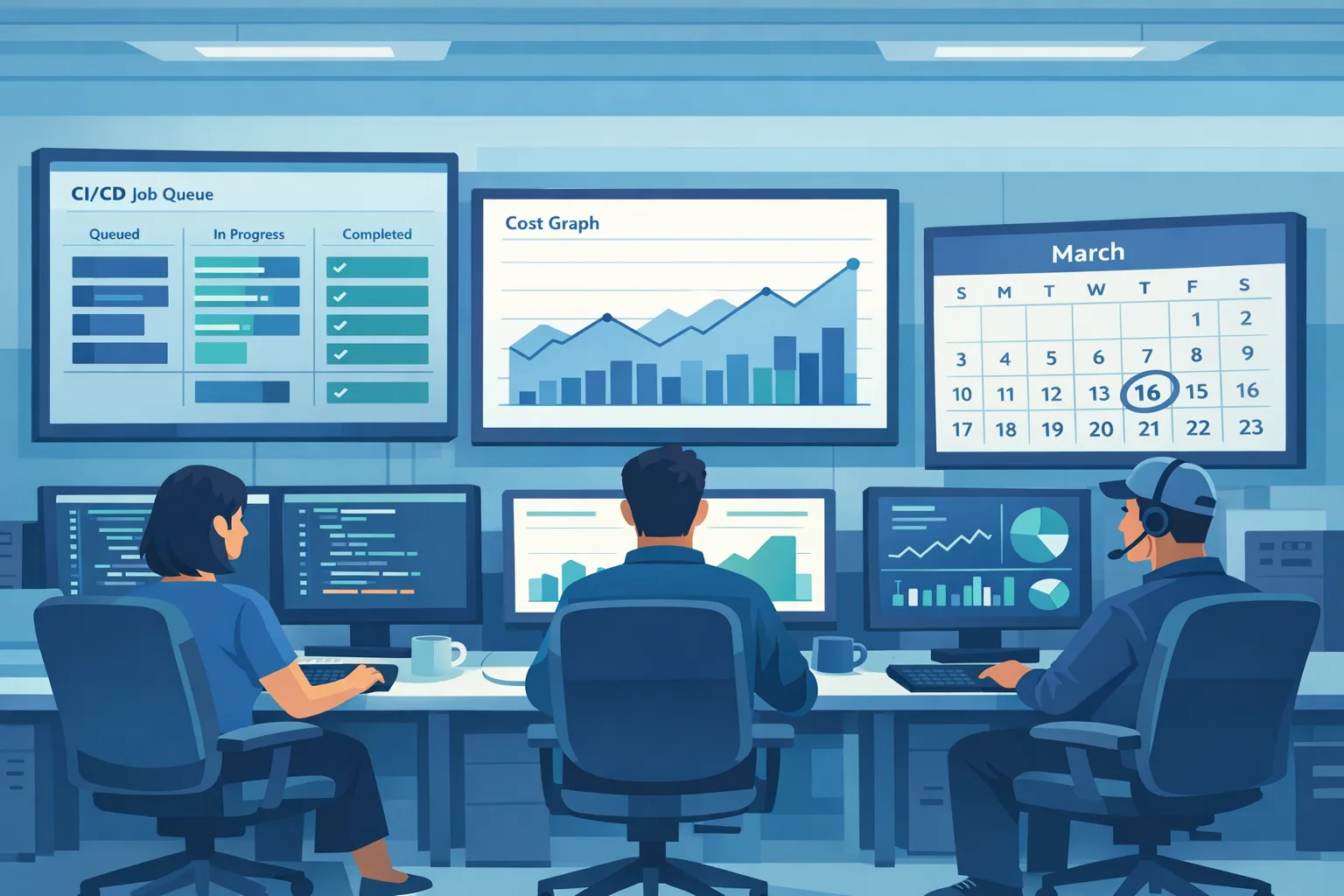
Let’s cut through the noise. GitHub Actions pricing 2026 means two concrete realities today: hosted runner prices dropped on January 1, 2026, and GitHub postponed the new $0.002/min “platform fee” for self‑hosted runners. Meanwhile, there’s a hard operational deadline: on March 16, 2026, self‑hosted runners must be v2.329.0+ to register. If your org ships daily, these aren’t abstractions—they’re budget and uptime events you can plan for right now.
What actually changed on January 1?
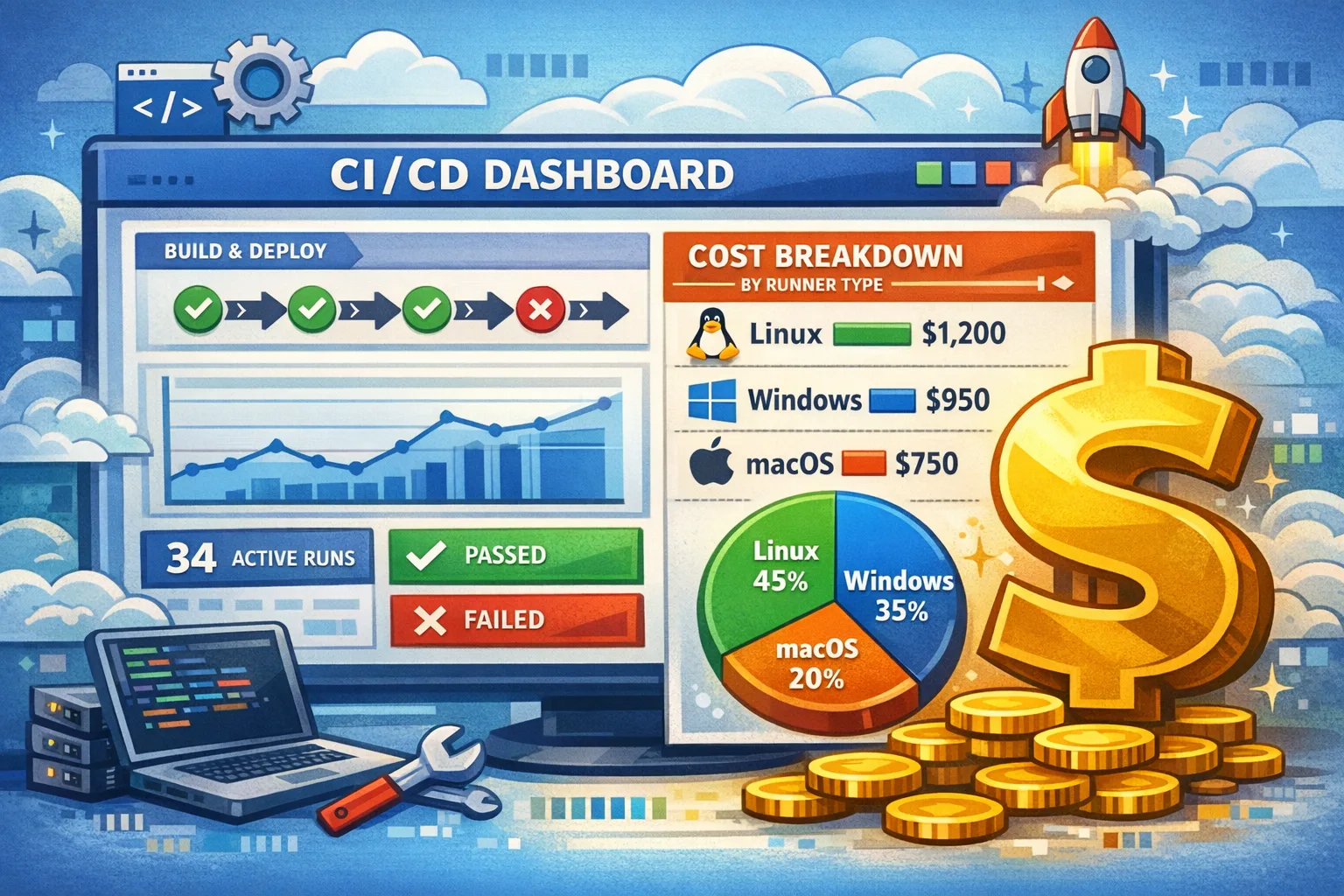
Hosted runner meter rates dropped, and your free minute quotas didn’t. Baselines are now easy to remember: Linux 2‑core around $0.006/min, Windows 2‑core around $0.010/min, and common macOS runners around $0.062/min. If you run private repos heavily on hosted runners, you should already see the benefit in your January statement.
Public repos remain free for standard hosted runners. Larger runner SKUs still bill, and artifact/cache storage continues to count against your plan’s included amounts. In other words: cheaper compute for a big slice of private workload, but not a license to waste minutes.
Is the self‑hosted fee real or not?
Short version: it’s postponed, not canceled. GitHub’s December 2025 update paused the $0.002/min platform charge for self‑hosted runners to reassess the rollout. As of February 28, 2026, there’s no new effective date. Could it return later this year? Yes. Should you budget scenarios now? Also yes—because the math is simple and planning beats panic.
Here’s a practical stance: treat “$0.002/min for self‑hosted in private/internal repos” as a contingency you may see this year. That way, you’ll have a model, a threshold for alerts, and a list of cuts you can make in hours—not weeks—if GitHub flips the switch.
The March 16 runner requirement you can’t ignore
Separate from pricing, GitHub will block configuration of self‑hosted runners older than v2.329.0 starting March 16, 2026. There’s a brownout window leading up to it. If you’ve got snowflake runners under desks or forgotten AMIs in side VPCs, this is the week to inventory and upgrade them.
Practical path: tag every registered runner with version and last‑seen time, then produce a one‑pager per environment that lists non‑compliant instances. Automate the upgrade and test re‑registration in staging before you touch production pools.
Run this 90‑minute cost audit today
You don’t need a data lake to see where your minutes go. Block 90 minutes and pull your January and February usage.
- Export usage by repo and runner type (hosted vs. self‑hosted). Grab artifact/cache usage too.
- Segment by workflow: build, unit tests, integration/e2e, lint/format, release. Add columns for concurrency, average duration, and frequency.
- Identify top 5 minute burners (by total minutes per month). Mark which are PR‑triggered vs. schedule/manual.
- Map to cost using current hosted rates. For self‑hosted, create a second column with a hypothetical $0.002/min so you can see the impact if the fee returns.
- Set guardrails: pick a target monthly minute budget per repo and a “tripwire” (e.g., +15% over baseline).
- Decide the first three fixes using the levers below. Lock owners and dates.
Result: you’ll know exactly which jobs to optimize, which to move, and how much you’d spend if a self‑hosted fee lands.
Five levers that cut Actions spend without slowing delivery
Here’s what consistently moves the needle on both minutes and reliability, pulled from real migrations and audits we run for clients.
1) Collapse noisy matrices
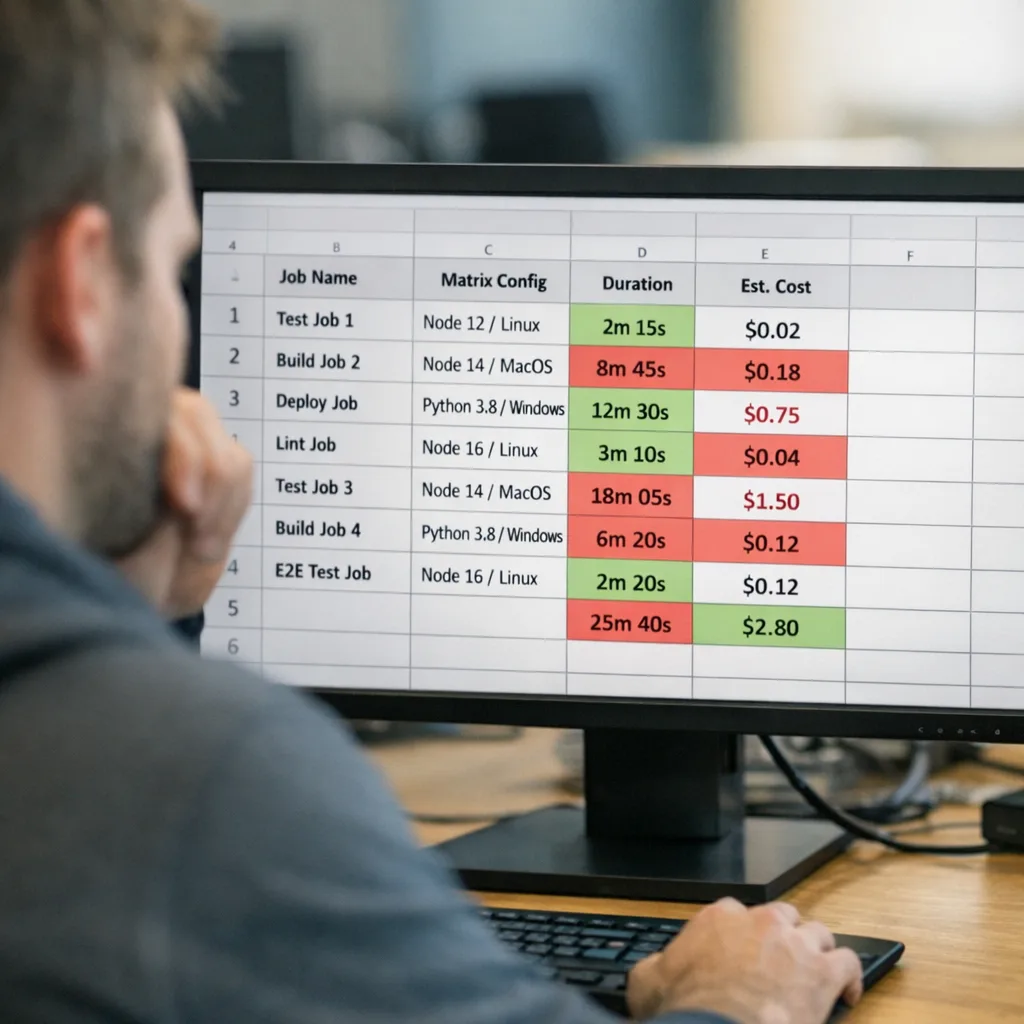
Job matrices multiply minutes fast. If you test 6 Node versions x 3 OSes x 4 databases, you’re probably paying to re‑prove the same thing. Keep critical compatibility rows on every PR, and push the full matrix to nightly or main‑branch merges. Most teams trim 20–40% of minutes here with no risk.
2) Cache with intent, not hope
Blindly caching npm/pip/gradle can add I/O and miss. Pin cache keys to lockfile hashes and OS/arch, then set a TTL that matches your release cadence. Measure hit rate weekly. If hits are under 70%, fix keys or reconsider what you cache.
3) Artifact and log discipline
Artifacts older than a week rarely matter. Default to 3–7 days, carve exceptions for release bundles. Route logs to a single compressed artifact per job with retention that matches incident review windows. Less churn, smaller bills.
4) Smarter triggers, smarter concurrency
Use path filters so docs and design changes don’t run full pipelines. Set concurrency with cancel-in-progress for PR jobs—no one needs five obsolete test runs finishing after you push a fix. That single setting is a quiet minute killer.
5) Move the right jobs to the right runners
Hosted is now cheaper for many private workloads. Keep short‑lived, bursty work (lint, unit tests) on hosted Linux to exploit elastic capacity. Keep long‑running or licensed jobs (Xcode/macOS, GPU, specialized toolchains) where you control the base image and secrets, i.e., self‑hosted. Don’t forget the maintenance cost of your fleet—time is a line item, too.
Hosted vs. self‑hosted: a decision tree that doesn’t waffle
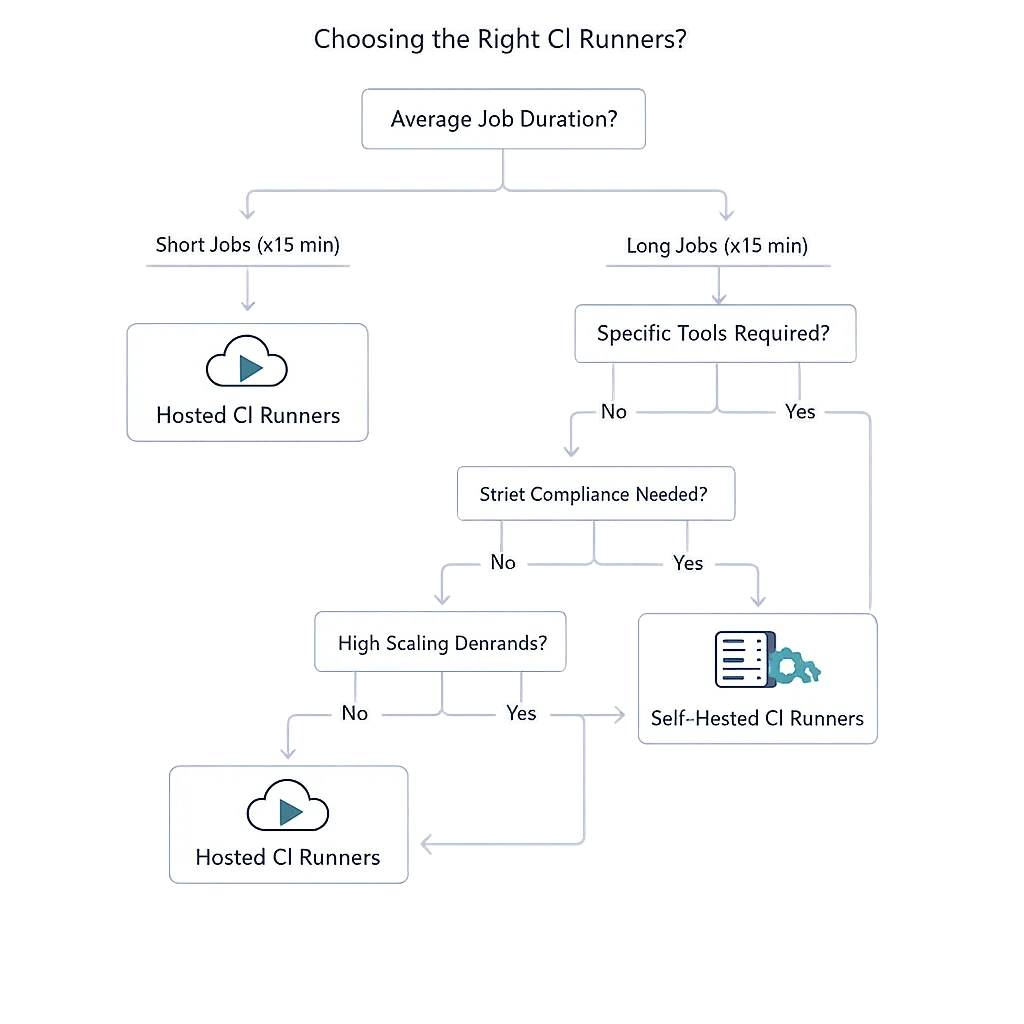
If all four are true, lean hosted:
- Workloads are stateless and under 15 minutes each.
- Tooling is mainstream (Node, Python, Java, Go) and supports Linux cleanly.
- Autoscaling beats your team’s appetite for managing images and daemons.
- Work mostly runs on PRs (bursty), not on fixed nightly windows.
If two or more are true, lean self‑hosted:
- You need macOS‑only or GPU jobs with pinned toolchains.
- You require VPC‑only network paths (e.g., private artifact registries, data egress constraints, or stricter egress firewalling like we outline in our Egress Firewalls for AI Agents guide).
- Your jobs are 30–120 minutes and benefit from custom images or attached volumes.
- You already operate a stable autoscaling group with good observability.
Remember: your split can be hybrid. Keep unit tests on hosted, push e2e to self‑hosted in a private subnet, and reevaluate quarterly.
People also ask: will open source stay free? What about artifacts?
Are standard hosted runners free for public repos?
Yes. GitHub continues to zero‑bill standard hosted runner minutes on public repositories. Larger SKUs still bill, so don’t blindly pick the beefiest machine for a README fix.
Will GitHub charge for self‑hosted runners later in 2026?
They might. As of February 28, 2026, the platform fee is postponed. Build a scenario model and monitoring so you can react in a day if the policy returns.
Do macOS jobs still cost significantly more?
Yes. Mac runners carry a higher per‑minute rate. Keep macOS‑only work tight and move everything cross‑platform to Linux runners when possible.
What about the runner version deadline?
By March 16, 2026, ensure all self‑hosted runners are v2.329.0 or newer or they won’t register. Treat this as a reliability exercise, not just compliance.
A simple scenario model if the self‑hosted fee returns
Let’s say your self‑hosted fleet burns 80,000 minutes/month in private repos. At $0.002/min, that’s $160/month. If e2e tests are 30 minutes and run 50 times/day, you’re looking at ~$90/month for that workflow alone. It’s not ruinous, but it’s real—especially when multiplied across teams and environments.
How do you blunt it?
- Eliminate redundant matrix rows (20–40% reduction).
- Shift short PR jobs to hosted Linux (often cheaper and easier to scale).
- Trim artifact retention to 3–7 days; compress logs.
- Enable concurrency cancels on PRs; add path filters.
- Batch long tests on main merges or nightly if PR signals are already strong.
Do the math monthly. If the fee never returns, you still bank the savings.
Checklist: upgrade runners before March 16
Use this and paste it into your runbook.
- Inventory with a script that lists runner name, version, labels, and last check‑in per org/repo.
- Map owners for every runner group. No owner, no prod.
- Upgrade dry run on staging pools; validate secrets mounting, caching, and artifact upload.
- Rollout window with change tickets and a rollback (re‑register prior AMI if needed).
- Alerting: set SLO alerts on queue time and job failures for 72 hours post‑upgrade.
Let’s get practical: your 45‑day CI roadmap
Here’s a short, high‑leverage plan we use on client engagements.
- Days 1–7: Run the 90‑minute audit. Set a minute budget per repo and tripwire alerting. Fix obvious misfires (pointless matrices, missing concurrency cancels).
- Days 8–21: Migrate PR‑only jobs (lint, unit) to hosted Linux. Pin cache keys and measure hit rates. Reduce artifact retention to 3–7 days.
- Days 22–30: Tighten e2e: gate the heaviest paths to main merges or nightly; mock slow external calls. Apply path filters to skip pipelines on docs/UI copy changes.
- Days 31–45: Re‑benchmark total minutes and lead time. Decide what stays self‑hosted (licensed/macOS/GPU) and what shifts permanently. Update your budget model with “self‑hosted fee on/off” toggles.
Working through other platform dates? Use our zero‑downtime Vercel now.json sunset plan and our Node.js EOL 2026 upgrade playbook as templates for sequencing upgrades without stalling delivery. If you’re orchestrating a mobile release at the same time, our Xcode 26 requirement guide covers the operational gotchas.
Governance that sticks: budgets, dashboards, and culture
Budgets work when they’re visible. Put a monthly minute target next to lead time, change failure rate, and MTTR in your team’s scorecard. Add a tiny meter to your PR template or dashboard: “CI minutes used this month / budget.” Tie optimizations to real outcomes—less flaky e2e, faster signal, fewer retries.
And talk about it. CI is a product your team consumes every day. Make ownership explicit: platform team sets policies and dashboards; app teams own their pipeline shape; security sets guardrails on secrets and egress; finance reviews variance monthly. That cross‑functional rhythm beats crisis emails on the 28th.
What to do next (this week)
- Confirm you’re on runner v2.329.0+ and schedule upgrades for any stragglers before March 16, 2026.
- Run the 90‑minute audit; create hosted vs. self‑hosted scenarios (fee on/off).
- Kill waste: collapse matrices, enable concurrency cancel, add path filters.
- Right‑size artifact retention and centralize logs.
- Pick one repo to migrate PR jobs to hosted Linux and measure the delta by Friday.
If you want a second set of eyes, our team runs fast CI audits and hands you a concrete action plan—usually inside a week. See our services and get in touch. We publish hands‑on ops playbooks regularly on the ByBowu blog.









Comments
Be the first to comment.