The Node.js security releases slated for mid‑December are now scheduled for January 7, 2026. The project has flagged three high‑severity issues plus one medium and one low, with updates coming across 25.x, 24.x, 22.x (Active LTS), and 20.x (Maintenance). That’s significant enough to warrant prep work right now—even though the bits land after the holidays. Here’s a practical playbook to ride out the freeze, tighten your supply chain, and be ready to roll the patches the moment they drop.

What changed—and why the delay matters
Let’s anchor the facts with dates. The Node.js team signaled December security releases covering four active lines, then updated the plan and moved the drop to January 7, 2026. End‑of‑life versions are, as always, affected but won’t receive fixes. For most organizations, that means one or more runtime lanes need a coordinated update, and the clock hasn’t stopped: attackers read the same advisories and speculate about the patched classes of bugs.
Here’s the thing: a delay doesn’t reduce risk. It increases the window where known but unpatched classes of weaknesses might be explored. At the same time, the JavaScript supply chain has been noisy this quarter, with waves of maintainer‑account compromises and malware pushing through npm, plus npm’s own security changes (token revocation and session‑based auth) landing on December 9. If you run a sizable Node fleet, treat the next two weeks as pre‑patch time—clean up pipelines, harden configs, and stage your tests.
Use the delay to stage your rollout
When the releases land on January 7, you’ll want three things ready: a clean inventory, a test matrix that mirrors production, and a proven deployment path. The best practice is to prebuild and test images against the latest non‑security point releases in each line you run (25.x/24.x/22.x/20.x), so the only delta on patch day is the security bump, not a pile of unrelated changes.
Inventory and version lanes
Start by enumerating Node versions per service and environment. Include Docker base images, serverless runtimes, and any cron or worker fleets that drift from web/API services. Note build‑time versus runtime versions—misaligned toolchains cause subtle breakage. If you’re still on Node 18 anywhere, make an explicit plan to move; many platforms have already closed support tickets on 18.x, and the compatibility gap grows every month.
Build once, promote everywhere
Standardize on one container per version lane. Build with reproducible locks (npm or pnpm lockfiles) and pin system dependencies. For serverless functions, pre‑package with the exact Node line you intend to run rather than relying on whatever the platform chooses by default. This makes canarying the January 7 builds predictable and cuts your blast radius.
People also ask: Should I wait for January 7 to act?
No. You can’t patch Node core yet, but you can reduce risk today. Rotate credentials, remove classic npm tokens that are now dead, and switch pipelines to short‑lived granular tokens or OIDC. Disable install scripts in CI, audit your dependencies, and rehearse the upgrade with current point releases so you’re not debugging unrelated friction on patch day.
Pre‑patch hardening: the “Holiday Change Freeze” checklist
If your company runs a freeze, make exceptions for mitigations that reduce risk without functional change. This checklist is built for exactly that. Work through it in the following order and keep change scope small.
1) Lock down builds and installs
Set your CI to ignore lifecycle scripts during install unless you specifically whitelist them. In npm: npm config set ignore-scripts true in CI and selectively re‑enable where needed. If you use pnpm or yarn, apply the equivalent flags. Add --frozen-lockfile (or ci) to installs to guarantee reproducibility. Validate that corepack is enabled so the right package manager version is used consistently.
2) Fix npm authentication now
The npm registry completed its token shift on December 9: classic tokens are permanently revoked; interactive logins yield two‑hour session tokens; write‑scoped granular tokens have capped lifetimes. For unattended publishing, move to OIDC‑based trusted publishing or adopt short‑lived granular tokens with explicit rotation. If your release still depends on a long‑lived secret, that’s a production incident waiting to happen.
3) Rotate secrets and enforce phishing‑resistant MFA
Any npm tokens remaining in vaults or CI variables should be regenerated with minimal scope and expiry. Enforce WebAuthn security keys for maintainer and release accounts. If you haven’t mapped which people can publish which packages, do that now and remove anyone who doesn’t need access.
4) Shore up observability
Before patch day, add version labeling to your metrics and logs so you can see request rate, error rate, latency, and memory by Node version. For containers, export process.versions at startup and tag traces. This makes correlation trivial during canaries.
5) Rehearse the upgrade
Spin a staging environment on the latest point release for your lane (for example, 22.x if your primary is 22 LTS). Run full regression and soak tests for at least two hours under production‑like load. Capture perf baselines. Fix any flaky tests now so you’re not second‑guessing on January 7.
What exactly will the Node.js security releases cover?
We know the shape, not the patch diffs: three high‑severity issues plus one medium and one low across 25.x, 24.x, 22.x, and 20.x. End‑of‑life lines are affected but won’t receive fixes. While the specifics land on release day, it’s safe to assume attention on core modules, underlying crypto/runtime integrations, or ecosystem‑triggered hardening. Treat the drop like a routine: patch, prove, promote.
People also ask: Does this affect Next.js and React Server Components?
Yes, indirectly. Most Next.js apps ride on Node and may use runtime features that behave differently across lines. If you’re already tracking RSC memory and edge/server splits, keep those dashboards close during the patch window. We’ve published a repeatable process in our Next.js patch‑and‑prove guide that maps well to this situation.
A pragmatic rollout plan for January 7
When the artifacts appear, don’t shotgun deploy. Follow a time‑boxed, low‑drama sequence and keep the paperwork tight so auditors see the control working.
Step 0: Read the release notes and tag the change
Capture the official release notes, enumerate affected services, and log the risk rationale. Attach your perf baselines and test matrix to the change ticket.
Step 1: Build fresh artifacts
Rebuild containers and serverless bundles with the new Node version for each lane. Keep everything else pinned so the delta is small. Sign artifacts. If you use SLSA or provenance attestations, attach them to the release.
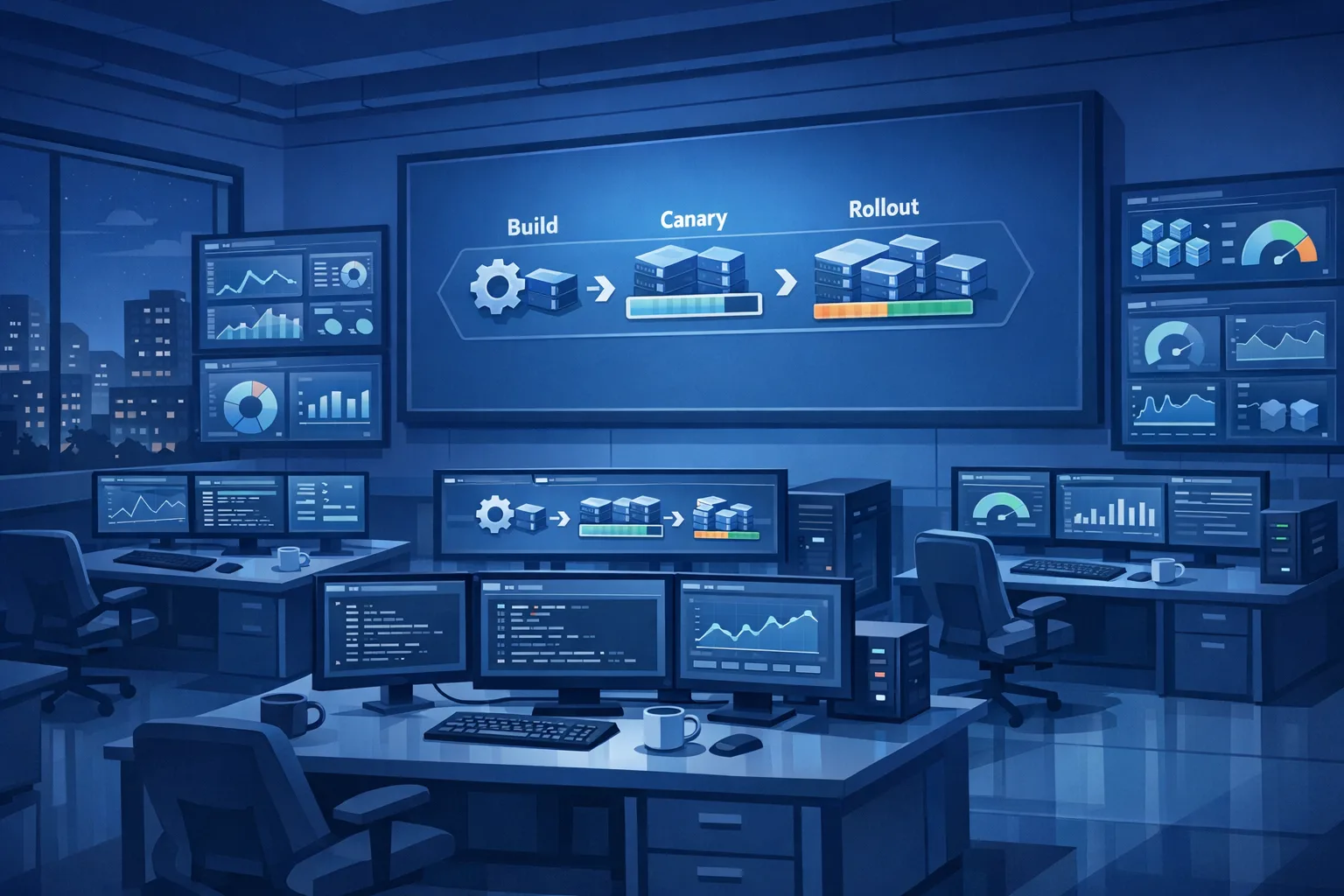
Step 2: Canary to 1–5% and watch four things
Monitor error rate, latency, memory, and CPU. For Node‑API/native modules (bcrypt, sharp, grpc, sqlite, etc.), validate that prebuilt binaries match the new ABI; if not, ensure rebuilds are happening cleanly in CI. Watch for unexpected OpenSSL or ICU diffs if your build doesn’t bundle them.
Step 3: Roll to 25–50% with auto‑rollback
Increase the slice and set an SLO‑based rollback policy. If your charts stay flat for 30–60 minutes under the busiest traffic band, promote to 100%.
Step 4: Prove and document
Close the loop: attach metrics before/after, note any mitigations, and record final versions. If you’re in a regulated environment, include screenshots of the dashboards and the artifact signatures.
People also ask: What if we’re still on Node 18?
Plan an upgrade. Continuing on 18 widens the compatibility gap across SDKs, build tools, and cloud services. Treat it as a separate project from the January 7 security drop—don’t try to change lanes and patch on the same day. Move to 22 LTS if you want a longer runway; align library versions and test for native module rebuilds.
Supply chain hygiene to do this week
The malware noise this fall wasn’t random. Campaigns that targeted maintainer accounts and CI secrets spread via lifecycle scripts and poisoned dependencies. Combine that with npm’s token shift and you’ve got a clear to‑do list: make installs predictable, minimize secret lifetime, and keep package execution out of your build unless you requested it.
Practical guardrails
Work through this short list:
- Disable install scripts in CI by default (
npm config set ignore-scripts true), whitelist only what you need. - Turn on dependable scanning for new
postinstallorpreparescripts and hard fail if an unreviewed script appears. - Adopt OIDC trusted publishing for npm so the registry issues just‑in‑time publish tokens per workflow run.
- Use immutable installs (
npm cior--frozen-lockfile) and treat lockfile diffs as code changes. - Rotate credentials and remove unused maintainers from package access lists.
If you need a concrete plan for npm’s authentication changes, our cutover guides lay out steps for both granular tokens and OIDC: see the 48‑hour Node patch plan for a tight rollout sequence and our detailed 72‑hour plan if you’re managing multiple business units.
Testing focus areas specific to Node upgrades
Most apps upgrade cleanly, but a few hotspots deserve extra scrutiny:
Native extensions and Node‑API
Libraries with native components must rebuild against the new ABI. Confirm CI caches aren’t serving stale prebuilds. Validate install logs for any node-gyp failures masked by noisy output.
TLS, crypto, and HTTP semantics
Security releases frequently adjust crypto defaults or input validation. Run integration tests against OAuth/OIDC flows, mTLS services, and any custom certificate logic. Compare cipher suites and minimum protocol versions if you terminate TLS in‑process.
Streams and backpressure
If your app is stream‑heavy (file uploads, media, proxying), put a load test across high‑RPS endpoints and watch memory. Subtle changes in buffering can look like leaks under pressure but are often tunables.
Where this intersects with frameworks
Next.js, Remix, NestJS, and others ride the platform. For Next.js on React Server Components, specifically, verify that server and edge routes are pinned to predictable Node versions and that your bundler targets match. We’ve covered safe rollout steps for framework updates in our React2Shell after‑action guide, which doubles as a checklist for runtime bumps without breaking production.

Operational timeline you can share with stakeholders
Give leadership a dated plan. It lowers anxiety and avoids surprise approvals.
December 20–23
Finish inventory, fix npm auth, disable scripts in CI, tag baselines for perf. Create change tickets and secure an exception for on‑call staffing around January 7–8.
December 26–30
Rehearse upgrades on non‑security point releases, soak test for a few hours, and resolve any ABI or TLS issues. Produce the test matrix and sign off.
January 2–6
Freeze feature deploys. Prepare signed release candidates pinned to the pre‑patch versions so you can diff only the Node runtime on the day.
January 7
Read the notes, build, canary, promote, document. Keep a rollback ready and SLO‑triggered.
People also ask: What’s the right Node version to standardize on?
For most companies, 22 LTS is the safest default through 2026: long runway, predictable security backports, and modern features. Keep 24/25 lanes only where you need newer platform capabilities and have the testing maturity to support them. Avoid running more lanes than you can meaningfully observe—two is plenty for most teams.
Risk management: compensate now, patch once
It’s tempting to backport speculative mitigations before you know the exact issues. Resist that impulse. Focus on compensating controls that are universally good: stricter auth, reproducible builds, reduced script execution, better visibility, and a rehearsed deploy. When the real patches land, you’ll move faster and with less drama.
What to do next (developers)
If you ship code, here’s your short list:
- Audit Node lanes and Docker bases; stage test builds today.
- Fix npm authentication: granular tokens or OIDC, no long‑lived secrets.
- Disable install scripts in CI by default; whitelist intentionally.
- Add version labels to metrics and traces; capture baselines.
- Prepare canary/rollback policies tied to SLOs.
What to do next (engineering leaders)
If you manage the risk, focus on clarity and staffing:
- Publish a one‑page timeline with January 7–8 as a staffed change window.
- Approve exceptions for mitigations during the freeze; block feature churn.
- Require evidence: test matrix, perf baselines, and signed artifacts.
- Consolidate to two supported Node lanes and set an end date for Node 18 if it still lingers.
Want a turnkey patch playbook?
If you need a ready‑made runbook, start with our compact what‑to‑patch‑first checklist. Pair it with the deep‑dive Next.js hardening guide for this week to cover the framework layer. If you’d rather not burn your on‑call, our team can help you define lanes, stage builds, and sit with your SREs through canaries—see our services overview and reach out via contact to schedule a fast assessment.

Final thought
The smartest move in a delayed release cycle is to use the extra time. Clean the pipes, prove your tests, and line up a small, boring deployment. When the Node.js security releases land on January 7, 2026, you’ll patch in hours—not days—and you’ll sleep just fine.



Comments
Be the first to comment.