The December Next.js security update isn’t another routine bump. It sits on top of the React2Shell fallout—a CVSS 10.0 RCE in React Server Components (RSC)—plus follow-on issues that forced additional patches. If your product uses the App Router with RSC, you need two things now: precise versions and a disciplined patch-and-proof loop. Let’s walk through what changed, which builds are safe, and a pragmatic runbook to patch, verify, and move on without leaving a mess for compliance.

Why this Next.js security update matters
Here’s the thing: RSC makes server code invokable from the client through the Flight protocol. That power is also a threat surface. In early December, the React team disclosed a pre-authentication RCE (CVE-2025-55182, widely called React2Shell). Next.js shipped guidance and tooling, then—days later—added new fixes for two additional issues surfaced during scrutiny of the first patch. One fix initially shipped incomplete and was corrected again. If your timeline stopped at the first bump, you might still be exposed.
I’ve helped several teams push emergency upgrades this month. The patterns are clear: apps that are strict about dependency pinning, CI reproducibility, and post-patch verification close exposure quicker and spend less time on incident paperwork. Teams that “yolo update” often miss a transitive dep, skip secret rotation, or leave stale containers alive behind a warm load balancer.
What changed after December 11
On December 11, Next.js published an advisory clarifying two additional RSC protocol issues and listed fixed versions across active release lines. Crucially, it noted the initial fix for one bug was incomplete and required another patch. Translation: if you upgraded promptly early that day, you probably needed to upgrade again to the later fixed versions. This is the rare time where “patch again” isn’t paranoia; it’s policy.
Operationally, the key shifts for you are:
- Do not assume the first wave of patches fully closed the loop. Validate the exact fixed version in your lockfile and runtime image.
- Plan for a second deployment if you patched before the addendum drop. Your SBOM and image digest should change accordingly.
- Treat secrets as compromised if your public endpoints were unpatched through early December—especially if you log RSC payloads or run shared infrastructure.
Which Next.js versions are safe now?
For App Router apps, patch to one of the specific fixed releases. The stable lines called out as fixed include:
14.x: 14.2.35
15.x: 15.0.7, 15.1.11, 15.2.8, 15.3.8, 15.4.10, 15.5.9
16.x: 16.0.10
If you’re on 13.3 or later but still in the 13–14 era, the guidance is to move to the latest 14.2.x patch (14.2.35 at the time of writing). Pages Router apps aren’t directly affected by the RSC bug, but most teams benefit from a patch anyway—security rollups ride along, and the cost to move within a minor line is low compared to the audit value it buys.
Don’t rely on “latest” in automation right now. Pin to the exact version, check the resolved version in package-lock.json or pnpm-lock.yaml, and verify the runtime image layer actually includes it.
Next.js security update: a field-tested patch playbook
Let’s get practical. Here’s the runbook we’ve used with product teams this month. It’s optimized for speed and provability without compromising quality.
1) Scope and freeze
Create a short-lived freeze on feature deploys while you patch. Capture the inventory: public Next.js services, internal tools, preview environments accidentally exposed, and any cron or worker that imports RSC server modules. Add your edge deployments if you run hybrid architectures.
2) Pin and upgrade precisely
Upgrade to a fixed release line explicitly:
npm install [email protected] --save-exact
# or
npm install [email protected] --save-exact
Regenerate lockfiles and rebuild your production image. If you use workspaces, ensure every app and package that declares Next.js gets the bump. Rebuild with no cache to avoid stale layers:
docker build --no-cache -t yourapp:patched .3) Close transitive holes
Update the React server packages even if the framework handles most of it. Add an overrides block as a backstop:
// package.json (pnpm/yarn support similar mechanisms)
"overrides": {
  "react-server-dom-webpack": "^19.2.1",
  "react": "^19.2.1",
  "react-dom": "^19.2.1"
}
Then force a full reinstall to ensure the lockfile and node_modules align.
4) Rotate critical secrets
If your app was online and unpatched through December 4 in U.S. afternoon hours, assume secrets may have leaked. Prioritize cloud provider keys, database creds, JWT signing keys, OAuth tokens, and any server-side environment variables used by RSC server actions. Don’t wait for perfect certainty—rotation is cheaper than incident response.
5) Prove the patch landed
Proof beats hope. Add these checks to CI and your release checklist:
- Software Bill of Materials: regenerate SBOM (CycloneDX or SPDX) and store it with the release tag.
- Runtime assertion: boot the container and run
node -e "require('next/package.json'); console.log(require('next/package.json').version)"in CI to assert the version pre-deploy. - Endpoint test: exercise a couple of server actions to confirm the binary and server functions are actually using the new bits, not a warmed instance.
6) Evict the old world
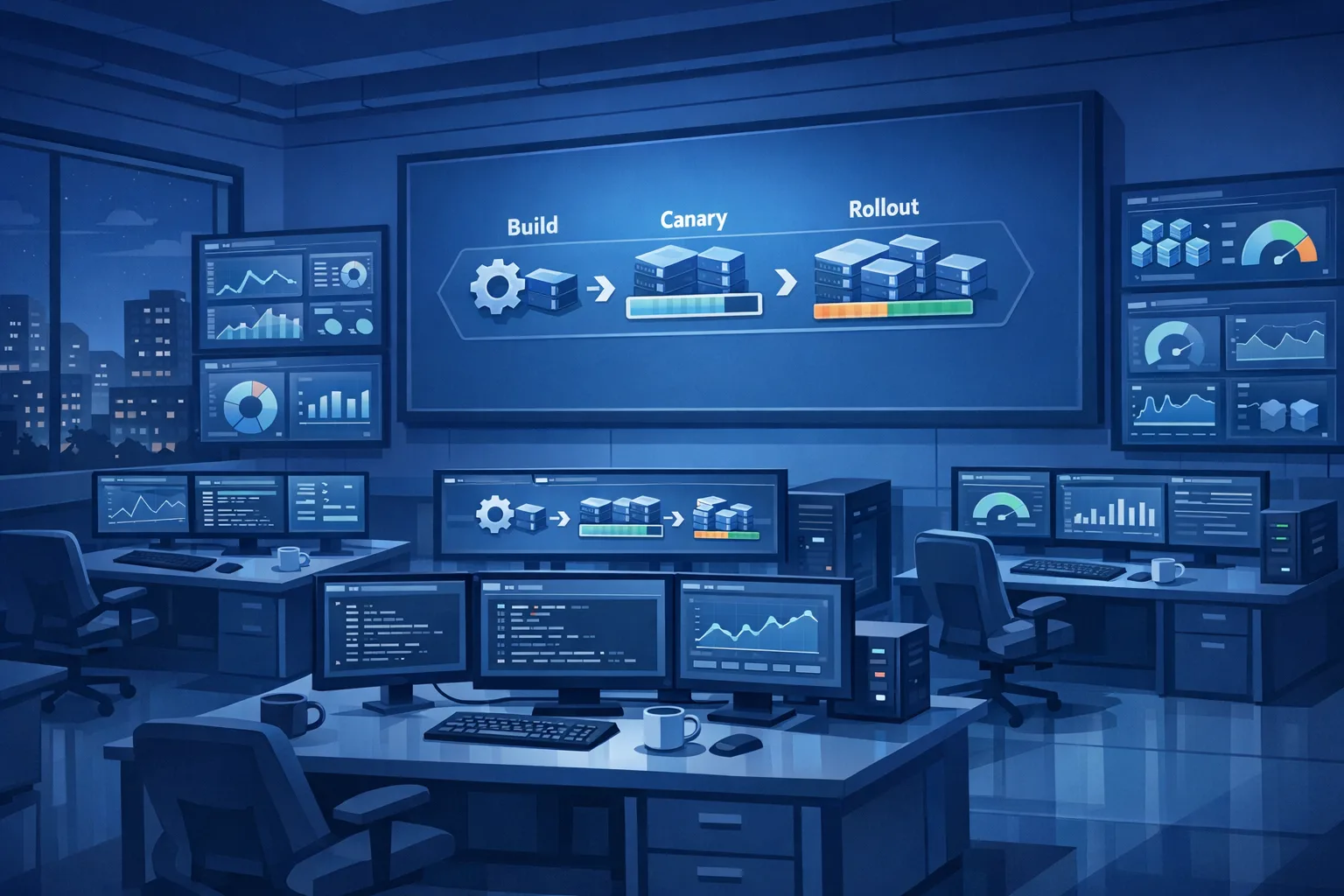
Blue/green and canaries are great until the old pool keeps serving a trickle of traffic. Force termination of pre-patch instances. If you run serverless, invalidate function caches and publish a new version alias. On Kubernetes, ensure the ReplicaSet for the old deployment is scaled to zero and garbage-collected.
7) Log review and indicators
Look for anomalous POSTs to server action endpoints, unusual serialization errors around early December, and any spikes in spawn/child_process if you log it. In cloud logs, scan for outbound connections to coin-miner pools, surprise curl | bash patterns, and shell process trees inside the Node container. If you capture request bodies, consider them sensitive data—quarantine and purge after triage.

People also ask
Do Pages Router apps need this patch?
They weren’t impacted by the core RSC bug. Still, most teams patch to stay aligned with security updates across the stack and to avoid confusion later during audits. If you plan to migrate to the App Router, patch now so you aren’t importing risk retroactively.
Which logs reveal exploitation attempts?
Web server access logs with full request paths to RSC endpoints, application logs showing deserialization stack traces, and container runtime logs with suspicious process trees are your best signals. Pair that with egress logs—many copy-paste payloads fetch a second-stage script over HTTP.
Do I have to rotate secrets even if I can’t prove compromise?
If your app was publicly reachable and unpatched through the first week of December, the safe choice is to rotate at least your high-value secrets. It’s a few hours of work versus weeks of incident remediation if a token shows up abused later.
How does this relate to Node.js security releases around December 18?
They’re separate issues but often land together on your calendar. Patch your Node.js runtime when security releases drop, then rebuild your Next.js image so you capture both layers of risk reduction in one maintenance window. If you need a detailed plan for Node, see our practical runbook linked below.
A short, data-backed timeline for your incident notes
Use this when answering due diligence questionnaires or internal postmortems:
- December 3, 2025: React discloses CVE-2025-55182 (RSC RCE). Severity: 10.0.
- December 4–6: Emergency guidance: patch immediately; rotate secrets if unpatched during this window.
- December 11: Next.js security update publishes additional vulnerabilities; addendum clarifies an initially incomplete fix and final patched versions across lines.
- Mid-December: Detection in the wild ranges from red-team to opportunistic loaders and coin miners. Teams report bursts of suspicious POSTs to RSC endpoints.
- Mid to late December: Node.js ships its own security releases; teams bundle runtime and framework patches in one push.
The PPRR loop: Patch, Prove, Rotate, Reduce
Here’s a simple framework we coach teams to run every time a high-severity web stack bug hits:
- Patch: Bump to the fixed Next.js version; rebuild from scratch; deploy with zero stale instances.
- Prove: SBOM, runtime version assertion, endpoint checks, and artifact signatures.
- Rotate: Secrets prioritized by blast radius: DB, cloud, JWT, OAuth, SSO, CI tokens. Automate via your vault provider.
- Reduce: Tighten RSC exposure: rate limit server actions, disable unused ones, isolate to dedicated origin, and add WAF rules for known exploit patterns. Trim logs containing potentially sensitive payloads.
Hardening RSC and the App Router
RSC is a productivity win, but treat it like an RPC surface:
- Least privilege: Server actions should not touch broad environment state. Wrap secrets behind small per-action credentials or short-lived tokens.
- Input shaping: Validate shape and range at the action boundary. Even with upstream fixes, assume untrusted input.
- Transport boundaries: Terminate TLS at the edge you control, and prefer a dedicated subdomain for RSC endpoints so you can target WAF and rate policies independently.
- Observability: Tag all RSC requests with a correlation ID; sample payload metadata (not raw bodies) for anomaly detection.
CI/CD guardrails so you don’t fight this battle twice
When the next bulletin lands, you’ll want buttons, not a war room:
- Policy as code: Block merges if
nextorreact-server-dom-*fall below fixed minimums. - Automated SBOM diffing: Fail the pipeline if the release SBOM doesn’t include the fixed versions.
- Golden image: Pre-bake a Node.js LTS image and a patched Next.js base layer. Teams inherit security by default.
- Secret rotation scripts: Keep a library of runbooks to rotate cloud, DB, and JWT keys with one command and staged rollout.
Real-world tradeoffs and edge cases
There are a few gotchas we keep seeing:
- Stuck on an older minor: If you’re pinned below 14.2.x for a plugin, test the patch in a shadow environment. Most blockers are dev-time only; production often works if you freeze the plugin and update Next.js.
- Serverless cold starts: Some teams worried the upgrade would increase cold-start time. In my tests across Vercel and AWS Lambda, differences were negligible when keeping the runtime Node line constant. Measure in your stack, but don’t use performance fear to delay a security patch.
- Third-party actions: If vendors ship server actions bundled in your app, they ride your version. Ask for their advisories anyway—some include additional hardening suggestions.
What to do next
- Upgrade to a fixed Next.js release (14.2.35 or 16.0.10 are safe anchors) and rebuild without cache.
- Regenerate your SBOM and assert the Next.js version in CI at runtime.
- Rotate high-value secrets if you were public and unpatched in early December.
- Shut down old instances. Don’t let canaries become permanent residents.
- Instrument RSC endpoints with rate limits, WAF signatures, and audit-friendly logging.
Further help and related resources
If you want a tactical, team-ready plan, our earlier pieces break the work into checklists and timelines. For a live patch drill or to outsource the runbook, our team can step in.
• Read the Next.js real‑world patch playbook for an end-to-end checklist.
• If you patched early, see Patch again after Dec 11 for the addendum details.
• Running mixed stacks? Our React2Shell 10‑day plan prioritizes rotation and proof steps.
• Pair the framework fix with runtime hardening using our Node.js security release runbook.
If you’d rather have us run the playbook with your team, reach out through our security services or contact us. We’ve done this all month; you don’t need to reinvent the wheel.

Zooming out
Incidents like this remind us that modern frameworks trade convenience for complexity at the protocol layer. That’s fine—as long as we respect the surface area. When an upstream protocol flaw becomes a pre-auth RCE, the only acceptable posture is fast patching, deliberate proof, and automated guardrails so you can do it again without drama. Ship the fix, lock the logs, rotate what matters, and get your team back to building.



Comments
Be the first to comment.