
Node.js Security Release: January 2026 Patch Guide
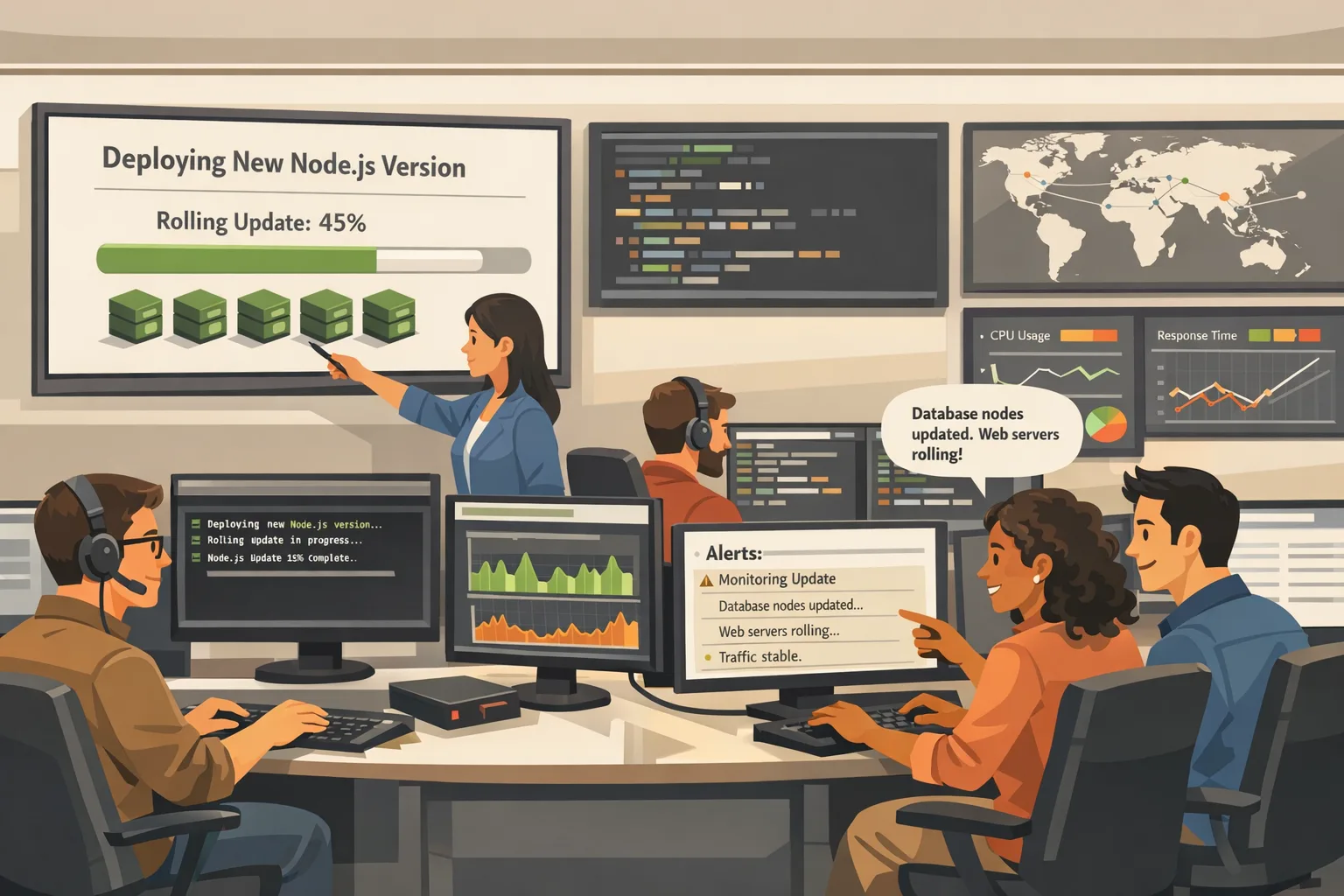
The Node.js security release on January 13, 2026 shipped patches across all supported lines and deserves your full attention. This Node.js security release closes high‑severity flaws that touch memory safety, HTTP/2 error handling, TLS, async hooks, and the experimental permission model. If you operate Node 20.x, 22.x, 24.x, or 25.x in production, plan an immediate rollout—preferably today—to the patched versions listed below. Here’s the practical breakdown and an upgrade plan you can execute in one focused session.
What changed in the Node.js security release (January 13, 2026)
Four supported release lines received coordinated fixes and dependency updates:
Patched Node versions: 20.20.0, 22.22.0, 24.13.0 (LTS), 25.3.0 (Current).
Dependency bumps: c‑ares 1.34.6; undici 6.23.0/7.18.0 (depending on line).
Notable vulnerabilities addressed (highlighted for operational impact):
- CVE‑2025‑55131 (High): Timeout‑triggered race can leave
Buffer.alloc()and TypedArrays non‑zeroed undervmtimeouts—possible in‑process secret exposure or corruption in edge timing scenarios. - CVE‑2025‑55130 (High): Permission model symlink traversal allows escaping
--allow-fs-read/--allow-fs-writeboundaries. - CVE‑2025‑59465 (High): Malformed HTTP/2 HEADERS can crash servers lacking robust secure socket error handling—remote DoS risk.
- CVE‑2025‑59466 (Medium): Uncatchable stack overflows with
async_hooks; apps depending onAsyncLocalStoragebecome more crash‑prone under deep recursion. - CVE‑2025‑59464 (Medium, 24.x specific): TLS client‑cert parsing memory leak; steady resource growth when repeatedly inspecting peer cert fields.
- CVE‑2026‑21636 (Medium): Permission model bypass via Unix Domain Sockets (UDS) when network permissions are expected to block connections (relevant to 25.x experimental flags).
- CVE‑2026‑21637 (Medium): Exceptions in TLS PSK/ALPN callbacks can bypass normal error handling, leading to process crashes or FD leaks.
- CVE‑2025‑55132 (Low):
fs.futimes()could modify timestamps despite read‑only model constraints.
Put simply: if you expose HTTP/2, use TLS client certs, rely on async context propagation, or run with the permission model, you’re in scope. Most production stacks touch at least one of those surfaces.
Does this affect your stack? Quick triage
Here’s the thing: not every app is equally exposed. In 15 minutes, you can sort yourself into a risk bucket and decide how aggressively to patch.
High urgency (patch today, test, ship):
- You terminate HTTP/2 in Node (native HTTP/2 or behind TLS terminating proxies that still route HTTP/2 to Node).
- You rely on
AsyncLocalStorage(common in observability/APM, request scoping, or React SSR pipelines) or customasync_hooks. - You use the permission model in any capacity (CI sandboxes, multi‑tenant plugins, or worker pools).
Medium urgency (patch within 48 hours):
- You parse TLS client certificates (
socket.getPeerCertificate(true)) or run PSK/ALPN callbacks. - Your workloads perform heavy buffer/TypedArray allocation under timeouts, sandboxed evaluation, or interruptible parsing.
Still patch, but low exposure:
- HTTP/1.1 behind a robust edge, no async hooks, no permission model, no TLS client‑cert flows—but you still want dependency bumps and defense‑in‑depth.
If your risk profile is “high urgency,” keep reading—then run the sprint plan below. If you want deeper context first, our focused breakdown here complements our earlier field note on what to patch today in Node.js.
The four‑hour patch sprint plan
Time‑boxed, production‑safe, and designed for small teams.
- Freeze the pipeline (15 min) – Pause feature deploys. Announce a change window. Snapshot Grafana/Sentry baselines.
- Inventory and choose versions (15 min) – For Node 20, 22, 24, 25, target 20.20.0, 22.22.0, 24.13.0, or 25.3.0 respectively. Note that 24.13.0 is LTS.
- Update base images (30 min) – Rebuild containers on distro tags that include the patched Node versions. If you install Node via package managers or nvm, pin to the exact patched versions and lock them in CI.
- Patch and vendor tests (60–90 min) – Run the targeted checks below before canarying:
HTTP/2 crash guard: Ensure you attach secure socket error handlers. In tests, send malformed HPACK/HEADERS; the server should log and recover, not exit.
Async hooks stress: Use a deep recursion test with AsyncLocalStorage in place; confirm the process doesn’t terminate without emitting catchable errors in patched Node versions.
Permission model hardening: Create a temp dir with a relative symlink to an outside file. With --permission and read/write granted only to the temp dir, the read should fail. Also attempt a UDS connect without --allow-net; it should now be blocked.
TLS client‑cert leak: If you call getPeerCertificate(true), run a looped handshake test. Memory should stay flat after the patch on 24.x.
- Canary and ringed rollout (45–60 min) – Roll to 5%, watch error budgets, then 25%, 100%. Keep an eye on memory, FD usage, and latency percentiles.
- Debrief and document (15 min) – Note code paths touched, flags, and test fixtures. Update your runbooks. If you need a second set of eyes, our what we do page outlines how we help clients ship safely under time pressure.
Version selection cheat‑sheet
• Node 20 → 20.20.0
• Node 22 → 22.22.0
• Node 24 (LTS) → 24.13.0
• Node 25 (Current) → 25.3.0
If you’re also pushing OS patches this week, consider bundling with your Windows and Linux cadence—our practical read on January 2026 Patch Tuesday priorities pairs well with this upgrade.
Deep dives: how the fixes change real systems
Buffer alloc race (CVE‑2025‑55131): why timing suddenly matters
Under specific timeout conditions—especially with vm plus a timeout—the runtime could expose a freshly allocated buffer before the zero‑fill completed. That’s rare, but it’s the sort of edge case that shows up in high‑load services doing sandboxed parsing, transpilation, or user‑supplied template evaluation. The risk is twofold: secret fragments leak into API responses, or you corrupt domain‑specific data structures and chase ghosts for days.
The patched releases enforce deterministic zero‑init before exposure. Practically, it removes a whole class of heisenbugs you could never reproduce on a dev laptop. If your code ever serializes newly allocated buffers or echoes partial payloads, upgrading eliminates an ugly footgun.
Permission model symlink traversal (CVE‑2025‑55130): escaping the sandbox
With the permission model enabled, you expect a process allowed to read only in a directory to stay there. Symlinks can be tricky; the bug allowed a relative symlink chain to step outside the allowed path. That’s a big deal in CI plugins, extension hosts, or multi‑tenant job runners where you isolate untrusted tasks.
The fix makes symlink resolution honor the same read/write checks as direct paths. After upgrading, keep the guardrails by adding a regression test: create tmp/allowed, symlink tmp/allowed/escape to ../../etc/hosts, grant read to tmp/allowed, and expect fs.readFile("escape") to fail. This one‑liner test belongs in every permission‑model project.
HTTP/2 HEADERS crash (CVE‑2025‑59465): when an error handler is a security control
Malformed HPACK data in a HEADERS frame could trigger a secure socket error that—without a proper handler—crashed the process. The patch strengthens defaults, but you should treat error handlers as part of your threat model. In busy API gateways or SSR servers, a single crafted request per worker can knock out capacity.
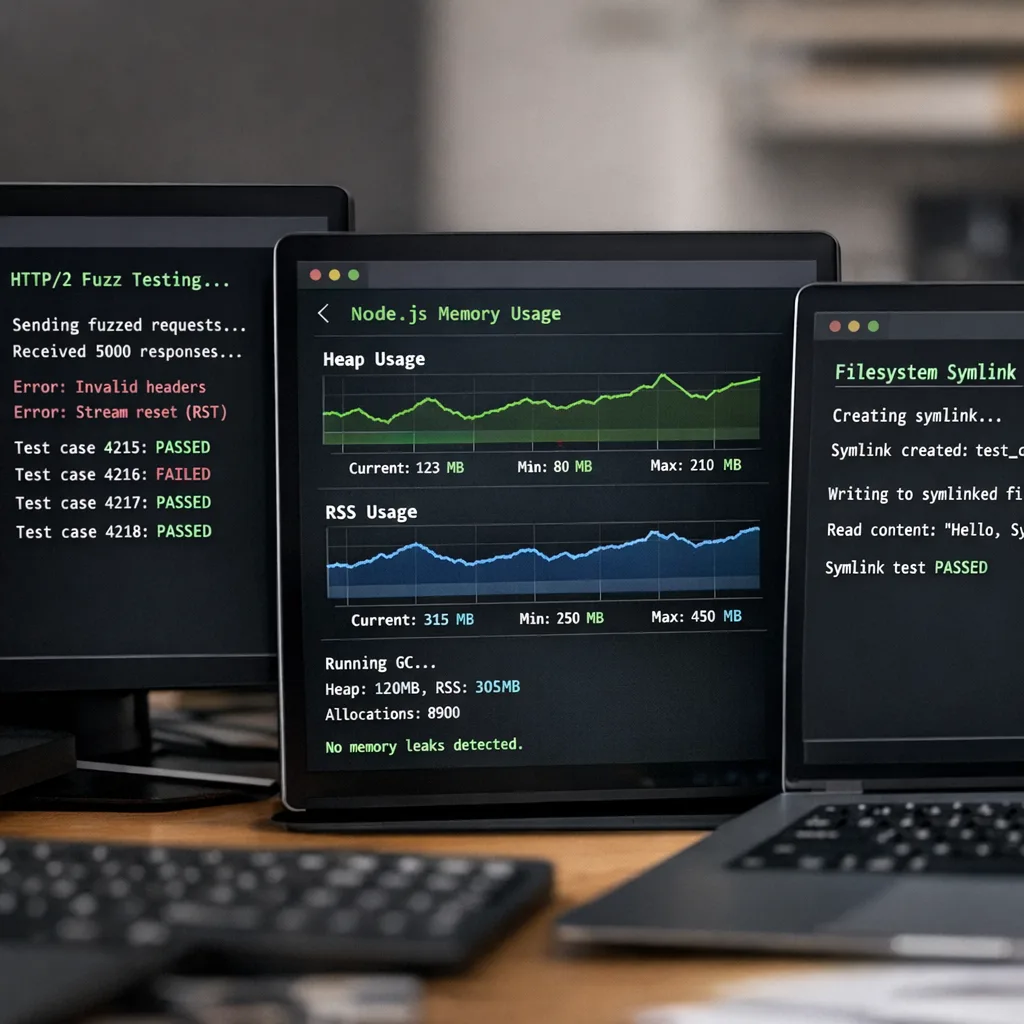
What to do: verify you register error handlers on sockets created by your HTTPS/HTTP2 server. Then run a fuzz test that injects bad HPACK data. Post‑patch, the connection should close gracefully and your process should live to serve the next request.
Async hooks crash behavior (CVE‑2025‑59466): the recursion trap
Apps that rely on AsyncLocalStorage inherit risks from deep recursion and unbounded user input creating pathological call stacks. Before the fix, a maximum call stack error could bypass your uncaughtException recovery path. The patch improves recoverability in a narrow case, but don’t build availability on stack space behavior—bound recursion, validate inputs, and prefer iterative state machines in hot paths.
If you instrument request scope with ALS, add a chaos test: induce controlled recursion in staging, assert that patched Node survives and continues to emit telemetry. If not, it’s a hint your library stack’s error handling needs a tune‑up.
TLS client‑cert parsing leak (CVE‑2025‑59464): slow memory balloon
This one bites long‑lived servers that inspect getPeerCertificate(true) fields. Repeated handshakes from clients with crafted certificates cause steady memory growth. Symptoms look like a rolling deploy: memory climbs, pods restart, users see intermittent 502s. The fix ensures all buffers are freed, including failure paths.
Your test: in staging, loop a client that presents a certificate and triggers field inspection. Watch RSS; post‑patch, the slope should flatten. If you don’t need to examine every field, minimize calls or cache normalized results.
UDS bypass in the permission model (CVE‑2026‑21636) and TLS callback exceptions (CVE‑2026‑21637)
Two medium‑severity gaps remind us that boundaries aren’t boundaries unless the entire stack enforces them. UDS connects should be gated by network permissions; now they are. TLS PSK/ALPN callbacks must route exceptions through reliable handlers; now they do. If you rely on the permission model for defense in depth, upgrade immediately and add explicit allowlists for --allow-net targets. For TLS, wrap callbacks in safe guards and assert that handler paths fire under injected failures.
People also ask
Is the Node.js permission model safe to use in production now?
It’s safer after this release, but it’s still evolving. Treat it as a strong sandbox layer, not your only layer. Combine it with cgroup/container isolation, strict filesystem layouts, and explicit allowlists. And keep a regression test that attempts a symlink escape and a UDS connection without --allow-net.
Do I need to change my code after updating Node.js?
Likely minimal changes—unless your app depended on unspecified behavior. You should add or verify error handlers for HTTPS/HTTP/2 sockets, wrap TLS PSK/ALPN callbacks defensively, and ensure your AsyncLocalStorage usage doesn’t assume particular stack overflow semantics. Most apps can upgrade and pass tests with no source changes.
How do I validate that I’m actually patched?
Run node -v in CI and at runtime on canaries; it should report 20.20.0, 22.22.0, 24.13.0, or 25.3.0. Reproduce the test scenarios above: malformed HTTP/2 frames, ALS recursion, symlink/UDS attempts, and TLS client‑cert loops. Your process should stay up, and memory/FD graphs should remain stable. If you need a guided runbook, reach out via our contact form.
Operational tips that pay off next quarter
Zooming out, the best time to prepare for the next coordinated drop is right after this one:
- Pin and audit Node versions in CI to prevent drift. Fewer surprises at deploy time.
- Add security smoke tests to your pipeline—just the small set in this article will catch regressions early.
- Standardize error handling for TLS and HTTP/2. Treat it as a reliability feature, not a log sink.
- Document your permission model posture (flags, allowed paths, socket allowlists) and include a one‑click regression job.
If you’re planning parallel work—like a framework bump—sequence carefully. For example, teams migrating to React 19 often lean on AsyncLocalStorage for server workloads. Our practical notes on shipping early React 19 changes pair well with this week’s patching to keep your SSR paths predictable.
What to do next
- Upgrade to 20.20.0, 22.22.0, 24.13.0, or 25.3.0 today.
- Run the four security smoke tests: HTTP/2 error handling, ALS recursion, symlink/UDS checks, TLS client‑cert memory.
- Rebuild base images and pin Node in CI.
- Add the symlink and UDS regression tests to your repo.
- Schedule a one‑week post‑patch review of memory and FD metrics.
Need a quick sanity check or hands‑on help under a tight SLA? Explore our security and reliability services and tell us what you’re shipping. We’ll help you move fast without breaking prod—and we’ll leave behind tests your teams will actually keep running.





Comments
Be the first to comment.