
January 2026 Node.js Security Release Playbook
The Node.js security release on January 13, 2026 landed across all supported lines—20.20.0, 22.22.0, 24.13.0, and 25.3.0—and it’s not a routine patch cycle. This Node.js security release fixes three High, four Medium, and one Low severity issues, plus dependency updates to c‑ares and undici. If your services handle HTTP/2, terminate TLS, or rely on the permission model, you should schedule an accelerated rollout. Below I’ll outline the risks, the fastest safe upgrade path, and the traps we’ve already seen teams hit in staging.
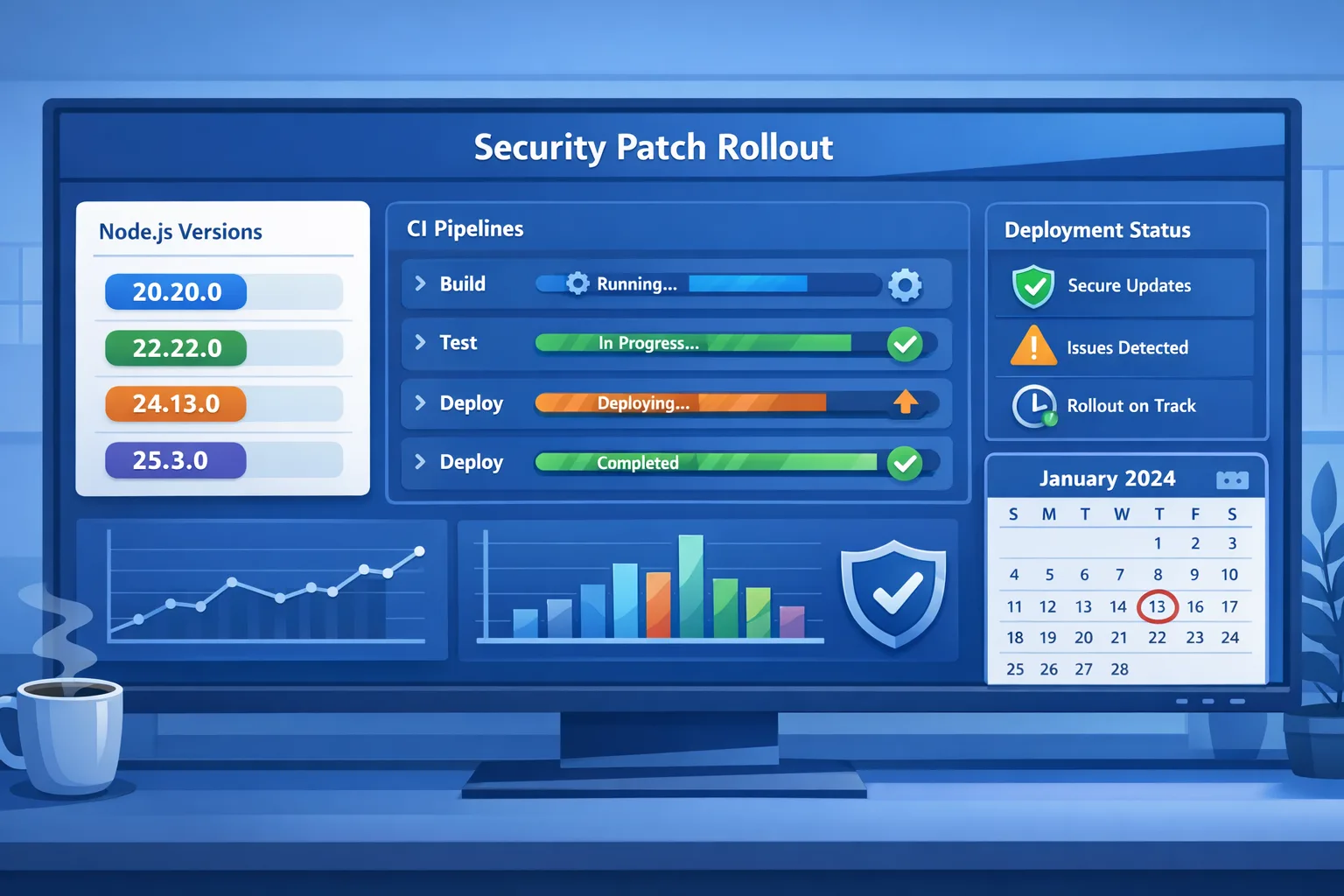
What changed in the Node.js security release
Here’s the condensed, practical view of what shipped on January 13, 2026 and why it matters operationally.
High severity fixes you can’t ignore
• Buffer/TypedArray zero‑fill race (CVE‑2025‑55131). Under timeout pressure (for example, the vm module’s timeout) buffers could become observable before they were fully initialized. That means secrets or residual memory could leak if you serialize or return those buffers. The fix enforces proper initialization before exposure.
• Permission model symlink bypass (CVE‑2025‑55130). With the permission model enabled, crafted symlinks could escape allowed paths and touch files you didn’t intend to expose. If you rely on --allow-fs-read/--allow-fs-write to sandbox tasks, this bug breaks your boundary. The fix now applies equivalent checks during symlink resolution.
• HTTP/2 HEADERS handling crash (CVE‑2025‑59465). Malformed input could lead to process crashes when TLS socket errors weren’t handled, making remote DoS a real risk on public endpoints. The fix installs safer defaults and improves error routing so the connection dies, not your process.
Medium and low severity changes that still bite
• TLS client certificate parsing leak (CVE‑2025‑59464). If you call socket.getPeerCertificate(true), repeated connections with client certs could leak memory and eventually exhaust RAM.
• Async hooks and stack‑overflow hardening. Under deep or pathological async recursion, async_hooks and related instrumentation could trigger unrecoverable crashes. Behavior now routes errors more safely and avoids process‑level terminations.
• Permission model inconsistencies. Gaps around Unix Domain Sockets and timestamp updates (fs.futimes(); CVE‑2025‑55132, Low) were closed so read‑only really means read‑only and network restrictions apply consistently.
• Dependency updates. c‑ares is updated to 1.34.6 for DNS hardening, and undici is updated across supported lines (6.23.x/7.18.x), addressing client‑side HTTP quirks that can amplify resource exhaustion patterns. Even if you don’t import undici directly, transitive updates may change behavior in your stack.
Net effect: surface area reduction at the boundaries where Node.js meets untrusted I/O—filesystems, TLS, and HTTP/2—plus memory‑safety fixes that close subtle data‑exposure avenues.
Who must patch right now?
Not every workload has the same exposure. Triage by these scenarios:
• You terminate TLS or accept client certificates. If your front door is Node.js (not a separate proxy) and you use mTLS for partner or internal services, schedule the upgrade inside 48 hours. Memory leaks here are slow‑burn outages.
• You serve HTTP/2 on the public internet. Remote DoS via malformed frames is an availability risk with direct business impact. Patch now and verify your TLS socket error handlers actually run.
• You run with the permission model. CI jobs, CLIs, and sandboxed tasks that lean on --permission flags must pick up the symlink fix; otherwise, your sandbox isn’t a sandbox.
• You use async_hooks or AsyncLocalStorage heavily. Observability, APM, and request‑scoped context tracking can see pathological recursion in edge cases. Upgrade and run your load tests that exercise tracing.
• You operate on 20.x/22.x. You’re still supported, but backports mean subtle differences. Validate behavior under your typical production stress patterns, not just unit tests.
The 48‑hour rollout plan we use with clients
Use this playbook when your teams need to move fast without gambling on prod stability.
Hour 0–4: Confirm scope and prepare builds
• Inventory which services actually terminate TLS, serve HTTP/2, or use the permission model. Label them Tier‑A.
• Cut a branch and bump Node.js in your Docker base images, .nvmrc, and CI runners to the patched line (20.20.0, 22.22.0, 24.13.0, or 25.3.0). Tag images clearly (-secfix-2026-01).
• If you vendor undici or pin c‑ares via native builds, refresh lockfiles and rebuild. Watch for any native module rebuilds that change ABI flags.
Hour 4–16: Run the right tests (not just more tests)
• HTTP/2 resilience probe. Spin up a canary with the patched runtime and fire malformed HEADERS frames using your favorite fuzzer or an integration test that sends oversized and invalid HPACK sequences. Expect clean connection termination and process survival.
• TLS memory profile. With --heapsnapshot-near-heap-limit=1 in a lower environment, loop client cert handshakes while calling socket.getPeerCertificate(true). Heap should stabilize after a few cycles; any monotonic growth is a red flag.
• Permission model escape tests. Create a temporary directory with a symlink chain that tries to break out of the allow‑listed path; verify the operation fails under --allow-fs-read/--allow-fs-write.
• Async hooks stress. Enable your tracing stack, then run a load scenario with deep nested async work (e.g., recursive microtasks or a fan‑out/fan‑in chain). You want clean error propagation, no uncaught process exits.
Hour 16–28: Staging soak and observability gates
• Stage with production‑like concurrency, traffic mix, and timeouts. Watch GC pause times, heap ceiling, and event‑loop utilization before and after. Bounded increases are fine; spikes usually trace back to plugin code hooking async_hooks.
• Validate custom TLS and HTTP/2 code. If you’ve attached bespoke secureConnection or TLS error handlers, confirm they still fire as expected under the new defaults.
• Rebaseline dashboards. Undici and c‑ares updates can change DNS latency and HTTP pool behavior. Export a week‑over‑week dashboard to catch regressions early.
Hour 28–48: Phased rollout and guardrails
• Canary 1–5% of traffic for Tier‑A services during business hours. Keep rollback one command away and gate on p99 latency and error rate bands.
• Expand to 25–50% if the canary holds for a full key cycle (e.g., cache TTL + typical user session length). Then complete rollout.
• Run post‑deploy drills. Intentionally trigger TLS and HTTP/2 errors against production instances to verify your alarms and handlers behave with real live traffic.
Want a deeper test matrix? We maintain a living checklist for runtime upgrades. For a copy and support from our engineers, see our test smarter checklist.
People also ask
Do I need to rebuild Docker images and base AMIs?
Yes. Rebuild anything that bakes Node.js into the image: app containers, CI runners, and developer images. If you use distroless or minimal bases, confirm new CA bundles and DNS libs land correctly alongside the Node.js bump.
Does this affect LTS only, or also Current?
All active release lines received patches on January 13, 2026. For production, pick the patched version on your line: 20.20.0, 22.22.0, 24.13.0, or 25.3.0. Don’t mix major upgrades with security patches under time pressure unless you’ve already rehearsed the jump.
We don’t enable the permission model—can we wait?
You’re less exposed on that specific class of bugs, but the HTTP/2 and TLS hardening still matter if your service is internet‑facing. Most teams should ship this within a week at the latest; Tier‑A endpoints should move within 48 hours.
How do the c‑ares and undici updates affect behavior?
DNS resolution and HTTP client pooling can shift in subtle ways: slightly different resolver timeouts, stricter header handling, changed back‑pressure under slow consumers. That’s why we recommend a staging soak and fresh baselines rather than a blind push.
What could break after you patch?
Here’s the thing—security fixes often harden behavior in ways that surface latent bugs in application code.
• Stricter Buffer semantics. If you had tests (or code) that depended on reading uninitialized memory—usually by accident—they’ll now behave predictably. Expect a few snapshot tests to change because of different zero‑fill timing.
• File‑system utilities under the permission model. Tools that walked symlinks without explicit allow‑lists will now error. CI scripts that copy artifacts via symlinked paths may need updated flags or path normalization.
• TLS error routing. If you relied on process‑level exceptions to bubble up from TLS sockets, you’ll see fewer global crashes and more connection‑scoped errors. Make sure your request‑level logging captures these correctly or you’ll miss useful signals.
• HTTP/2 header quirks. Servers that were lenient with invalid or oversized headers might now reject requests earlier in the lifecycle. Review any custom proxies or edge logic that massages headers before Node.js sees them.
• Dependency ripples. undici changes can shift retry behavior and timeouts; c‑ares may alter DNS failure modes. We’ve seen this impact service discovery during partial outages. Add explicit retries with jitter where needed.
Zooming out: the Node/npm threat model in 2025–2026
The runtime itself isn’t the only risk. Late 2025 brought high‑profile supply‑chain campaigns against npm, including malicious packages and mass fake package uploads seeded to later turn malicious. That backdrop is exactly why runtime hardening matters: attackers probe every layer—registry, dependencies, protocol edges—looking for the weakest link.
Two moves reduce your blast radius immediately: tighten dependency hygiene and keep the runtime patched. Lockfiles, scoped registries, and provenance checks are boring—and they work. Pair that with HTTP/2 and TLS hardening from this release, and opportunistic attacks get much harder to pull off.

Copy‑ready checks you can drop into CI
Here’s a compact set of guards we add to upgrade pipelines:
• Version gate. Fail builds if node -v doesn’t match your patched line. Don’t let old runners sneak through.
• HTTP/2 probe. Run a small suite that sends invalid headers against a test server; assert process stays alive and logs the error.
• TLS handshake loop. Establish 1,000 sequential mTLS connections in CI and verify memory returns to baseline within 60 seconds.
• Permission model escape test. Mount a temp dir, create a symlink chain, attempt out‑of‑bounds reads, and assert denial under --allow-fs-read.
• Async recursion guard. Trigger controlled deep recursion under AsyncLocalStorage and assert graceful failure without process exit.
If you want a field‑tested checklist for your stack, our team publishes upgrade guides regularly in the ByBOWU blog and offers hands‑on help via our security engineering services.
What to do next
• Patch Tier‑A services within 48 hours: Node.js 20.20.0, 22.22.0, 24.13.0, or 25.3.0. Rebuild images, runners, and AMIs.
• Run the four targeted tests above in CI. Don’t rely on unit tests to catch protocol‑edge regressions.
• Add error handlers for TLS sockets explicitly, even though defaults improved. Defense in depth still wins.
• Review any permission model usage in CI/worker tasks and update symlink handling. Expect stricter failures.
• Baseline performance after upgrade—especially DNS latency and HTTP client behavior—before and after charts prevent finger‑pointing later.
Need a fast assist? Our deeper patch‑fast analysis and the 7‑day rollout playbook are tailored for busy teams. Or just talk to us and we’ll help you ship this safely.
Final take
Patching is table stakes, but how you patch decides whether this week is calm or chaotic. The January 13 release closes real gaps at the protocol edges where attackers love to live, and the fixes are worth the rollout effort. Treat this as a dry run for future runtime upgrades: inventory exposure, test the edges, phase your rollout, and keep receipts in your dashboards. Do that, and the next Node.js security release becomes a two‑day routine—not a fire drill.




Comments
Be the first to comment.