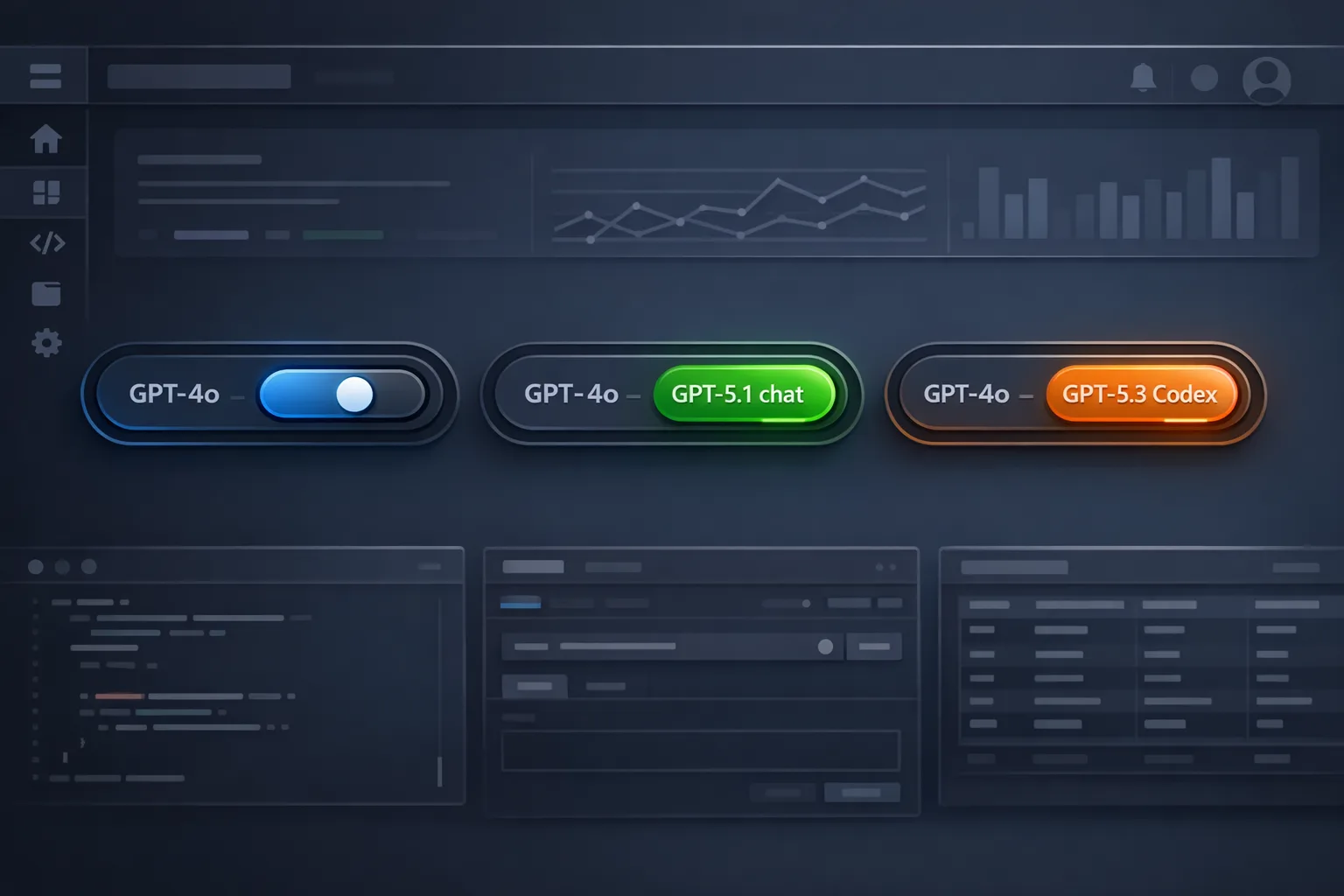
GPT‑4o Deprecation: A Fast, Safe Migration Playbook
The GPT‑4o deprecation is no longer a rumor or a future worry. On February 13, 2026, OpenAI removed GPT‑4o from ChatGPT, and on February 17, 2026, the chatgpt‑4o‑latest API snapshot was retired. If you still depend on 4o for production traffic, your users have already felt the change. Let’s turn that pain into a clean cutover—without outages, regressions, or a support queue on fire.
I’ve shipped multiple model swaps under deadline pressure. The teams that win follow a two‑track plan: stabilize today with minimal rework, then iterate toward strategic gains. This article gives you both—what changed, the safest immediate replacements, and a practical migration framework you can run this week.
GPT‑4o deprecation: what actually changed between Feb 5–17, 2026
Here’s the thing: not all deprecations hit the same way. This one arrived in stages and created mixed signals.
First, on February 5, 2026, OpenAI announced GPT‑5.3‑Codex, a new agentic coding model. It claims a 25% speed boost and state‑of‑the‑art results on tough real‑world coding and agent benchmarks like SWE‑Bench Pro (56.8%) and Terminal‑Bench 2.0 (77.3%). That immediately raised the “should we retool?” question for teams whose apps include code generation or software automation.
Then, on February 13, 2026, GPT‑4o was retired from ChatGPT. Business, Enterprise, and EDU customers retained access to GPT‑4o inside Custom GPTs until April 3, 2026, but for most user workflows, the default jumped to newer models. If your support docs or prompts referenced “use 4o,” those instructions just broke.
Finally, on February 17, 2026, the chatgpt‑4o‑latest API snapshot shut down, with gpt‑5.1‑chat‑latest the recommended replacement. Crucially, OpenAI has signaled that general API access to 4o variants may continue outside that snapshot, but the writing’s on the wall: you should treat this as the beginning of the end for 4o in your stack and move your default routing.
If your CI still runs evaluation suites against 4o baselines, or if your prompt engineering relied on 4o’s warmer tone, expect measurable deltas now. That’s normal—and solvable with a tight migration loop.
Will GPT‑4o still work in the API?
Short answer: don’t plan on it. While parts of the 4o family may linger for specific features or enterprise carve‑outs, the chatgpt‑4o‑latest removal on February 17, 2026, is a clear API signal. If you haven’t set a new default, do it today. If procurement or compliance needs more runway, lock your routing layer so you can swap models without code churn, then start controlled canaries.
The zero‑downtime model migration framework
Let’s get practical. Below is the exact framework we use when we help clients migrate models under deadline pressure. Adjust the steps to your risk tolerance, but keep the order.
1) Inventory and classify usage
Map every path that calls GPT‑4o or the retired snapshot: endpoints, background jobs, batch pipelines, and internal tools. Classify by business impact: conversion‑critical, customer‑supporting, and internal‑only. You’re going to stage these in that exact order.
2) Decouple with a routing layer
If your app calls models directly from product code, introduce a thin routing service: it accepts a task label (summarize, code‑review, classify), maps it to a model, and logs inputs/outputs with versioned prompts. Now “switching models” is a config change, not a deploy. If you don’t have this yet, build it first—even a 200‑line service can save your month.
3) Establish a replacement matrix
Pick a primary and a fallback for each task. For general chat or reasoning, gpt‑5.1‑chat‑latest is the default starting point. For code‑heavy or software‑agent tasks, plan an A/B between your current best and GPT‑5.3‑Codex where available. Document constraints: context limits, token pricing, tool‑use support, and any safety filters that might affect outputs.
4) Re‑baseline prompts
Prompts tuned for 4o’s style can underperform elsewhere. Run your top 20 prompts through the new primary model with production examples. Update system messages, tighten role instructions, and remove prompts that over‑steer tone. Keep a diff log so you can tie performance shifts to prompt revisions, not only model changes.
5) Build a fast eval loop
Create a “must win” eval set: 100–300 production‑like inputs with ground‑truth or acceptability rules. Score with a blend of auto‑metrics (pass/fail checks, regex guards, safety flags) and human review on the top failure clusters. Keep your evals cheap and daily. The goal is trend data, not one perfect benchmark.
6) Canary and observe
Send 5–10% of traffic to the new model for your highest‑impact surfaces. Track success rate, latency, and business KPIs. Roll forward to 50% once you’ve cleared functional regressions. Watch for longer tails: certain verticals (finance, healthcare) surface edge cases late. Hold a rollback plan for the first 72 hours at each step.
7) Lock it in and retire the old path
Once the new default beats or matches your KPI floor, freeze prompt versions and turn off the 4o route. Keep the fallback for a week, then remove it. Don’t let “temporary” toggles linger—they rot.
Teams that follow this order—inventory, routing, replacement matrix, prompt re‑baseline, evals, canary, retire—ship with fewer user‑visible surprises and less weekend pager duty.
How GPT‑5.3‑Codex changes the calculus
Zooming out, GPT‑5.3‑Codex is more than a model bump. It’s the first mainstream agentic coding model that feels comfortable taking on longer‑horizon tasks while keeping you in the loop. OpenAI reports 25% faster interactions and higher scores on SWE‑Bench Pro (56.8%) and Terminal‑Bench 2.0 (77.3%), plus strong results on OSWorld‑Verified and GDPval. That matters if your product synthesizes code, manipulates repos, or runs structured tool‑use loops.
But there’s a catch: availability. As of mid‑February 2026, GPT‑5.3‑Codex is broadly accessible in the Codex app and ChatGPT with paid plans, with API access expanding in stages. If your business case hinges on API integration, plan for a phased trial: keep your mainline on gpt‑5.1‑chat‑latest while you run side‑traffic through 5.3‑Codex for the code‑specific moments where it pays off.
Latency, throughput, and cost: what to expect
Expect lower end‑to‑end latency on interactive coding tasks and a higher hit rate on multi‑step executions. That can shrink the number of retries, which often matters more than a nominal per‑token price difference. In practice, the best way to control spend is still to bound context windows, enforce strict tool contracts, and terminate loops aggressively on goal conditions.
Where 5.3‑Codex is worth the switch—now
Three scenarios consistently win:
First, IDE‑like experiences where users expect rapid back‑and‑forth and inline edits. The 25% speedup translates directly into perceived quality.
Second, autonomous test writing and refactor planning. Higher Terminal‑Bench scores show up as fewer dead‑ends when the agent has to navigate a real shell, not just propose code.
Third, security‑adjacent tasks, where the model’s safety stack and vulnerability awareness reduce the chance of generating risky patterns. You still need linting and policy gates, but the baseline is stronger.
Compatibility gotchas to test before you flip the switch
No migration is free. Here are the wrinkles I’ve seen bite teams the hardest—and how to catch them fast.
Tool calling: Audit function signatures and strictness. Some models are more literal about parameter schemas, which is good for safety but punishing for loose payloads. Add input validators and default fallbacks at the router.
Temperature and style controls: If you tuned 4o for “friendly but concise” support replies, expect tone shifts. Encode tone in the system prompt and cap randomness on first responses, then loosen only where you measure uplift.
Context discipline: Faster models invite longer prompts. Don’t. Use content‑aware truncation, retrieve only what’s necessary, and add short “answer using only the provided context” guards where hallucinations carry business risk.
Streaming UX: Verify token streaming behavior and partial‑response markers in your client. Users anchor to perceived responsiveness more than they do to raw completion time.
Safety filters: Re‑run your red‑team prompts and confirm refusal patterns align with your policy. Adjust your escalation flow if the new default declines borderline requests more often.
People also ask
What should I replace chatgpt‑4o‑latest with?
Default to gpt‑5.1‑chat‑latest for general reasoning and chat surfaces. For code or agentic workflows, schedule targeted trials with GPT‑5.3‑Codex as access opens for your account. Keep a fallback model in your router and a per‑task routing map.
Does GPT‑4o still exist anywhere?
It was removed from ChatGPT on February 13, 2026. Enterprise/Business/EDU customers retained it for Custom GPTs until April 3, 2026. Treat ongoing API access as temporary and move your defaults.
Will GPT‑5.3‑Codex break my prompts?
Probably not, but it may interpret under‑specified instructions more ambitiously. That’s often a win. Still, re‑baseline your top prompts and enforce function/tool contracts to avoid side effects.
How do I keep my product’s “voice” after 4o?
Bake tone into system prompts and add a post‑processor that normalizes greetings, sign‑offs, and formatting. Capture three style exemplars your brand team approves and keep them in tests.
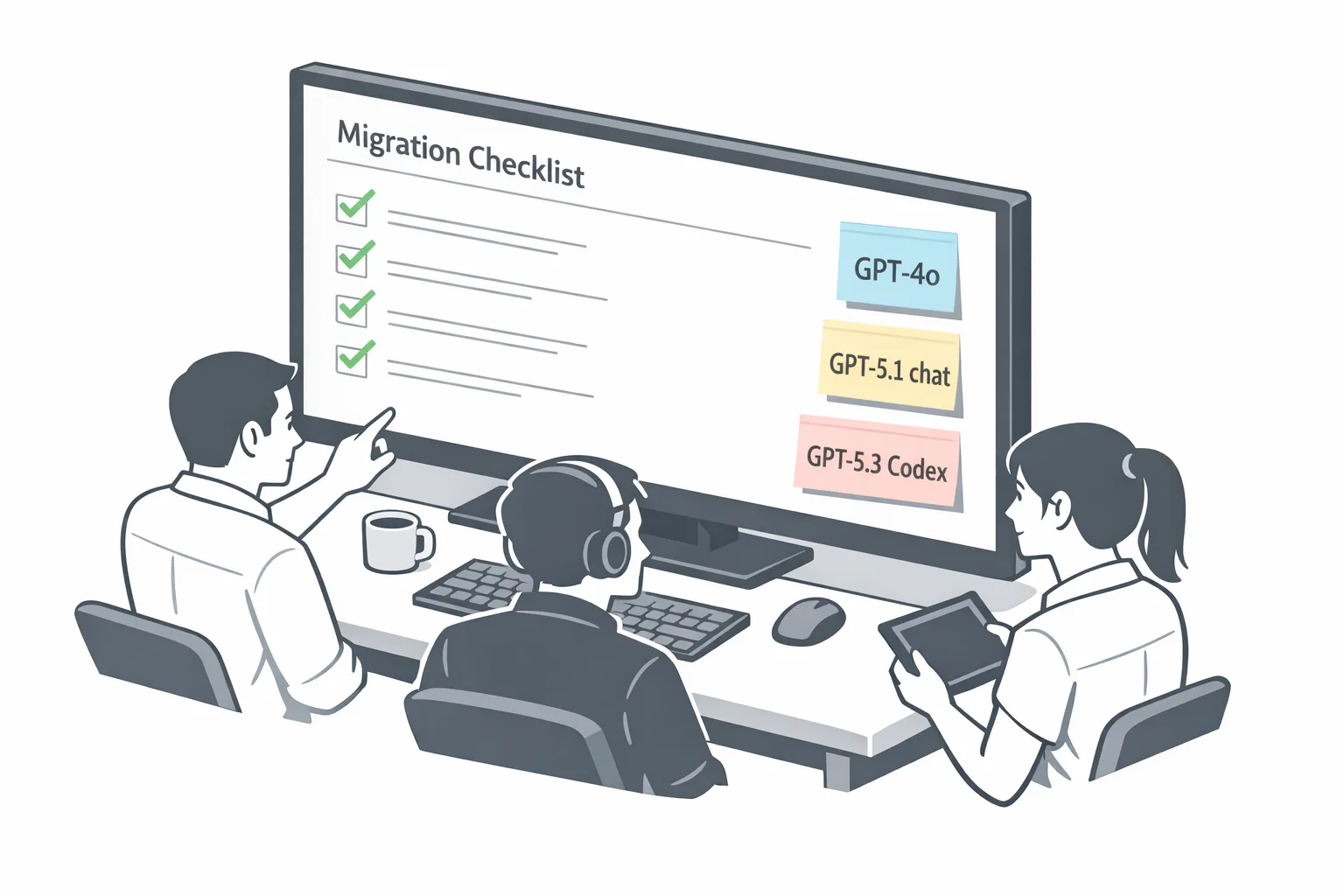
A lightweight migration checklist you can run today
Here’s a compact list for teams moving fast:
• Set your router default to gpt‑5.1‑chat‑latest. Keep a toggle for rapid rollback.
• Re‑run your top 20 prompts and freeze revised versions with IDs.
• Ship a 200‑example eval set with auto‑checks for correctness, PII leaks, and refusal rates.
• Canary 10% of traffic for 48–72 hours; cut tickets by clustering failure cases and prompt‑tuning once.
• Start a side‑trial of GPT‑5.3‑Codex on code‑heavy paths with strict tool contracts.
• Add budget guards: context limits, max tool hops, retry caps, and timeout fallbacks.
• Schedule a deprecation clean‑up to remove 4o code paths after one stable week.
Timelines, versions, and benchmarks worth tracking
Dates to know: February 5, 2026—GPT‑5.3‑Codex announced with a 25% speed boost and state‑of‑the‑art coding/agent benchmarks. February 13, 2026—GPT‑4o removed from ChatGPT, with certain enterprise carve‑outs until April 3, 2026. February 17, 2026—chatgpt‑4o‑latest snapshot removed from the API; recommended replacement named as gpt‑5.1‑chat‑latest. If you manage compliance docs or change logs, put these dates in writing.
Benchmarks to watch: SWE‑Bench Pro (multi‑language, contamination‑resistant), Terminal‑Bench 2.0 (shell navigation and execution), and OSWorld‑Verified (realistic OS tasks). If your product touches code or automates PC tasks, these are more relevant than generic multiple‑choice tests.
Risk, compliance, and incident readiness
New model, new risk posture. Rerun your safety matrix:
• Data handling: Confirm no unexpected logging of sensitive data from tools/plugins. Scrub PII at the router and obfuscate before storing eval artifacts.
• Rate limits: Provision headroom for spikes during canaries. Your traffic will fragment across models for a bit; don’t discover you’re capped the hard way.
• Output controls: Validate all externalized outputs—emails, UI messages, code patches—before they reach users or repos. Thin guardrails catch thick outages.
Have an incident drill ready: one‑click rollback, banner messaging for support, and a script for account reps. Most “AI incidents” turn into reputation hits because notification lags, not because the underlying issue was unfixable.
What this means for product and pricing strategy
Moving off GPT‑4o is more than a technical task. It’s a chance to realign value. If your app leaned on 4o’s warmth to drive engagement, invest a week to codify tone and formatting so your voice survives model swaps. If your moat is speed, lean into the 25% improvement where it cuts real user wait time—like interactive editors and debugging flows. And if your pricing is usage‑based, capture savings from fewer retries and shorter context via hard caps, not wishful thinking.
Need a template or a partner?
If you want a battle‑tested blueprint, we’ve documented our shipping playbooks publicly. For a mobile‑side example of deadline‑driven shipping, see our No‑Panic Ship Playbook. If you’re planning a broader AI roadmap change, explore how our team structures engagements on What We Do and browse representative outcomes in our Portfolio. When you’re ready to talk specifics—routing layers, eval harnesses, or staged rollouts—drop us a line via Contacts.
What to do next (this week)
• Flip your default model to gpt‑5.1‑chat‑latest and enable per‑task routing.
• Re‑baseline prompts and freeze the new versions behind IDs.
• Ship a 100–300 example eval set with auto checks and schedule it nightly.
• Run a 10% canary with a 72‑hour rollback window.
• Trial GPT‑5.3‑Codex on the small set of flows where code or tool use dominates.
• Book a post‑mortem to delete the old 4o path and update your runbooks with the February 2026 dates.
Model churn is the new normal. But with a router, a small eval set, and disciplined canaries, you can turn vendor timelines into mild product updates—not production fires. Ship the swap, keep your voice, and use GPT‑5.3‑Codex where it actually moves the needle.



Comments
Be the first to comment.