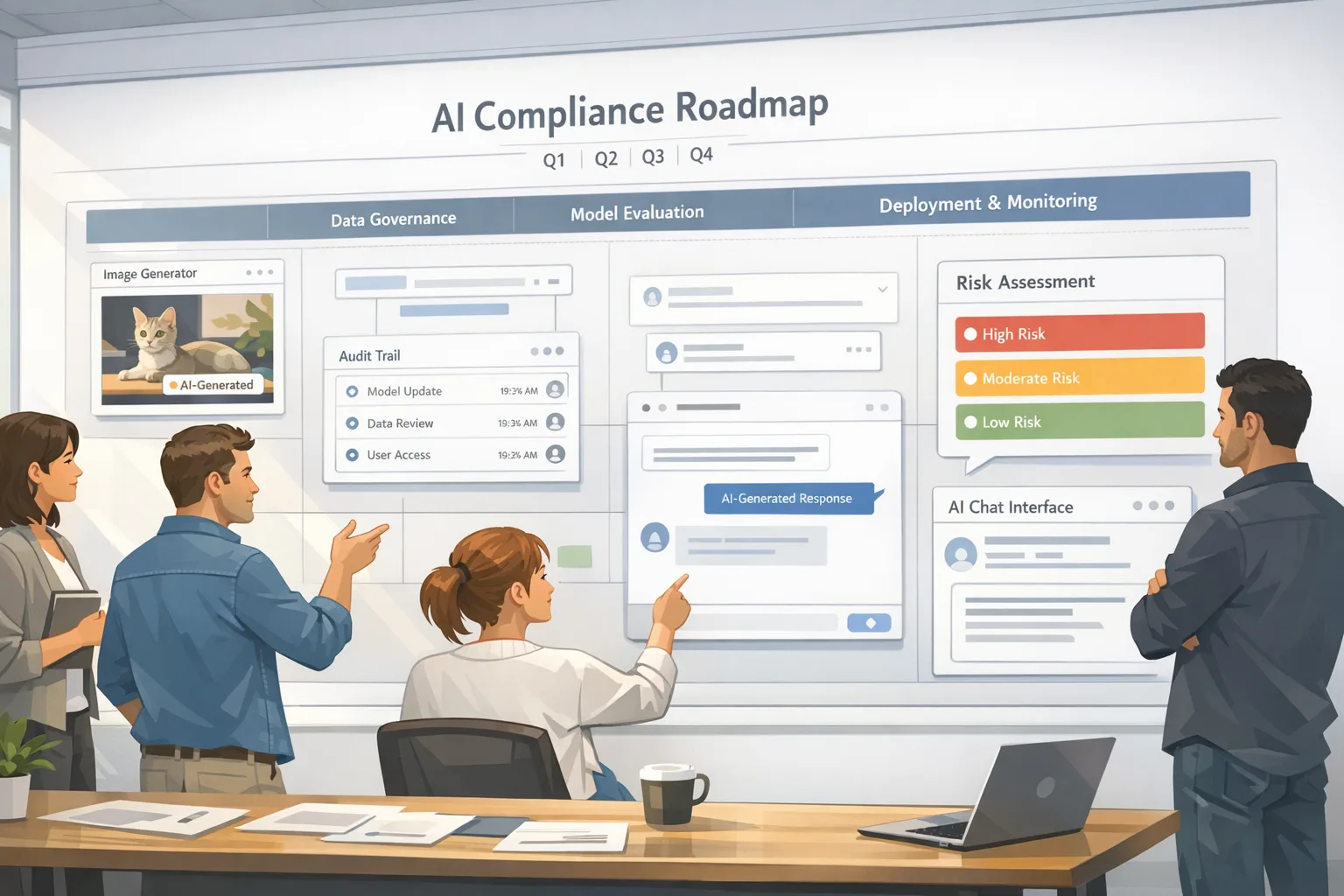
EU AI Act 2026: A Pragmatic Developer Plan
The EU AI Act 2026 deadline is the one software leaders can’t “wait-and-see.” On August 2, 2026, the majority of obligations kick in: transparency rules for generative and interactive systems, enforcement by EU and national authorities, and hard requirements for many high‑risk AI use cases. If you build or sell AI into the EU—or your outputs reach EU users—this guide gives you a focused plan to comply without derailing delivery.
What’s actually changing by August 2, 2026?
Three shifts matter for most teams:
First, Article 50 transparency obligations start applying. If your system is interactive (think chatbots or voice assistants) or generates/edits content (images, video, text, audio), you must clearly signal AI involvement and label synthetic outputs. You’ll need durable, user-visible markers and back-end provenance that survive basic transformations.
Second, enforcement moves from theory to practice. EU-level bodies and Member State authorities are empowered to supervise and sanction. Maximum penalties for the worst violations can reach up to €35 million or 7% of worldwide revenue, with additional tiers (e.g., up to €15 million or 3%) for other breaches. That’s not hypothetical; budget owners will notice.
Third, high‑risk AI systems—like those used in employment decisions, creditworthiness, essential services access, or critical infrastructure—face lifecycle controls: risk management, data governance, logging, human oversight, post‑market monitoring, and, where applicable, conformity assessment. If you’re anywhere near Annex III scenarios, assume a heavier lift.
Does the EU AI Act apply to U.S. or non‑EU companies?
Yes. If you place AI systems on the EU market or your outputs are used in the EU, you’re likely in scope. The Act is functionally extraterritorial. U.S. companies with EU users, B2B providers with EU customers, and API vendors whose outputs surface in EU apps all need a plan.
Key dates and milestones you can’t miss
Let’s anchor the timeline so your team can plan sprints against real calendar dates:
• February 2, 2025: Prohibited practices and AI literacy obligations apply. Bans include social scoring and certain manipulative or biometric uses in sensitive contexts.
• August 2, 2025: Governance rules and duties for general‑purpose AI (GPAI) models apply; Member States designate authorities and set penalties; the EU AI Office coordinates oversight of GPAI.
• August 2, 2026: Enforcement and the majority of rules start to bite—including Article 50 transparency and Annex III high‑risk duties for non‑embedded systems; each Member State should have at least one regulatory sandbox live.
• August 2, 2027: Extended deadline arrives for some high‑risk systems embedded in regulated products.
There’s ongoing talk in Brussels about sequencing tweaks via a “Digital Omnibus” package that could shift specific enforcement windows, particularly around transparency. Treat any adjustment as a bonus week, not a strategy. Your engineering plan still needs August 2026 readiness.
Primary keyword focus: EU AI Act 2026 for builders
When teams search “EU AI Act 2026,” they want the shortest path from confusion to ship-ready. So here’s the core: if your product includes an LLM front end, generates content for end users, or influences decisions about humans, you need labeling, provenance, human-in-the-loop controls, and auditable logs. The burden scales with risk. That’s the practical lens to manage every decision.
The 6-part delivery plan (8 weeks to momentum, 6 months to durable compliance)
1) Inventory your AI touchpoints (2 weeks)
Map where AI is used today and where it’s planned: interactive UIs, content generation, background ranking, fraud, eligibility, safety features. Tag each by: user-facing vs. back-end; content-generating vs. decision-support; and business criticality. Capture model sources (vendor, open source, in-house), training data lineage, and fine‑tune datasets.
2) Classify by risk and scope (1 week)
Use three bins to start: a) Article 50 transparency-relevant (interactive/generative); b) Annex III high‑risk candidates (employment, credit, essential services, law enforcement suppliers, etc.); c) everything else. Don’t overcomplicate the first pass—precision comes later.
3) Ship transparency that actually works (2–4 weeks)
• User-facing notices: Put a clear “AI” indicator at the point of interaction, not buried in footers.
• Output labels: Add robust markers for generated or materially edited content. Consider dual techniques: visible badges plus metadata/watermarks for downstream detection.
• Explainability snippets: Short, plain-language summaries of what the AI does, typical failure modes, and how users can report issues.
• Developer tooling: A single toggle in your content pipeline to mark or exempt outputs (e.g., for artistic or lawful exceptions). Bonus: document how the exemption is justified.
4) Stand up human oversight and logging for high‑risk flows (4–8 weeks)
For high‑risk candidates, design for intervention: checkpoint queues with human approval, rejection, or free‑text rationale; immutable logs covering inputs, model versions, prompts, confidence scores, human actions, and outcomes; and incident workflows for model drift or harmful outputs. If you already run security or privacy incident response, extend that muscle to AI incidents.
5) Put your model sources on a leash (2–3 weeks)
Formalize contracts/SLA addenda with model vendors: security posture, allowed training on your data, content provenance features, rate limits, uptime, and deprecation notices. For open-source or self‑hosted models, capture versioning, dataset documentation, and fine‑tune recipes. Maintain a “bill of materials” for AI components similar to an SBOM.
6) Create a lightweight AI conformity file (2 weeks, then ongoing)
Bundle the essentials: risk classification, intended purpose, data governance notes, transparency UX screenshots, oversight diagrams, logging schema, evaluation metrics, and a summary of known limitations. Keep it to 10–20 pages and store it with your product docs. When auditors—or big enterprise customers—ask, you’re ready.
“People also ask” — Straight answers
Do I need an EU legal entity to comply?
No. You need to comply if your systems or outputs are placed on the EU market or used by EU users. Representation and contact points may be required in some cases, but an EU subsidiary isn’t the prerequisite most teams imagine.
What counts as a high‑risk AI system?
Think of uses that materially affect people’s rights or access: hiring or promotion screens, credit or insurance pricing, essential public/private services, critical infrastructure safety components, or law enforcement uses. If your AI nudges ads or suggests a song, you’re likely not high‑risk. If it decides who gets a benefit, assume high‑risk and design accordingly.
Will watermarking alone satisfy Article 50?
Unlikely. Expect multilayer transparency: visible user notices, durable output markers, and disclosures when content is AI‑generated or materially manipulated. Watermarking without user-facing context or provenance is brittle.
Are the fines real?
Yes. The ceiling reaches €35 million or 7% of global revenue for prohibited practices; other material breaches can hit €15 million or 3%. Even if regulators start with guidance and warnings, enterprise customers won’t wait for a test case—they’ll require contractual assurances now.
Design patterns that hold up under scrutiny
Here’s what’s working in production:
• Inline disclosure chips that travel with content across share surfaces.
• “Why you’re seeing this” tooltips for recommender or ranking features.
• Reviewer cockpits for high‑risk flows: human decisions, prompts, and rationale in one pane with exportable logs.
• Periodic model evaluations on real data slices (not just synthetic benchmarks), with regression gates in CI.
And a few traps to avoid:
• Burying AI notices in privacy policies. The Act cares about user-level transparency, not legal boilerplate alone.
• Over‑labeling every UI with “AI” warnings—users tune it out. Place labels where interaction or outputs occur.
• Treating LLMs like static libraries. Models, prompts, and guardrails drift. Schedule evaluations, just like security patch cycles.
How this interacts with other 2026 changes
Compliance rarely lands in isolation. If you ship on Android, policy changes this year include age‑appropriate experiences grounded in the Age Signals API and additional forms for crypto apps. If you operate ad tech or measurement stacks, strategies for third‑party cookies and cross‑site identity are in flux. The takeaway: align your AI transparency UX with the consent and disclosure models you already use—consistency cuts friction for users and auditors.
For a deeper look at privacy tradeoffs in ads and analytics, see our playbook on third‑party cookies in 2026. If your mobile org is wrangling platform checks, our guidance on Google Play developer verification pairs well with the governance you’ll set up for AI. And if you need a repeatable patching cadence for libraries and SDKs that touch model security, our Android Security Bulletin fix plan outlines a tempo most teams can adopt.
Build once, prove many times: the audit‑friendly stack
Your goal isn’t paperwork; it’s evidence. Consider these components:
• Transparency service: a backend that stamps content with labels and embeds metadata/watermarks; logs label events for audit.
• Policy registry: a small service where product managers declare intended purpose, risk tier, and exemptions (with approval flow).
• Oversight hooks: queues and APIs that let humans stop or approve high‑risk actions, with durable journaling.
• Evaluation harness: prompts, fixtures, metrics, and thresholds that run in CI and scheduled jobs; snapshots stored with model versions.
• Customer disclosure kit: one‑pager templates, UX screenshots, and data sheets your sales team can drop into RFPs.
Data you should capture now (even if you’re small)
• Model provenance: name, version, provider, license, last update.
• Training/fine‑tune sources: categories, licenses, and any sensitive data controls.
• Input filters and content policies: what you block and why.
• Observed failure modes: hallucinations, bias patterns, prompt injection vectors; mitigations tried and results.
• Human oversight settings: who approves, when, and escalation paths.
• Post‑market monitoring: user feedback loops and incident definitions.

Framework: The 2–2–2 Compliance Sprint
When time is tight, use this cadence:
• Two weeks to inventory and classify. Create the system list, tag by scope and risk, and mark owners.
• Two weeks to ship hardening for transparency. Deliver visible user notices, output labels, and basic provenance logging.
• Two weeks to wire oversight for the riskiest flow. Add human approval and immutable logs to one high‑risk path. Prove it works, then scale.
That’s six weeks to meaningful progress, not theoretical compliance.
Edge cases worth sweating
• Synthetic edits vs. minor touch‑ups: Define “materially manipulated” for your product. Set thresholds (e.g., face swaps = label; exposure correction = no label). Document it.
• UGC platforms: If users upload AI content, you still need detection/label prompts and a way to respect exceptions (e.g., satire).
• Downstream partners: If you syndicate AI content, ensure labels and metadata survive transformations or have a re‑labeling contract clause.
• Accessibility: Disclosures must be perceivable—screenreader-friendly labels, not just icons.
What about general‑purpose AI (GPAI) models?
If you provide or significantly fine‑tune GPAI models, duties started in 2025 and are expected to be actively enforced from 2026 onward. Expect requests for training data summaries, security posture, and incident reporting. If you’re a downstream deployer using third‑party models, your obligations center on transparency to users, lawful purpose, and robust oversight where risk is high. Ask vendors for attestations and integrate them into your conformity file.
Practical procurement questions for your model vendor
• What transparency features are built in (watermarks, C2PA, metadata)?
• How do you version and notify for model changes?
• What’s your abuse monitoring and incident response process?
• Do you retrain on our data by default? Can we opt out?
• Can you support per‑tenant keys and on‑prem deployment if needed for risk control?
What to do next (this week)
• Appoint a product owner for AI compliance. Not legal—someone who ships.
• Stand up a single transparency pattern in one product surface and get PMF from users.
• Start your conformity file with screenshots and decisions you’ve already made.
• Ask model vendors for their transparency and incident docs; file them.
• Book a 60‑minute readout for leadership with your August 2, 2026 plan, with dates.
Need a hand?
If you want an outside push, our team runs focused compliance sprints—thirty days from inventory to shipped transparency and a repeatable review cadence. See what we do or reach out via services to set up a working session. We speak engineering and product first, and we won’t bury you in paperwork.
Zooming out
The EU AI Act 2026 isn’t a stop sign for innovation. It’s a demand for adult engineering: clear user disclosures, empirical evaluations, and real oversight when decisions can harm people. Teams that translate these requirements into crisp product patterns will not only avoid fines; they’ll sell faster in enterprise deals, reduce operational surprises, and earn user trust when it counts.


Comments
Be the first to comment.