Google Play External Links 2026: Fees, Flow, Ship
Developers asked for clarity; now we have enough to ship. Google Play external links and alternative billing are officially in play for U.S. users, with a compliance date of January 28, 2026 if you plan to link out or use non‑Play payments. The catch: new program enrollments, mandatory APIs, and a fee model you need to simulate before you cut over traffic. (support.google.com)
Here’s the thing—this is not a theory thread. If you serve U.S. Android users and want to keep linking or take non‑Play payments inside your app, you need a release plan, instrumentation, and a revenue model that holds up when the proposed fees switch on. You don’t need to bet the business; you do need to ship a compliant baseline with feature flags.
The short version: what changed, and when?
On October 29, 2025, a court order forced Google to let U.S. Play apps link to external content (web purchases or off‑Play app downloads) and offer alternative billing options. Google then formalized U.S. programs with an enrollment and compliance date of January 28, 2026 for developers who want to keep linking or keep alternative billing. A January 22, 2026 hearing may tweak fee schedules, but the developer‑facing programs and API requirements are active. (phandroid.com)
The injunction remains in effect into 2027, and higher courts have allowed key parts to proceed, which is why you’re implementing now rather than waiting for final appellate outcomes. (reuters.com)
External links vs. alternative billing: which path do you ship?
These are distinct programs and flows:
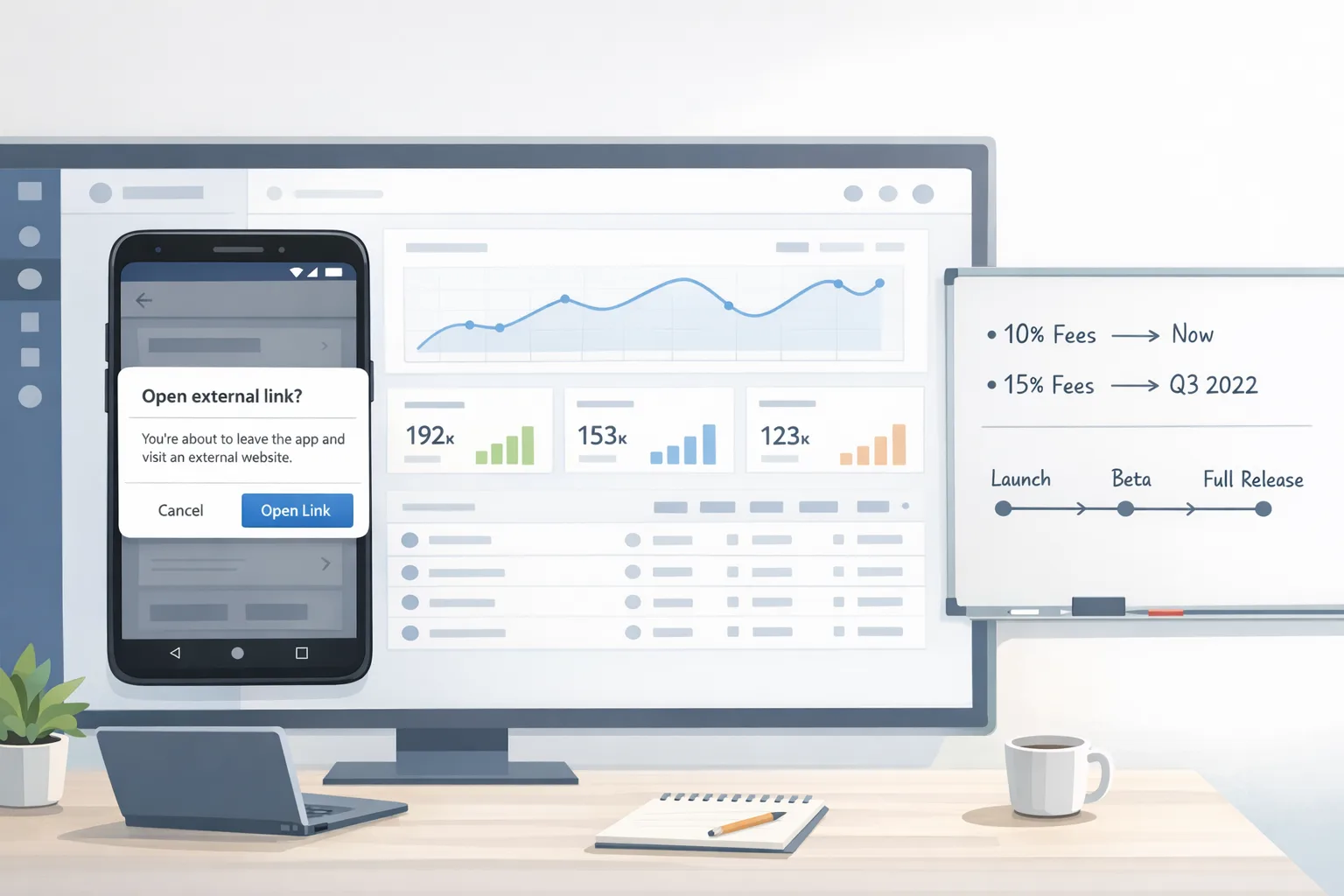
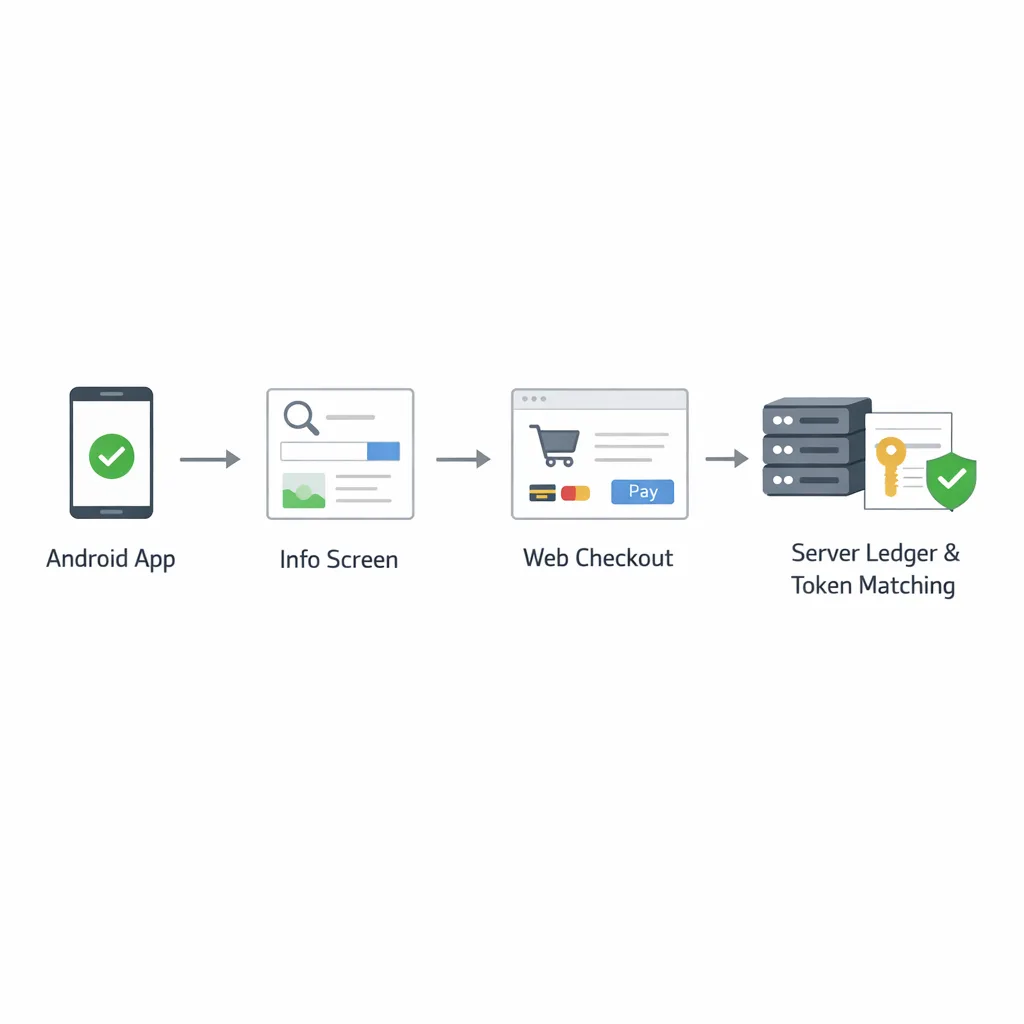
External content links let your Play‑distributed app present a Google‑mandated information screen and then deep‑link users outside the app to a web checkout or an app download not managed by the Play Store. You must integrate Play Billing Library (PBL) 8.2.1+ for the external links APIs, including eligibility checks and tokenized reporting. (developer.android.com)
Alternative billing keeps the user inside your app but lets you run your own processor. Google has dedicated alternative billing APIs and enrollment. PBL 6.2.1+ is the documented floor for those APIs, though you’ll likely standardize on the latest 8.x to avoid mixing client versions. (developer.android.com)
External payments (out‑of‑app, but initiated in‑app) gained explicit client support on PBL 8.3.0 (December 23, 2025), which added programmatic hooks for external payments enablement and reporting. If you’re serious about robust reporting and future fee compliance, target 8.3.0 for new builds. (developer.android.com)
Will I owe Google if I link out?
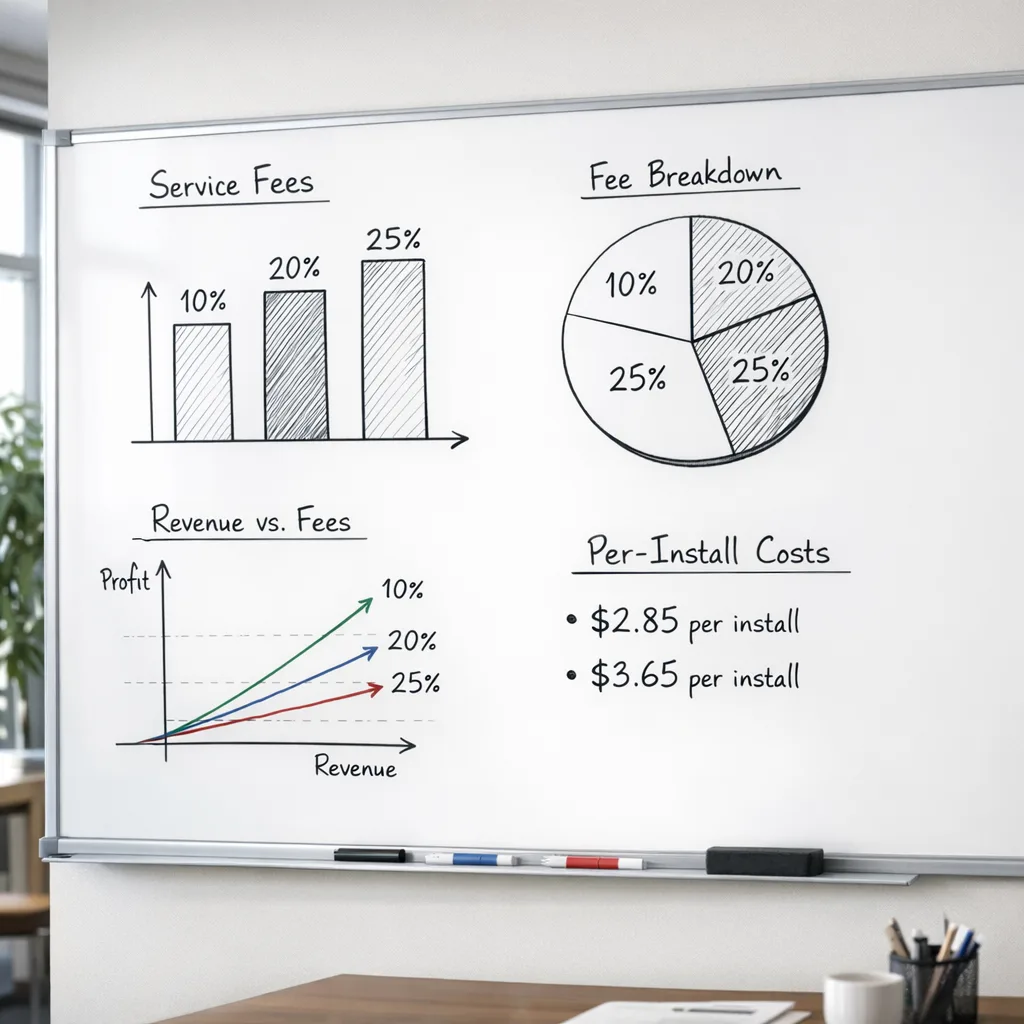
Yes—plan for it. Google has outlined a U.S. fee design tied to external content links and alternative billing, including ongoing service fees on qualifying transactions and per‑install fees if a user installs an external app within a defined window after clicking your in‑app link (reported figures: $2.85 per app, $3.65 per game within 24 hours). Google has signaled intent to assess 20% on most external‑link purchases and 10% on subscriptions, with alternative billing at 25%/10%. Final timing is subject to the court process, but you should model these numbers now. (theverge.com)
There’s also an Initial Acquisition Fee discussed in Google’s program materials: 3% on qualifying off‑Play transactions within the first six months after a Play‑managed app install, then 0% after six months. That fee is part of Google’s external offers/links framework and may apply to external‑origin transactions you attribute to your Play app. Keep it in your pro formas. (support.google.com)
Exact dates and versions you should put on the whiteboard
• December 9, 2025: Google posts a U.S. policy update launching External Content Links and expanding alternative billing programs; the compliance date to continue these behaviors is January 28, 2026. (support.google.com)
• December 23, 2025: PBL 8.3.0 release with explicit external payments classes and methods. If you plan to support external payments flows and future reporting, align your client to 8.3.0. (developer.android.com)
• January 22, 2026: Next hearing in the Epic v. Google matter; Google’s fee approach is still under judicial oversight. Ship with feature‑flagged economics. (theverge.com)
Engineering plan for external links you can run this week
Here’s a practical, minimal‑risk path we’ve shipped with teams:
1) Enroll your app(s) in the External Content Links program via Play Console. Validate that your app, content, and destinations meet the U.S. eligibility rules. (support.google.com)
2) Upgrade client to PBL 8.2.1+ (we recommend 8.3.0 to standardize) and wire up the new APIs: check program availability, create the reporting token, show the Google‑required info screen, then launch the link. This gives you a clean, auditable flow. (developer.android.com)
3) Back‑end reporting: accept the external transaction token and map it to your order ID. Store timestamp, SKU, price, currency, and acquisition cohort (≤6 months vs. >6 months since Play install). You’ll need this when Google begins assessing service and acquisition fees.
4) Feature‑flag routing: route a small percent of eligible users to the external flow. Keep the rest on Play Billing so you can A/B price, conversion, chargeback rate, and support load.
5) Monitoring: log the full funnel—eligibility check outcomes, information dialog impressions, click‑throughs, checkout starts, successful conversions, and return‑to‑app events. Tie these to first‑purchase cohorts for fee modeling.
Engineering plan for alternative billing (inside the app)
1) Enroll in the alternative billing program in the U.S., acknowledging user protections and disclosures. (developer.android.com)
2) Integrate the alternative billing APIs and the required disclosure dialog. Keep Play Billing available if you want a user‑choice model. PBL 8.x reduces edge‑case pain going forward. (developer.android.com)
3) Processor abstraction: swap a single payments facade with provider adapters (Stripe/Adyen/Neon/Paddle). Normalize receipt events and failure codes to your entitlement service. You’ll be glad you did when policy changes land.
4) Server attribution: tag every non‑Play purchase with channel and cohort, so you can apply Google’s prospective service rates and know exactly when “saving 3–5%” turns into “paying more than GPB.”
Fee math: realistic scenarios to model in 2026
Let’s get practical. Assume the external‑link service fee is 20% for non‑subscription digital items, 10% for subscriptions; alternative billing is 25%/10%; and the Initial Acquisition Fee is 3% for ≤6 months after Play install. Those are the numbers Google has surfaced publicly or through reporting; use ranges in your sensitivity tests until the court locks specifics. (theverge.com)
Scenario A: you sell a $50 one‑time digital item via an external web checkout. If the buyer is within six months of their Play install, model 13% to Google (3% acquisition + 10% ongoing service), or $6.50. Add your processor’s ~2.9% + $0.30; call it roughly $8.00–$8.50 total platform cost. If your historical Play fee was 30% ($15), you still win—until per‑install external download fees or a 20% transaction rate kicks in. (support.google.com)
Scenario B: a $15 monthly subscription on alternative billing. At 10% ongoing, your platform cost is $1.50 plus processor fees (~$0.74 at 2.9% + $0.30), totaling about $2.24. Versus 15% on Play ($2.25) it’s a wash. If Google applies 25% to non‑subscription items under alternative billing, in‑app one‑time purchases likely favor Play Billing unless you recapture margin elsewhere. (techcrunch.com)
Scenario C: you link to install another app off‑Play. If a user clicks your in‑app link and installs within 24 hours, model a fixed fee—$2.85 per non‑game app, $3.65 per game. Ten thousand game installs would be $36,500. Price that against your LTV and CAC, and consider pushing installs to web/email re‑engagement beyond the attribution window if you’re margin‑sensitive. (theverge.com)
Common pitfalls and edge cases
• Not checking eligibility: the APIs require that you confirm user eligibility before presenting external links; failing this can trigger policy issues and broken UX. (developer.android.com)
• Mismatched client versions: mixing a PBL 8.2.1 external‑link flow with older billing components increases QA surface and policy risk. Standardize on 8.3.0 if you’re touching payments this quarter. (developer.android.com)
• Incomplete reporting: if you don’t store Google’s external transaction token and reconcile it with your orders, you’ll be blind when Google starts assessing fees. Build that mapping now, even if you don’t send anything back yet.
• Support load spike: external checkouts mean new refund paths. Staff for first‑week “where’s my purchase?” tickets and document the difference between Play and non‑Play refunds in your help center.
People also ask
Do I have to keep Google Play Billing available?
For alternative billing, Google supports both “your billing only” and a user‑choice model depending on enrollment and configuration. Many teams keep GPB available to reduce friction and preserve familiar flows while they test alternatives. (developer.android.com)
What API level of Play Billing Library do I need?
External content links require PBL 8.2.1+; external payments hooks arrived in 8.3.0; alternative billing APIs work with 6.2.1+, but aiming at the latest 8.x is prudent. (developer.android.com)
Will Google’s fees definitely apply on January 28?
As of early January 2026, Google has outlined fees and timelines, but some elements await judicial oversight; reporting indicates fees may be applied after programs and enforcement mechanisms are in place. Ship the integrations now and model fees so you can switch pricing by flag. (theverge.com)
A quick Apple note: don’t miss the Jan 31 age‑rating cutoff
If you also ship on iOS, you’ve got another clock. Apple’s new age‑rating system requires developers to complete updated App Store Connect questions by January 31, 2026, or you’ll be blocked from submitting app updates. Make sure your content answers reflect any new AI/chat features and parental controls. (developer.apple.com)
Need a step‑by‑step? We published a ship‑ready checklist here: App Store Age Rating Update: Ship by Jan 31.
Framework: the 3x3 rollout for Google Play external links
Use this to launch in days, not weeks.
Phase 1 — Compliance Baseline (Week 1)
- Enroll programs; enable PBL 8.3.0; add eligibility checks and info dialog; route 5% of eligible traffic via feature flag. (support.google.com)
- Instrument external tokens; store cohort (≤6 months vs. >6 months); log funnel metrics.
- Publish a brief help article clarifying refund paths and contact options.
Phase 2 — ROI Validation (Weeks 2–3)
- Run price tests on external vs. Play flows where policy allows; measure conversion deltas, chargebacks, and support time per order.
- Model fees at low/mid/high assumptions (10–13% subs, 20–23% items, $2.85/$3.65 installs) and compare to GPB status quo. (theverge.com)
- Evaluate offering your billing only vs. user‑choice, by SKU.
Phase 3 — Scale & Safeguards (Weeks 4–6)
- Move to 25–50% external routing for SKUs with clear lift; maintain Play for the rest.
- Add fraud rules and velocity checks to your processor; enable proactive support macros for top five failure reasons.
- Set kill switches for fee activation; if Google flips the switch, your pricing can update without a new build.
Tooling and docs that actually help
Bookmark the official release notes for PBL 8.3.0 so your team isn’t guessing about method names and contracts. (developer.android.com)
Read Google’s December 9 policy note and the External Content Links integration guide; keep both open during implementation. (support.google.com)
For deeper planning, our breakdowns cover engineering and finance angles: the 2026 Builder’s Guide, the engineering plan for links, and a detailed fees, flows, ROI explainer. If you’re shipping before January 28, also skim what to ship by Jan 28 so you don’t miss a console checkbox.
Risks, gotchas, and how to mitigate them
• Policy drift: program terms may evolve under court supervision. Keep your pricing and routing behind a remote config and isolate fee calculations in one service so you can pivot the numbers in minutes. (theverge.com)
• Attribution disputes: design deterministic mapping between Google’s external token and your order. If attribution drives fees, you need transparency for finance and for potential audits.
• UX friction: the information screen is non‑negotiable. Use copy and design near your CTA to pre‑set expectations so the system dialog doesn’t look like a surprise roadblock. (developer.android.com)
• Support for dual flows: alternative billing and Play Billing side‑by‑side is more complex. Make entitlement idempotent and reconcile on both provider webhooks and client acks to avoid double‑grants.
What to do next
• Lock your January 28 release plan; enroll programs; upgrade to PBL 8.3.0; ship the info dialog + eligibility checks. (support.google.com)
• Run three fee models (best/base/worst) for your top five SKUs; include the 3% Initial Acquisition Fee and potential $2.85/$3.65 install fees. (support.google.com)
• Keep Play Billing live for high‑friction flows; test external links on SKUs where your web conversion is already strong.
• On iOS, finish the age‑rating questionnaire by January 31, 2026 so your release train doesn’t stall. (developer.apple.com)
Mobile storefront rules finally give you some room to maneuver in the U.S. Use it. Ship a compliant base, measure the deltas, and be ready to flip economics on a dime. That’s how you win amid policy churn.

Comments
Be the first to comment.