Android January 2026 Security Update: Ship Fast
The Android January 2026 security update is live, and it’s not a routine patch. The Android Security Bulletin (security patch level 2026‑01‑05) includes a critical Dolby DD+ decoder vulnerability now recognized in the platform’s 0‑click attack surface. Pixel’s companion bulletin adds fixes that touch Bluetooth Fast Pair. If you build or operate Android apps, treat this month as an action item—not a note. (source.android.com)
What changed in the Android January 2026 security update?
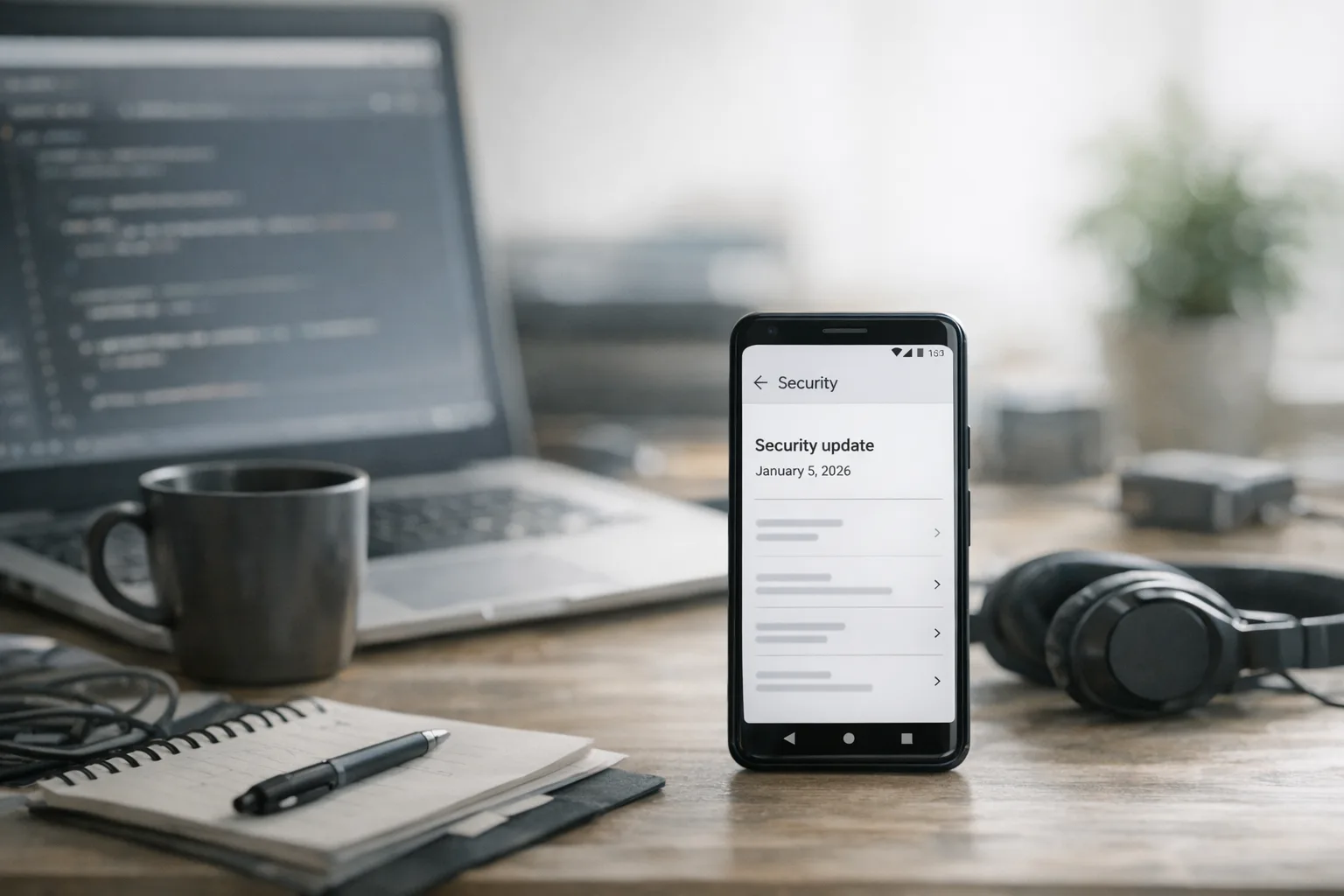
Google published the Android Security Bulletin on January 5, 2026, declaring 2026‑01‑05 as the patch level that addresses the month’s issues. Notably, a Dolby Digital Plus (DD+) component is listed as critical (CVE‑2025‑54957) with Dolby-specific details referenced. Google states partners are notified at least a month in advance, and source changes land to AOSP following publication. (source.android.com)
On January 12 (updated January 15), Google’s Pixel Update Bulletin confirmed all supported Pixel devices will receive the 2026‑01‑05 level. That bulletin also enumerates Pixel-specific vulnerabilities, including a critical Bluetooth item (CVE‑2025‑36911) commonly described as the “WhisperPair” class affecting accessories that use Fast Pair. (source.android.com)
OEMs have started rolling out their builds. Samsung’s January 2026 SMR notes application of Google patches, explicitly including CVE‑2025‑54957 as critical. Coverage is expanding model by model, with reports of roughly five dozen total fixes on recent Galaxy lines. Don’t wait for a user base to be 100% patched before you adjust your own app-level exposure. (security.samsungmobile.com)
Primary risk: why the Dolby bug is different this time
Security people have argued for years that media decoders rarely translate to practical mobile compromise. This month, Project Zero showed why that attitude ages poorly. In a three-part series, researchers demonstrated a 0‑click exploit chain targeting Pixel 9 where the Dolby UDC bug (CVE‑2025‑54957) is used for code execution inside the mediacodec sandbox, then escalated further. The series explicitly notes these issues were fixed as of January 5, 2026. (projectzero.google)
What’s the practical insight for app teams? Your messaging, media, and VoIP apps often pre-process attachments for previews, transcription, and search. That “convenience” pulls decoders into the 0‑click path—files can be parsed before a user taps anything. For the Dolby case, inbound audio with malformed DD+ payloads can be enough to trigger the vulnerable path on unpatched devices. Yes, the OEM and platform fix it, but you control whether your app touches risky content eagerly or lazily. (projectzero.google)
Secondary risk: Fast Pair/“WhisperPair” implications for enterprises
KU Leuven’s COSIC team published research on “WhisperPair,” a set of vulnerabilities and mis-implementations related to Fast Pair accessories that can enable stealth pairing, audio hijack, and in some cases location tracking via the Find network. Pixel’s January bulletin lists a critical Bluetooth information disclosure CVE as part of the month’s fixes, and the research team says patches and firmware updates exist but require accessory vendor updates. In managed fleets, uncontrolled accessories are now a policy and inventory problem, not just a user preference. (source.android.com)
Android January 2026 security update: what’s in scope?
To ground the plan, here are the anchor facts you can treat as stable:
- Android Security Bulletin published January 5, 2026; security patch level 2026‑01‑05 addresses the listed issues, including the Dolby CVE. (source.android.com)
- Pixel Update Bulletin published January 12, updated January 15; all supported Pixels receive 2026‑01‑05; Bluetooth/WhisperPair-related CVE is called out as critical. (source.android.com)
- Samsung’s SMR for January confirms inclusion of CVE‑2025‑54957 as critical; broad rollouts are in progress across models. (security.samsungmobile.com)
People also ask: is this only an Android problem?
The vulnerable Dolby component (UDC) appears across platforms. Project Zero mentions integrations spanning Android, iOS, Windows, and more. The Android angle is urgent because typical Android message/media handling places audio decoders in the 0‑click surface by design. Outside Android, risk still exists where the same UDC versions are integrated—and vendors have shipped patches since late 2025—but exploitation paths differ. Coordinate with your desktop and iOS teams, especially if you parse DD+ server-side. (projectzero.google)
People also ask: can I mitigate WhisperPair by toggling settings on phones?
Partially. The vulnerable behavior identified by researchers often lives in the accessory firmware and vendor implementations. That means mitigation requires accessory updates or avoidance policies. Enterprise MDM can restrict unapproved Bluetooth accessories; consumer apps can warn when sensitive features (voice notes, secure calls) detect untrusted audio endpoints. But the durable fix is firmware from the accessory vendor. (esat.kuleuven.be)
People also ask: was Dolby’s severity really “critical”?
Severity differs by context and assessor. Dolby’s advisory history originally framed the bug with lower severity under certain assumptions; the Android bulletin lists CVE‑2025‑54957 as critical in the mobile context, and multiple government trackers show high CVSS scores. For our purposes—mobile apps where audio is parsed 0‑click—treat it as critical until your fleet patch rates clear 95%. (source.android.com)
Framework: the 72‑hour hotfix plan for mobile product teams
Here’s a focused, shippable playbook we’ve used with clients when platform patches are rolling out but not yet ubiquitous.
0) Assign owners and a timer
Put security, Android engineering, QA, SRE, and support in a small room (or Slack/Meet) for 72 hours. Define a single decision log. Timebox everything.
1) Reduce eager decoding in your apps
Anywhere you auto-transcribe or preview audio, gate it behind explicit user action for the next two releases. Disable background pre-processing of unsolicited audio on devices below 2026‑01‑05 until they upgrade. If you must analyze media, sandbox it in a non-privileged worker process with strict SELinux and tightened seccomp profile where applicable. (source.android.com)
2) Harden your inbound media pipeline
Server-side, reject malformed DD+/EAC‑3 payloads and strip unknown EMDF containers. Put a size, duration, channel count, and bitrate budget on what your backend accepts. Log rejects by user agent and Android patch level so you can measure exposure in real time. (projectzero.google)
3) Accessory hygiene: prefer known-good endpoints
If your app supports voice messages, calls, or meetings, prompt users on first run after update: “Use trusted audio devices only; update headphone firmware.” In enterprise builds, block unverified Fast Pair accessories via MDM until vendor firmware versions are on an allowlist you maintain. Link to a help page that explains why. (esat.kuleuven.be)
4) Crash and exploit telemetry
Add signatures for suspicious audio parsing failures (decoder SIGSEGV around DD+/EMDF paths) and flag them by patch level. If you see a spike on pre‑2026‑01‑05 devices, temporarily disable media previews server-side for that cohort and show a UX banner prompting a system update. (source.android.com)
5) In‑app nudge campaigns
Don’t just rely on OS notifications. If your Android app reaches millions, your banner can move patch adoption. Detect ro.build.version.security_patch and show a dismissible card: “Security update available—fixes media & Bluetooth risks.” Tie to OEM update instructions. (source.android.com)
Technical notes teams should know
Why the Dolby bug is exploitable in practice: Project Zero’s write‑up explains how EMDF parsing enables a controlled out‑of‑bounds write via an integer overflow in the UDC’s allocation logic, with a second “leak” capability that makes exploitation more reliable. For app architects, the point isn’t the line numbers—it’s recognizing that decoders can operate on untrusted content in background flows you created for UX. Audit those flows. (projectzero.google)
On the Bluetooth side, WhisperPair illustrates that protocols and certifications don’t guarantee uniform enforcement across vendors. Some accessories accept pairing in states they shouldn’t, which collapses your threat model for “trusted audio endpoints.” An app that assumes “headphones paired == safe microphone” might be wrong if an accessory silently pairs nearby. (esat.kuleuven.be)
Priority matrix: who needs to move first?
Use this to triage effort today:
- Messaging/communications apps with audio previews, voicemail, or transcription: highest priority to gate and sandbox parsing paths until fleet patch rate catches up. (projectzero.google)
- Enterprise/MDM providers: publish a policy template restricting unverified Fast Pair accessories on Android until firmware is updated; provide a remediation checklist for IT. (esat.kuleuven.be)
- Media/streaming apps that accept user uploads: enforce strict media validation and rate‑limit unusual DD+ payloads. (projectzero.google)
- Every Android app with large DAU: ship in‑app OS‑update nudges keyed to patch level; measure impression→update click‑through. (source.android.com)
How to talk to leadership and customers
Keep it simple: “A platform update on January 5 addresses media and Bluetooth risks. We’ve limited background audio parsing, tightened server checks, and are nudging users to update. No user action is required to keep using the app, but updating the OS and accessory firmware gives the strongest protection.” This is a trust moment. Don’t bury it in a changelog.
What to do next (this week)
- Ship a hotfix that disables automatic audio preview/transcription on devices below 2026‑01‑05, and add server-side DD+ validation now. (source.android.com)
- Publish a help article or in‑app card telling users to update accessory firmware; include examples for popular vendors. (esat.kuleuven.be)
- For managed fleets, push an MDM rule to block new Fast Pair accessories until approved. (esat.kuleuven.be)
- Instrument telemetry to track crash patterns in media decode and correlate with OS patch level.
- Do a tabletop exercise: “What if a crafted audio file hits our app today?” Make sure customer support has a script.
Where we can help
If you need a hand triaging, our team has shipped enterprise-grade mitigations during active platform rollouts. See how we approach rapid security hardening on our services page, and browse relevant playbooks like January 2026 Patch Tuesday: What to Fix First and Node.js Security Release: What to Patch Today. If you’re planning 2026 platform transitions, our AOSP Biannual Releases: 2026 Shipping Playbook will keep your schedule sane, and you can always reach out via contact.
SEO note for the humans skimming
If you’re scanning for the key term: Android January 2026 security update. That’s what you’re dealing with. Patch level is 2026‑01‑05, Dolby CVE‑2025‑54957 is marked critical in Android, and Pixel’s bulletin highlights a critical Bluetooth Fast Pair CVE. Translate that into shipping decisions today. (source.android.com)
Zooming out
We’ve reached the point where “media support” equals “attack surface,” and accessory ecosystems amplify risk in ways most app owners don’t model. The fix is not panic; it’s disciplined engineering: reduce eager parsing, validate aggressively, guide users to the patch, and instrument everything. Do that this week and the next Dolby‑class bug will feel like a maintenance window, not a fire drill.




Comments
Be the first to comment.