Markdown for Agents: Ship AI‑Readable Pages Now
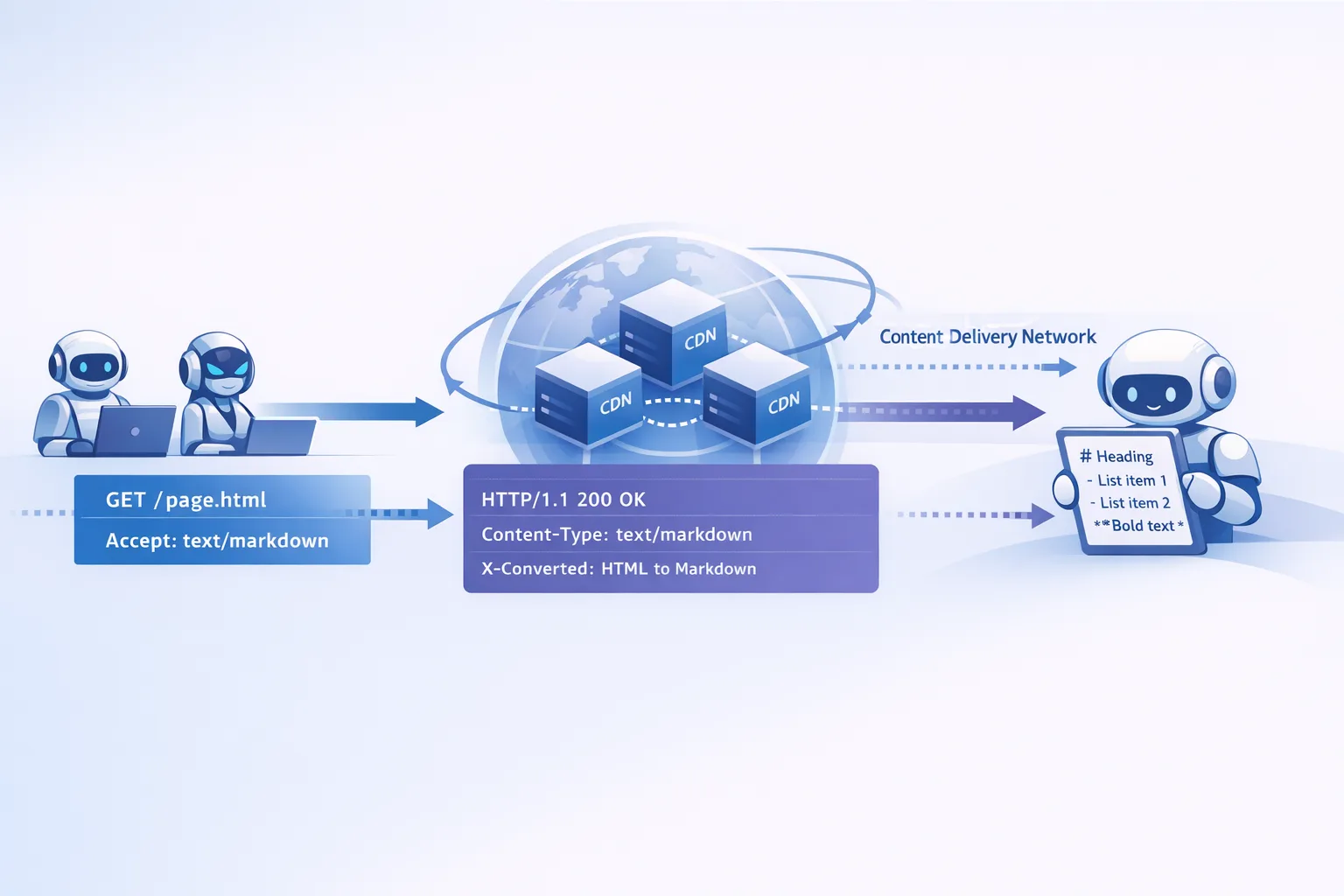
AI crawlers don’t want your CSS. They want the meaning. With Markdown for Agents, announced on February 12, 2026, websites can respond to requests that include Accept: text/markdown with a compact Markdown view of the same content. In Cloudflare’s own example, a page dropped from roughly 16,180 tokens as HTML to about 3,150 as Markdown—an ~80% reduction. That change alone makes your content cheaper and faster for agents to ingest, which increases the odds your pages power answers, summaries, and agentic automations.
Markdown for Agents: what it is and what it changes
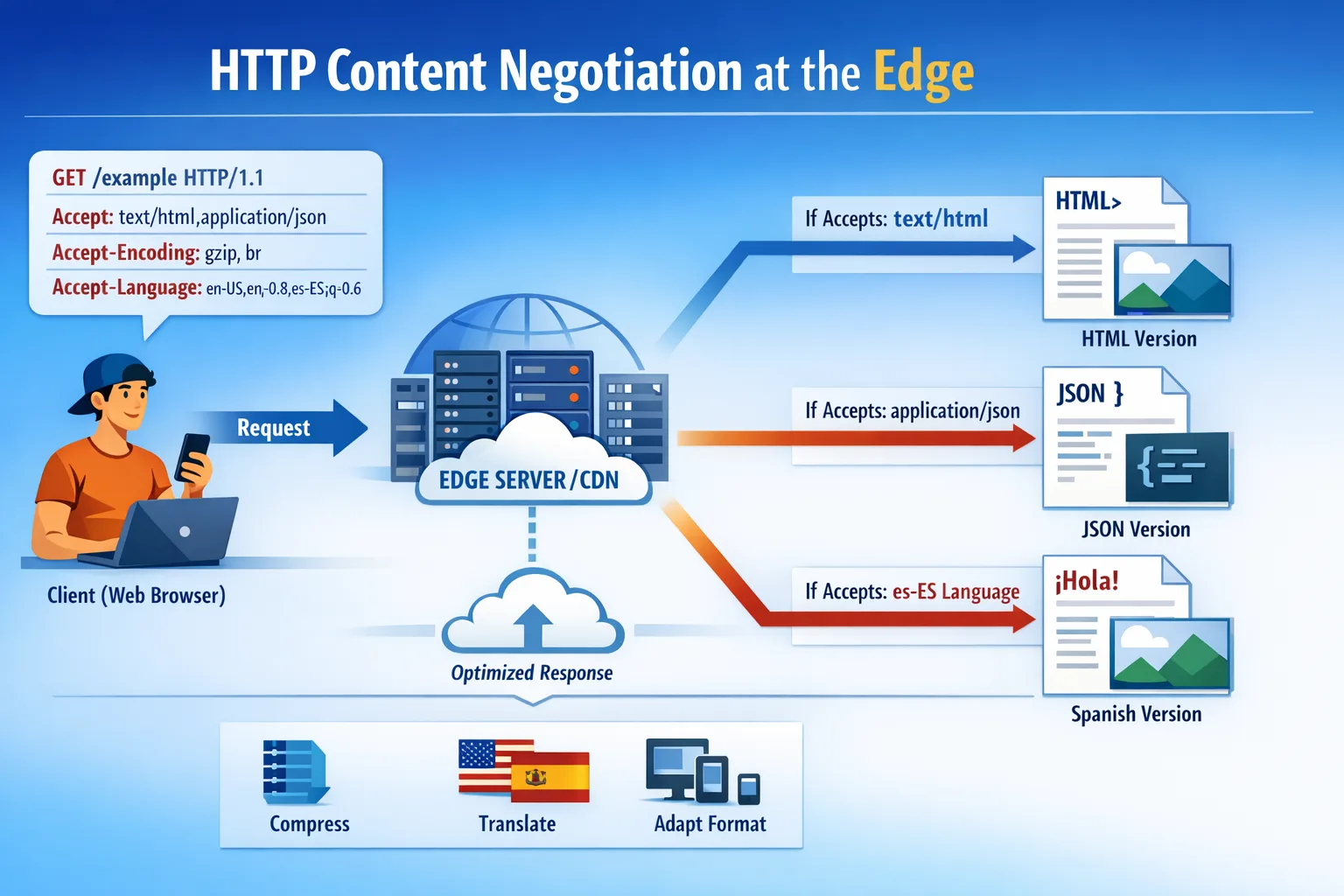
Traditionally, AI systems scrape HTML, strip tags, and try to reconstruct structure. That’s wasteful and brittle. Markdown for Agents formalizes a simpler handshake: when an agent sets Accept: text/markdown, your edge or origin serves a semantically faithful Markdown representation—headings, lists, links, code blocks, tables—without layout chrome.
Why this matters now: agent traffic is growing, and cost matters. LLM contexts are metered by tokens. If your page requires five times fewer tokens than a competitor’s, your content is more likely to be selected for inclusion in an answer or used inside an automation. You don’t need to guess what to remove; content negotiation makes it explicit and reversible, and humans still get full HTML.
The minimal header contract
If you’re implementing this today, your first mile is small:
- Requests from agents include
Accept: text/markdown. - Your response returns
Content-Type: text/markdown; charset=utf-8. - Optionally expose
x-markdown-tokens: <approximate-token-count>so agents can budget context windows before parsing. - Set a
content-signalheader to express usage intent, for examplecontent-signal: ai-train=yes, search=yes, ai-input=yes. This clarifies how your content may be used by AI systems in training, indexing, or live answers.
You can generate Markdown server-side from your CMS, at the edge via a transform, or by storing dual formats alongside each other. The key is parity: the Markdown must carry the same substance as the HTML view.
Use cases that win immediately
Some properties see outsized ROI right away:
- Docs and knowledge bases. API references, guides, and runbooks already mirror Markdown internally. Serving Markdown natively eliminates client-side cleanup.
- Product and pricing pages. Agents extract features, tiers, limits, and SLAs. Structured Markdown makes this precise and lowers hallucination risk.
- Support and policy pages. Refund windows, shipping cutoffs, privacy clauses—agents need exact text. Markdown keeps the words intact without the template noise.
Seven-day rollout plan (works for most stacks)
Here’s the thing: you don’t need a big-bang migration. This is a one‑week, low‑risk increment if you treat it like any other channel rollout.
Day 1: Pick scope and owners
Start with a controlled slice: /docs/** and /blog/** or your /kb/**. Name an owner in content, web platform, and SEO. Create a short checklist in your issue tracker.
Day 2: Generate Markdown
Choose one of three patterns:
- Dual-render at origin. If your CMS uses Markdown internally (e.g., MDX), expose the raw Markdown for agent requests and continue rendering HTML for browsers.
- Edge transform. Convert HTML to Markdown at the edge for eligible paths. This avoids touching templates but requires careful QA.
- Pre-rendered Markdown. Store a Markdown variant next to the HTML (e.g.,
post.md+post.html) and route byAcceptheader.
Day 3: Wire content negotiation
On your CDN or backend router, add logic to detect Accept: text/markdown and swap the response pipeline to the Markdown source. Return Content-Type: text/markdown, include x-markdown-tokens if you can compute it, and set content-signal with your current policy.
Day 4: Caching without surprises
Don’t ship until caching is right. If you use Cloudflare, be aware that simply returning Vary: Accept isn’t enough on many plans; Cloudflare’s default cache key doesn’t consider most Vary values. Two safe options:
- Enterprise custom cache key. Add the
Acceptheader (or a normalized value liketext/markdown|text/html) to the cache key so each variant is cached separately. - Query-param rewrite. For non‑Enterprise setups, rewrite Markdown requests to a canonical query such as
?_fmt=mdwhenAccept: text/markdownis present. That forces distinct cache keys for HTML and Markdown while keeping URLs stable for users.
Either way, document the rule and add an automated test that asserts two cache entries exist for the same path with different formats.
Day 5: Quality gates
Create a Markdown parity harness. For each chosen URL, run:
- Fetch HTML and collect the main article node (server-side or via a headless browser).
- Fetch Markdown via
Accept: text/markdown. - Compute semantic diff on blocks: headings, list items, code fences, table cells, and link HREFs. Fail the build if differences exceed a threshold (e.g., missing paragraph, truncated code block).
Add a profanity/PII scan to the Markdown stream so snippets from comments, banners, or UGC can’t leak into agent answers by accident.
Day 6: Observability hooks
Log rate, paths, and user agents for Markdown responses. Track average x-markdown-tokens by path to spot regressions. Alert if the token count jumps above a set percentage week over week—this often flags a template regression or a noisy widget that slipped in.
Day 7: Ship behind a flag
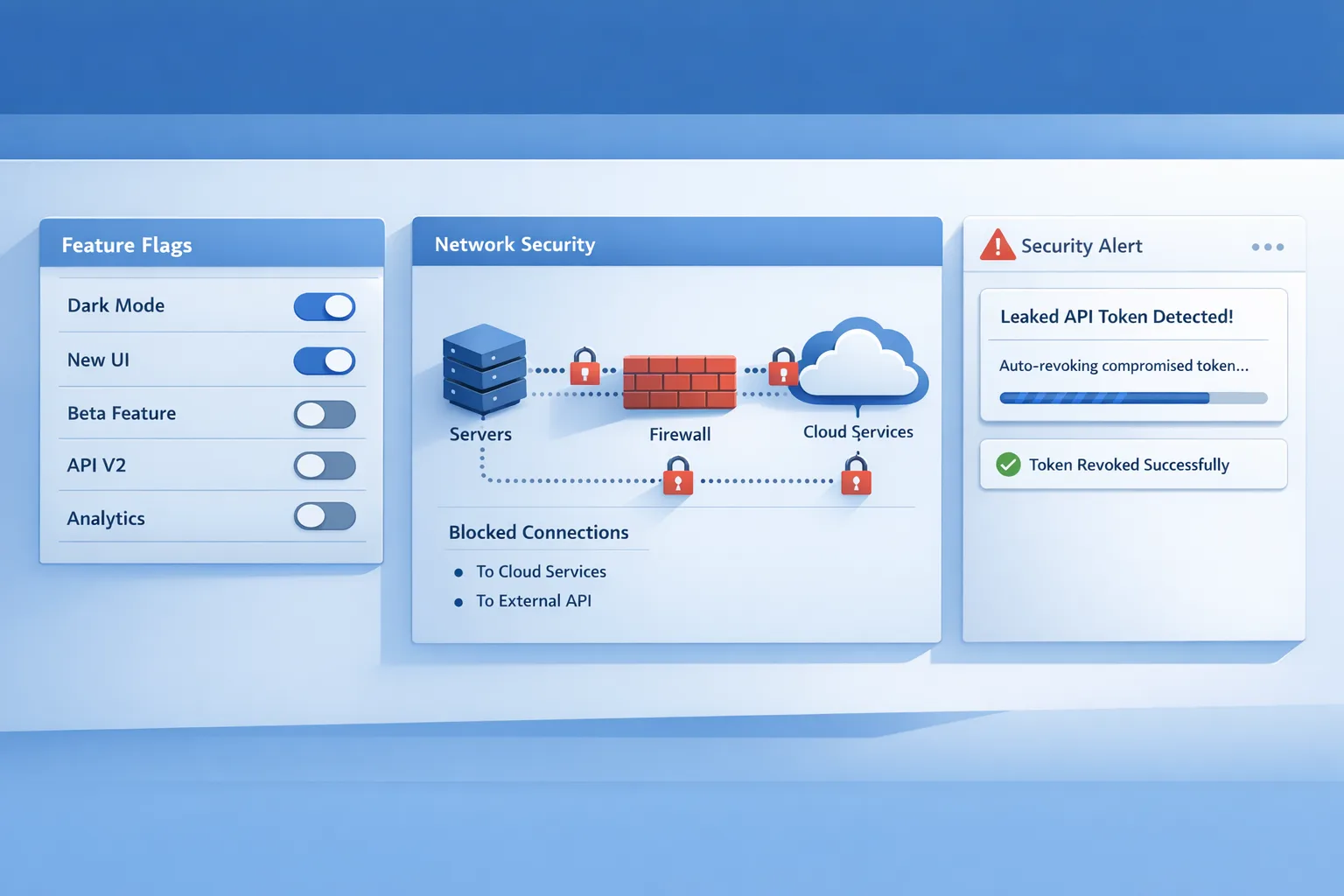
Roll out to 5–10% of eligible traffic first. If your platform supports feature flags and egress controls, use them. We’ve written about safe launches and environment guardrails in our guide to shipping with flags and sandboxed egress. Once metrics are green, ramp to 100% of agent traffic for the chosen paths.
Guardrails: keep parity and avoid “AI cloaking”
Markdown must match human-visible content in meaning and claims. Auditors and search engines have long memories of the old black‑hat trick: serving one thing to crawlers and another to users. Your Markdown can omit layout, navigation, and ads, but it shouldn’t change product specs, prices, or policies. Keep a weekly job that fetches a sample set of URLs as both HTML and Markdown and flags deltas outside your rules (e.g., missing pricing tables).
Architecture options and trade‑offs
1) Edge transform
Pros: Zero template changes; easy to scope by route; instant backfill of legacy content. Cons: Transform quality varies; must sanitize aggressively; compute cost at the edge; tune caching carefully.
2) Origin dual-render
Pros: Highest fidelity; simpler cache behavior; easy to add structured hints. Cons: Requires template work; CI tests to keep both paths green.
3) Stored Markdown
Pros: Deterministic output; fast; versionable. Cons: Editorial workflow must manage two artifacts; risk of drift without pre‑publish checks.
Performance notes for server‑rendered apps
If your site streams server-rendered content (e.g., React Server Components or Next.js app router), you’ll see a second‑order win by reducing transform overhead in the response pipeline. Recent engineering work shows that replacing Promise‑heavy WebStreams paths with Node’s native streams can yield order‑of‑magnitude throughput gains for common 1KB chunk patterns. If you’re streaming HTML and Markdown variants from the same backend, faster streaming makes transform and delivery costs negligible compared to the model’s token cost.
FAQ: quick answers execs and engineers ask
Will this affect our Google rankings?
No, not if you implement it correctly. Human users and search crawlers requesting HTML still receive HTML. Markdown for Agents only triggers when the requester explicitly asks for it via Accept: text/markdown. Keep content parity to avoid risk.
Do we need Cloudflare to use this?
No. The pattern is standards‑based: HTTP content negotiation. You can implement it in any CDN, reverse proxy, or origin server that can route on request headers. Cloudflare provides a turnkey switch and helpful headers, but the technique is portable.
How do we prevent AI training on our content?
Use the content-signal header to declare ai-train=no and document your policy. Consider requiring authenticated access for sensitive knowledge bases, watermarking samples, and rate‑limiting unknown agent traffic. For stricter control, segment private docs behind auth and do not expose a Markdown variant.
What about dynamic prices or inventory?
Return the same numbers across HTML and Markdown. If numbers are personalized, scope Markdown for Agents to public, non‑personalized pages only, or generate per‑request Markdown behind auth. For carts and quotes, disable Markdown responses entirely.
How do we test quickly?
curl -H "Accept: text/markdown" https://yoursite.com/docs/widget should return Markdown. Add -I to verify headers. Capture x-markdown-tokens to estimate cost. Integrate a parity check into CI so the build fails on drift.
Quality checklist you can run today
Print this and check it off during rollout:
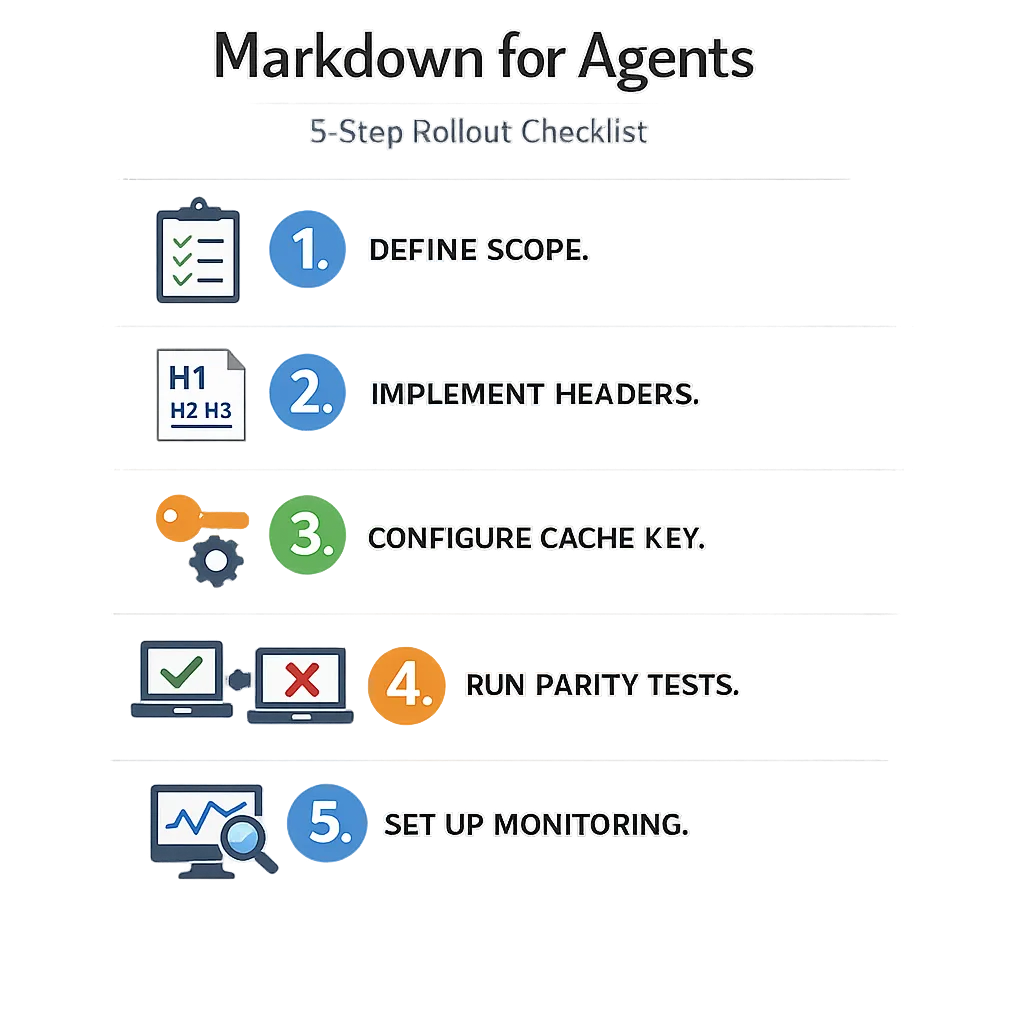
- We scoped initial rollout to a path set with public, factual content.
- We return
Content-Type: text/markdown, optionalx-markdown-tokens, and acontent-signalpolicy. - We confirmed separate cache keys for HTML vs Markdown (custom cache key or query rewrite).
- We added a parity test that compares HTML article nodes to Markdown blocks.
- We scan Markdown for PII and banned phrases.
- We log Markdown hits by path and user agent and alert on token regressions.
- We launched behind a flag and documented a rollback switch.
Implementation sketch (express-style pseudo‑code)
app.get('/docs/:slug', async (req, res) => {
  const wantsMarkdown = req.headers.accept?.includes('text/markdown');
  const doc = await loadDoc(req.params.slug);

  if (wantsMarkdown) {
    const md = await toMarkdown(doc.html); // or doc.markdown
    res.setHeader('Content-Type', 'text/markdown; charset=utf-8');
    res.setHeader('content-signal', 'ai-train=yes, search=yes, ai-input=yes');
    res.setHeader('x-markdown-tokens', estimateTokens(md).toString());
    return res.send(md);
  }

  // default HTML path
  return res.send(renderHtml(doc));
});
Adapt the routing to your CDN: add a rule that when Accept contains text/markdown, you rewrite or route to the Markdown path and adjust the cache key appropriately.
Risk review and how to mitigate
Content drift. Your Markdown and HTML diverge over time. Fix: add a pre‑publish hook that renders both and compares blocks; refuse publish on large diffs.
Cache poisoning or bleed‑through. HTML and Markdown share a cache key. Fix: custom cache key or header‑driven rewrite to a canonical query string for Markdown.
Unwanted training. Agents ignore your content-signal policy. Fix: rate‑limit or block unknown agent user agents; watermark samples; require auth on sensitive paths.
Token explosions. A widget or table balloons Markdown size. Fix: monitor x-markdown-tokens baselines and alert on spikes; refactor tables into concise lists or collapse repetitive markup at source.
How this ties to your broader platform
Serving Markdown to agents is one pillar of an answer‑ready web stack. The other pillars are controlled deployment and observability. If you want a partner to help wire this safely—flagging releases, staging transforms, and monitoring—we’ve documented how we ship complex changes in what we do and how we support clients across launches in our services overview. You can also browse recent builds that balance speed with governance.
What to do next
- Choose two content paths for a pilot and create a short parity checklist.
- Implement the Accept‑based route and set
content-signalandx-markdown-tokens. - Fix cache keys so HTML and Markdown don’t collide.
- Roll out behind a feature flag, then ramp after a week of clean metrics.
- Document your agent policy and add it to your platform playbook so new pages inherit it.
Zooming out
In 2009 we optimized for browsers. In 2026, we also optimize for agents. Markdown for Agents takes a decades‑old HTTP idea—content negotiation—and applies it to a new distribution channel. You’ll spend a day wiring headers and cache keys, maybe a week building parity tests. Then the payoff compounds: lower token costs for the ecosystem, fewer parsing mistakes, and a cleaner path for your content to power answers everywhere it shows up.
If you want help scoping a pilot or building the guardrails, reach out through our service packages or contact us directly. We’ll stand up a safe, measurable rollout you can ship in a week.




Comments
Be the first to comment.