
JDK 26: What Matters Now for Teams
JDK 26 arrives on March 17, 2026, and while it isn’t an LTS, it’s the right moment to kick the tires. Why? Because JDK 26 brings HTTP/3 to the Java HTTP Client, introduces warnings that prepare the platform to make final fields truly final, nudges performance with G1 synchronization changes, and keeps incubating work developers asked for (Vector API, structured concurrency). If you plan to stay on LTS in production, you should still pilot JDK 26 this month to spot issues before September 2026 when its short support window closes.
Why JDK 26 matters even if you’re staying on LTS
Here’s the thing: non‑LTS feature releases are where future defaults are seeded. The fourth preview of primitive types in patterns and the sixth preview of structured concurrency are not toys; they’re how your team learns new idioms before they lock in on an LTS. The “Prepare to Make Final Mean Final” change (JEP 500) is especially relevant. Starting with JDK 26, the JVM emits run‑time warnings when deep reflection mutates final fields. A future release will likely throw exceptions by default. If you run frameworks or serializers that poke at finals, you want that signal now, not when your next LTS upgrade surprises you.
Operationally, JDK 26’s support window is short—think months, not years—which actually makes it perfect for controlled pilots. You’ll get enough time to evaluate features like HTTP/3 and G1 throughput tweaks, then decide whether to adopt those patterns on your current LTS or plan for their arrival in the next one.
What’s actually new in JDK 26
No fluff. These are the changes worth your attention and a quick hands‑on:
HTTP/3 for the Java HTTP Client
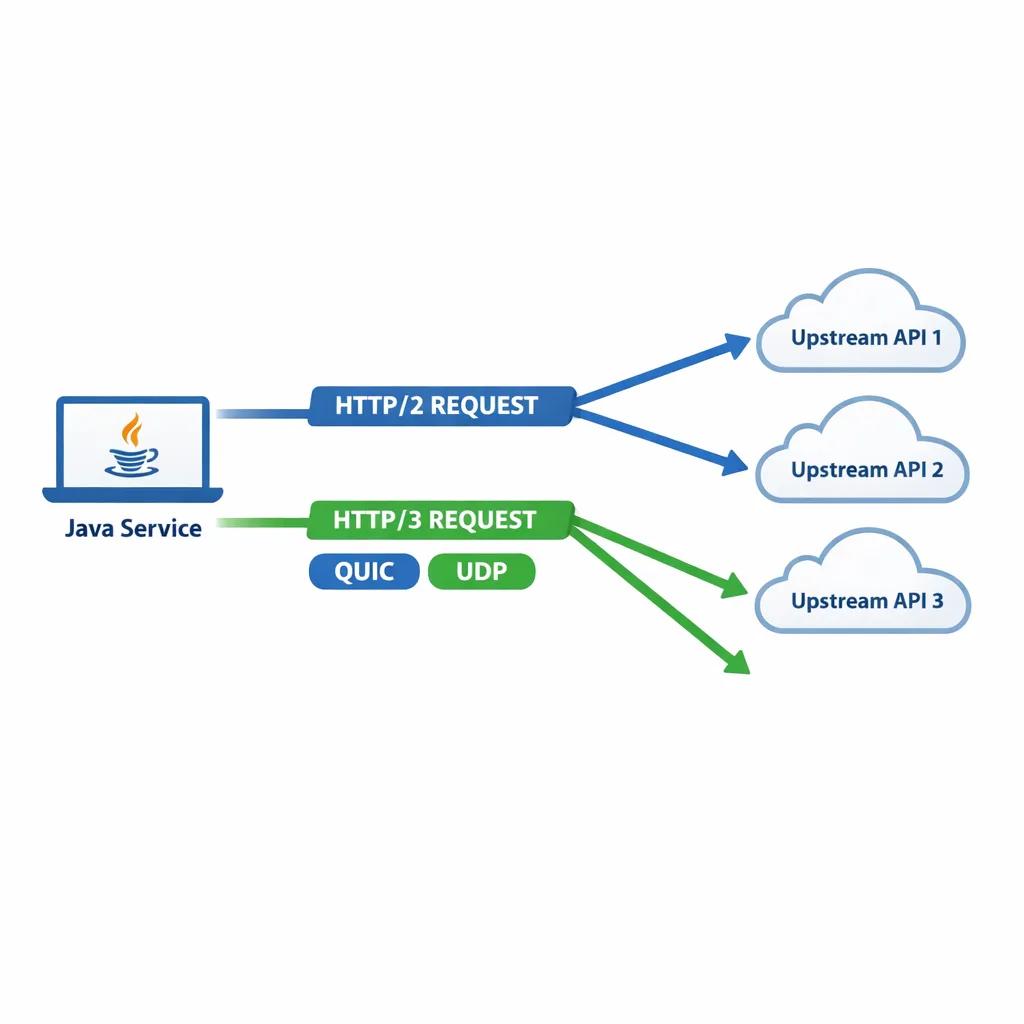
Java’s HttpClient can now speak HTTP/3 over QUIC, opt‑in. That means faster connection setup, better behavior on lossy networks, and less head‑of‑line blocking. You enable it per client or per request, for example: HttpClient.newBuilder().version(HttpClient.Version.HTTP_3).build(). The default remains HTTP/2; if a server doesn’t support HTTP/3, the client falls back gracefully. For service‑to‑service calls, especially over the public internet or mobile networks, it’s worth A/B testing now.
JDK 26 and “final means final” (JEP 500)
JDK 26 starts warning when code uses deep reflection to mutate final fields. That’s a clear message: integrity by default is coming. If you legitimately need to mutate finals (e.g., some serializers), you can acknowledge it explicitly at startup with --enable-final-field-mutation for specific modules or ALL-UNNAMED. Expect this to tighten later—warnings may become exceptions in a subsequent release. Libraries depending on reflection tricks should get ahead of this now.
Ahead‑of‑Time object caching with any GC
As part of Project Leyden’s goals, the JVM can cache pre‑initialized objects in a GC‑agnostic format and load them sequentially at startup. Translation: better startup and warmup, and you’re not pinned to a single collector implementation to benefit. If you run CLIs, serverless handlers, or microservices under tight cold‑start budgets, this is the feature to explore in a lab branch.
Vector API, eleventh incubator
The Vector API keeps improving. It lets you express SIMD‑friendly computations that the JIT reliably lowers to CPU vector instructions on x64 and AArch64. If you do image transforms, crypto‑adjacent work, or numerical kernels, try swapping a hot loop for a vectorized version and measure. Incubator status means API shape can still change, but performance benefits are real where workloads fit.
Structured concurrency, sixth preview
Structured concurrency treats related tasks as a single unit of work. You get cleaner cancellation and error handling, plus better observability. Many teams have hand‑rolled scaffolding like this with thread pools and CompletableFuture; the preview gives you a standard path to retire that code gradually.
G1 GC throughput improvements
JDK 26 reduces synchronization between application threads and G1’s GC threads and trims write‑barrier code size. Don’t expect magic, but reductions in coordination overhead can show up as smoother latency profiles and a bit more headroom at high allocation rates. Validate in your own telemetry.
Lazy constants, PEM APIs, and one removal
Lazy constants (second preview) let the JVM treat selected objects like true constants without eager initialization. The PEM encoding API (second preview) gives a standard way to encode/decode keys and cert artifacts. And yes, the obsolete Applet API is finally removed. If you still compile ancient code that references applets, you’ll get compile errors—fix by deleting dead references or isolating that legacy module behind conditionals in your build.
JDK 26: common questions
Is JDK 26 an LTS release?
No. It’s a feature release with a support horizon measured in months (GA on March 17, 2026; plan that window through September 2026 if you need vendor updates). If you must pin versions long‑term, stay on an LTS for production and use JDK 26 for evaluation and forward‑compat readiness.
Will JDK 26 break my build?
Unlikely, unless you depend on removed or strongly warned behavior. Preview/incubator features are off by default—you won’t accidentally compile against them without flags. Watch your logs for final‑field mutation warnings and review any compilation failures tied to the removed Applet API.
How do I enable HTTP/3 in Java?
Opt in via HttpClient.Builder.version(HttpClient.Version.HTTP_3) or use HttpRequest.Builder.version(...) per request. Expect fallback to HTTP/2/1.1 if the server doesn’t speak HTTP/3. For hard enforcement (no fallback), configure discovery options accordingly and validate your target supports QUIC.
What if my framework uses deep reflection?
You’ll see warnings in JDK 26. Short term, use targeted --enable-final-field-mutation to keep the app quiet while you file issues with the framework. Long term, prefer APIs that don’t mutate finals; library authors should provide documented switches or alternative code paths.
The one‑sprint JDK 26 pilot plan
Give your team five days. You’ll come out with a go/no‑go plus concrete issues and patches.
- Define scope: pick one service with real traffic and HTTP client calls, plus one batch job with CPU‑heavy work. Decide success metrics (startup, latency p95, error rate, log noise).
- Provision a clean JDK 26 toolchain and container base image. Pin versions. Document
JAVA_TOOL_OPTIONSyou’ll use. - Compile and run with your current flags. Don’t enable previews yet. Record baseline perf and memory under JDK 21/25 first, then JDK 26.
- Scan logs for “final field” warnings. Inventory the code paths or libraries involved. Capture stack traces to file issues upstream.
- Enable HTTP/3 for a small percentage of outbound calls via config. Compare connection setup times and error patterns when UDP/QUIC is unavailable or rate‑limited.
- Turn on a canary using the G1 changes (no extra flags needed). Monitor allocation rates, pause times, and CPU during GC. Look for throughput deltas rather than miracles.
- Test the PEM API in a small crypto utility (key import/export) if you have homegrown tooling; validate interop with OpenSSL and HSM flows.
- Experiment with the Vector API in a microbenchmark relevant to your domain. Keep a plain‑Java baseline and confirm correctness under stress.
- Try a sample with structured concurrency in a noncritical code path where you juggle multiple dependent calls; evaluate readability and cancellation behavior.
- If cold starts matter (CLI, serverless), prototype ahead‑of‑time object caching. Measure end‑to‑end startup, not just JVM initialization.
- Run a soak test with production‑like data. Capture flame graphs before/after.
- Decide: adopt selectively now (e.g., HTTP/3 in a client, new GC defaults), or park findings and stick with LTS while tracking the warning→exception trajectory on finals.
Performance: what to expect—and how to measure
There’s no universal speedup. You’ll see benefits only where the change touches your workload. HTTP/3 helps on high‑latency or lossy networks; it won’t do much for same‑rack traffic behind a proxy that terminates TLS/TCP. G1’s synchronization reductions make the most difference under sustained allocation with lots of mutator/collector coordination. Vector API pays off when your data fits SIMD lanes and you operate on large enough chunks per call. Treat each as a hypothesis: measure with production‑like payloads, realistic concurrency, and at least a few hours of steady‑state traffic.
Security and crypto updates that unblock cleanup
Two angles for your backlog. First, the PEM API consolidates glue code many teams maintain to wrangle keys and certs; standardizing here reduces foot‑guns and odd encodings across environments. Second, the final‑field warnings create a forcing function for dependency hygiene. If a serializer or framework relies on mutating finals, raise an issue and plan a version upgrade. Between those nudges and HTTP/3’s QUIC handshake behavior, your security and platform teams finally get to delete some custom patches.
Risks, traps, and edge cases to test
HTTP/3 over QUIC uses UDP. Some enterprise networks throttle or block it. Validate fallback paths and timeouts; ensure you don’t degrade user‑visible latency when discovery bounces between protocols. For final‑field warnings, SREs should decide where the logs land and how alerts fire—don’t let a noisy dependency page your on‑call rotation at 2 a.m. G1 tuning: if you carry forward custom flags, re‑baseline; some hand‑tuned values set years ago can now get in the way of the default heuristics. And if ancient applet references still lurk in a corner repo, expect compilation errors—delete them.
JDK 26 in a polyglot shop
Most teams run Java alongside Node, Python, or Go. If that’s you, coordinate your upgrade windows. For example, Node.js 20 reaches end‑of‑life on April 30, 2026; if you own TypeScript services too, combine your JDK 26 pilot with a Node runtime plan so CI and container base images don’t diverge. We’ve outlined a practical, deadline‑aware approach in our guide on the Node.js 20 EOL upgrade deadline.
Architecture notes from the field
We’ve seen three patterns work well when introducing non‑LTS features into LTS estates. One: feature toggles at the client lib—e.g., add HTTP/3 as an opt‑in per endpoint, then expand coverage as observability proves it out. Two: pave a new golden path for concurrent code with structured concurrency in new modules only, avoiding rewrites. Three: add microbenchmarks to the repo for vectorizable hot loops; gate merges on correctness and a minimum throughput threshold to catch regressions early.
A practical checklist to go live
- Inventory reflection use. Triage any final‑field warnings by library and code path; open upstream issues with repros.
- Enable HTTP/3 for one service and confirm fallbacks, timeouts, and dashboards. Document how to disable quickly.
- Re‑baseline GC metrics under G1 without legacy flags; remove overrides unless you can prove they still help.
- Protect correctness: add property‑based tests for any vectorized code; fuzz PEM encode/decode across platforms.
- Line up base images and JDK distributions across CI/CD so you’re not testing on a different build than you ship.
- Write a rollback note: one page that explains how to revert to your LTS build and which toggles to flip.
What to do next
Make the pilot official this week. Book capacity for a five‑day spike, add the flags you’ll test (--enable-final-field-mutation where needed), and run the canary with clear KPIs. If you want help framing the experiment or hardening results into a rollout, our team ships these upgrades for a living—see how we work on how we ship risk‑reduced platform upgrades and explore our Java upgrade and performance tuning services. If you’re ready to budget, our transparent pricing page helps you plan. Or if you just want to trade notes and get a second pair of eyes on your plan, talk to us.
Zooming out
JDK 26 isn’t a fireworks release, but it’s strategic. HTTP/3 brings your client stack current with the modern web. The “final means final” journey forces clarity on invariants and speeds up the JVM down the road. G1’s small cuts target throughput where it counts. And incubator/preview features keep maturing in place so the next LTS doesn’t feel alien. Run the pilot, write down what you learned, and feed it into your backlog. That’s how you keep Java boring in production—and that’s a compliment.









Comments
Be the first to comment.