EU AI Act Compliance in 2026: The Real Build Plan
EU AI Act compliance stops being theoretical on August 2, 2026. If you build or deploy AI for EU users, this isn’t a legal footnote—it’s a product blocker. The good news: most teams can stand up a robust, auditable program in weeks if they cut the busywork and focus on the control surfaces regulators care about. This is your practical build plan.
What’s actually happening on August 2, 2026?
Here’s the thing: the AI Act entered into force in 2024, but application is staggered. Two early layers already apply—prohibited practices (since February 2, 2025) and governance/GPAI obligations (since August 2, 2025). The broader framework applies on August 2, 2026, with high‑risk obligations phased by article and category. There’s also an ongoing legislative “digital omnibus” track aiming to shift some high‑risk timelines so providers aren’t penalized while EU standards and guidance are still landing.
Key dates product leaders should pin on the roadmap:
- February 2, 2025: Prohibited AI practices ban is live.
- August 2, 2025: Governance and some GPAI obligations apply; the AI Office begins scaling guidance and oversight.
- August 2, 2026: General application date; transparency items (like AI‑generated content notices) and several operational duties become day‑to‑day reality.
- Watermarking/marking for certain AI‑generated content: currently targeted for December 2, 2026 under the omnibus track.
- High‑risk AI embedded in regulated products: scheduled for August 2, 2027 unless amended by the omnibus changes.
- Stand‑alone high‑risk Annex III systems: widely discussed shift toward December 2, 2027 under the omnibus deal; formal adoption still matters, so track it.
- EU database registrations for high‑risk AI: required before market placement once your category is in scope and the registry is operational for your use case.
Build your plan so you can ship safely by August 2, 2026, while staying flexible if some high‑risk dates move by a few months. Flexibility beats last‑minute scrambles.
What counts as a “high‑risk AI system”?
Two doors lead to high‑risk classification. Door one: the AI is a safety component of a regulated product (medical devices, rail, aviation, machinery, etc.). Door two: it’s used for a listed high‑risk purpose (Annex III)—think hiring, education, access to essential services, law enforcement, or biometric systems, among others. Classification is purpose-driven. That means the same model can be non‑high‑risk in one workflow and high‑risk in another depending on how it’s deployed and what’s at stake.
Expect Commission guidelines (and ultimately harmonized standards) to tighten how teams interpret the borderlands: e.g., when a recommendation or scoring tool quietly becomes a gatekeeper affecting a person’s rights or access. When in doubt, run a structured risk test and document why you’re in or out.
EU AI Act compliance, defined the way engineers can work with
The Act’s requirements map cleanly to workflows you already know from secure software delivery and ML operations. The trick is making them auditable. Here’s the minimal viable compliance engine that still scales:
The BRIDGE model: six control surfaces you can ship in 45–90 days
BRIDGE is how we’ve implemented AI governance in real teams without stalling feature velocity.
- B — Boundaries. Capture intended purpose, domain, and user groups. Define in‑scope models, prompts, and integrations. Decide and document what the system must not do.
- R — Risk management. Maintain a living hazard list: foreseeable misuse, bias vectors, drift, data leakage, prompt injection paths, and safety fallbacks. Tie each risk to a concrete control and a test.
- I — Inputs & data governance. Log training/eval data provenance, sensitive attributes policies, filtering, and augmentation. Validate input datasets against representativeness requirements for the intended purpose.
- D — Documentation. Produce human‑readable, regulator‑friendly docs that mirror Annex IV/technical file expectations: intended purpose, architecture, training data summary, metrics, known limitations, human oversight design, and a change log.
- G — Guardrails & oversight. Implement human‑in‑the‑loop points, fallbacks, and thresholds for confidence/uncertainty. Assign an accountable owner—someone who can pause rollout if post‑market signals spike.
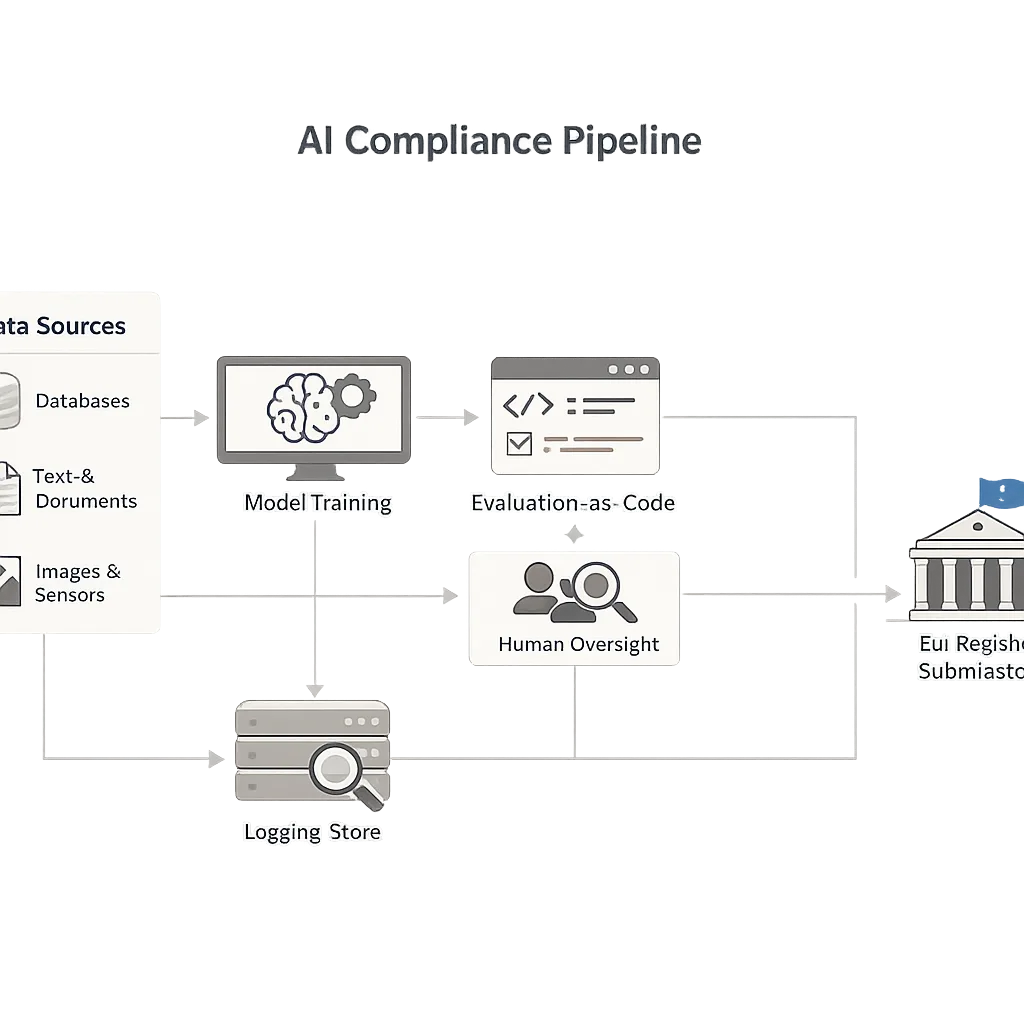
- E — Evidence & events. Centralize logs: inputs, outputs, interventions, model version, prompt/template version, confidence scores, and serious‑incident flags. Events are your audit trail and your post‑market monitoring feed.
Ship BRIDGE as code. Put the artifacts in your repo, tag releases to a model version, and automate exports to your technical documentation bundle. If someone can’t reproduce a claim or a metric, you don’t have compliance—you have a slide deck.
People also ask: Do US companies need to comply if they don’t have an EU office?
Yes. The scope hooks onto the EU market and affected people, not your headquarters. If EU users can access or are targeted by your AI system, you’re in scope. Non‑EU providers may need an EU‑based authorized representative for certain obligations; either way, you’ll need a clear contact path for regulators and a way to fulfill registration, incident reporting, and information requests on EU time zones.
People also ask: What documentation will an auditor actually read?
They’ll want the technical file that proves you understood your system’s risks, implemented guardrails, verified them with tests, and can trace any decision to a model/prompt version and dataset slice. Think “explain it to a skeptical staff engineer” energy: short, precise, linked to evidence, and current to the version on the market.
Policy changes to track between now and year‑end
Three moving pieces matter as of June 29, 2026. First, the “digital omnibus” negotiations, which aim to align dates with the availability of harmonized standards and Commission guidelines. Second, the AI Office’s guidance on classifying high‑risk use cases and on transparency/watermarking. Third, the operational readiness of the EU database for high‑risk AI systems. None of these change your core build work. They change sequencing and “go‑to‑market” paperwork timing.
Let’s get practical: a 90‑day build plan
This plan assumes you run at least one model in production for EU users—chat, recommendations, or decision support—and you want August 2 to be boring.
Days 1–15: Inventory and intent
- Write the one‑pager: intended purpose, impacted users, decisions assisted or made, and what the system must not do.
- Inventory models (foundation and fine‑tunes), prompts/templates, datasets, and integrations. Map where personal data enters, how it’s transformed, and where outputs flow.
- Baseline metrics: accuracy, false‑positive/negative costs by cohort, latency, and uncertainty behavior.
- Decide your human‑oversight pattern: approve‑before‑act, review‑after‑act with holdbacks, or supervisory sampling—justify it to risk.
Days 16–45: Controls and tests
- Risk register v1: misuse cases, bias vectors, prompt injection, privacy leakage, content risks. Assign an owner and a control for each.
- Data governance: document provenance, licenses, sensitive attributes policy, representativeness checks for the intended purpose, retention, and deletion.
- Guardrails: input filters, safety classifiers, retrieval boundaries, and fallback behaviors. Add a policy for uncertain outputs.
- Test packs: red‑team prompts, bias tests across cohorts, injection/resilience suites, and data leakage/unit tests. Automate to run on each model/prompt change.
Days 46–70: Documentation and evidence
- Build your technical file: intended purpose, architecture, data summary, metrics, limitations, monitoring and incident‑response plan, human oversight, and change control.
- Centralize logs and serious‑incident flags. Ensure you can export incident timelines with inputs/outputs/model version.
- Dry‑run an internal conformity assessment: run through your checklists like an external auditor would.
Days 71–90: Go‑to‑market hygiene
- Labeling and transparency: implement end‑user notices where required and internal UI cues for operators.
- Registration readiness: ensure your provider details, intended purpose statement, and declarations of conformity are complete for EU database submission when your category opens.
- Organize your “fast answers” kit: a short package you can send to a regulator on 24–48 hours’ notice—contacts, system overview, logs, and most recent risk report.
Designing human oversight that’s not theater
Oversight fails when it’s a generic checkbox. It works when it’s contextual. Two examples teams ship successfully:
- Threshold gating for actions. If the model is below a confidence threshold, require human approval before acting. Above the threshold, allow auto‑execute but sample 5–10% for review. Tie thresholds to risk and cohort performance.
- Intervention journaling. When humans override a model, capture the reason code, evidence, and outcome. This becomes gold for retraining and for audit narratives.
Neither is expensive to implement; both produce evidence regulators recognize.
Watermarking and content transparency: how to keep momentum
If you generate images, audio, or video, build a pipeline toggle now for watermarking/marking so you can flip policies without refactoring. Treat creatives and marketing as key stakeholders. Your goal is to guarantee consistent labeling across channels (product UI, email, social, support) and maintain an exception log for formats that resist watermarking so legal has something to work with.
How to make your conformity assessment boring
Nobody wants a hero project here. Keep it predictable:
- Quality Management System (QMS). Keep it light but real—roles, approvals, and evidence locations. “Where does this live?” should have one answer.
- Traceability. Every shipped decision should resolve to a model version, a prompt/template hash, and a dataset signature.
- Change control. Gate risky changes behind tests you actually trust. If a diff changes behavior, your docs must update automatically.
That’s it. You don’t need a 200‑page novella. You need a living system that survives model and prompt iteration.
Registration: what to have ready before you click submit
For high‑risk categories that open for registration, prepare these before you touch a portal: provider identity and contact details; intended purpose text that’s specific and consistent with your UI and docs; system identity and versioning; your risk management narrative tied to tests; a declaration of conformity; and a named person authorized to represent the provider. If you operate in sensitive public‑sector categories, expect some details to land in a non‑public registry segment—so don’t stall waiting for a public URL.
Engineering patterns that pay off under the AI Act
- Prompt and policy versioning. Treat prompts and safety policies like code; tag with semantic versions and store diffs. If outputs change, you’ll know why.
- Eval-as-code. Don’t hand‑wave your metrics. Keep evaluation suites alongside code; run them in CI; publish a simple scorecard with pass/fail and trend lines.
- Data contracts. Declare what inputs are allowed, what’s prohibited, and how sensitive attributes are handled. Enforce at ingestion with schema validation.
- Serious‑incident playbooks. Define severity, routing, timelines, notification templates, and rollback steps. Run a tabletop drill once per quarter.
Edge cases and gotchas
“We’re just using an API.” You’re still a provider if you wrap and place a system on the EU market under your name. You own risk management, documentation, and oversight. Get upstream assurances, but don’t outsource accountability.
“It’s decision support, not decision making.” If operators rubber‑stamp model output, regulators treat it like automated decisioning. Prove that humans meaningfully intervene by showing override rates, reason codes, and extra evidence requirements.
“Our model’s a fast‑moving target.” Then ship more tests and better versioning. Live systems drift; compliance is about catching it early and proving you did.
What to do next (this week)
- Assign an accountable owner for each in‑scope system. No committees.
- Stand up a single repo location for BRIDGE artifacts and your technical file.
- Automate your eval suite and wire it into CI on model/prompt change.
- Draft your intended‑purpose statement and paste it into product docs and ops runbooks for consistency.
- Create your serious‑incident definition and 24‑hour response workflow.
Where we can help
If you want a partner who ships with you—not at you—our team implements the BRIDGE model, stitches it into your delivery pipeline, and gets you audit‑ready without slowing releases. Explore how we work on our delivery approach, see outcomes in the client portfolio, and get deeper engineering playbooks on the ByBowu blog. When you’re ready, reach out via contact—we’ll start with your inventory and a two‑hour working session.
FAQ for product and engineering leaders
How many people do we need to run this?
For a single high‑risk system, a lean core often suffices: one product owner, one ML lead, one data governance/infra engineer, and fractional support from legal and security. Your CI does the rest.
What if our category becomes high‑risk later?
You’ll be glad you treated this as engineering hygiene, not one‑off paperwork. The same BRIDGE artifacts satisfy security reviews, customer due diligence, and internal risk committees—even if you never end up in Annex III.
Will this slow down our roadmap?
Only if you bolt it on at the end. Put evals and documentation in the same PRs as your prompt and model changes. Make “evidence updated” a merge check. Shipping stays fast.

Final word
EU AI Act compliance isn’t red tape; it’s operational clarity. Teams that build these muscles now will ship faster, face fewer incident headaches, and have cleaner upgrade paths when guidance and standards land. August 2, 2026 is close enough to feel real. Ship the controls that matter, keep them in code, and make your next regulator conversation wonderfully boring.







Comments
Be the first to comment.