Let’s be plain: the React2Shell story didn’t end on December 3. The initial remote code execution in React Server Components (RSC) triggered a wave of downstream advisories, follow-up patches a week later, and active exploitation in the wild. Next.js shipped targeted guidance and a one‑shot updater. Microsoft advised rotating secrets for unpatched apps that were online during the early window. Node.js, meanwhile, queued a security release for early January. If you own a Next.js App Router estate or any RSC‑backed app, you need a holiday plan that does three things: patch correctly, prove you’re safe, and harden the build chain.

TL;DR timeline: what changed after Dec 3
December 3, 2025: the React team disclosed a critical RCE in RSC packages, rated CVSS 10.0, and released fixed versions across 19.0.1, 19.1.2, and 19.2.1 for the affected react‑server‑dom packages. Frameworks that integrate RSC—most visibly Next.js App Router—issued downstream advisories the same day with precise upgrade paths and an automated fixer (npx fix-react2shell-next).
December 11, 2025: two additional RSC vulnerabilities (DoS and source exposure) were published with new fixed versions. The DoS fix needed an addendum shortly after, which means some teams had to patch twice. Crucially, the new issues didn’t reopen RCE, but they did require another pass to make sure your exact versions landed on the corrected builds.
Mid‑December: multiple security teams confirmed exploitation in the wild, urging anyone who was online and unpatched around December 4 to rotate secrets, review logs and telemetry, and treat internet‑facing Next.js apps as highest priority.
January 7, 2026 (scheduled): the Node.js project plans coordinated security releases across active lines. That timing matters for your change calendar: you don’t want to discover a Node‑level patch requirement after you’ve wrapped your RSC/Next.js fixes. Plan windows now so you can absorb both with minimal risk.
Are my Next.js apps actually affected?
If you’re using the App Router with Server Components or Server Actions, assume yes and verify. If you’re still on Pages Router without RSC, your exposure is lower—but teams often mix patterns during migrations. You must check what’s deployed, not just what the repo claims, because many orgs ship multiple apps and edge functions from one monorepo.
Quick exposure check
On a running instance (or a reproducible container image), inspect node_modules or the lockfile for these packages and versions:
• react-server-dom-webpack, react-server-dom-parcel, react-server-dom-turbopack: vulnerable in React 19.0.0, 19.1.0, 19.1.1, and 19.2.0; fixed in 19.0.1, 19.1.2, 19.2.1; later fixes for the follow‑up issues were 19.0.3, 19.1.4, and 19.2.3.
• Next.js ranges: releases across 15.x/16.x had coordinated patches; use the official advisory mapping for your line and apply the latest fixed point release.
Remember: container images with old layers or serverless deployments with cached bundles can keep stale copies even after your main branch updates. Verify the artifact that’s actually serving traffic.
React2Shell patching: the exact sequence that works
Here’s the thing: most teams “patched” once on December 3 and moved on. Then the December 11 set landed, and some fixes were incomplete, forcing another round. To stop the churn, use this sequence and capture evidence as you go.
1) Freeze deploys, then update React and Next.js in one PR
Upgrade RSC packages to safe versions and bump Next.js to the advisory’s fixed release for your branch line. If you’re on 15.x, land the latest 15.x fix; if you’re on 16.x, land that line’s fix. Don’t mix major bumps unless you’re explicitly doing a framework upgrade project.
2) Run the Next.js one‑shot fixer
Execute npx fix-react2shell-next from the app root to ensure your Next.js app pulls the patched RSC dependencies, updates any protocol‑level flags, and clears lingering lockfile anomalies. Commit the changes it makes—security reviewers will ask.
3) Rebuild artifacts cleanly
Delete caches and node_modules, then perform a clean install. In CI, prefer npm ci --ignore-scripts or your package manager’s equivalent to reduce script‑based supply chain risk during patch cycles. For pnpm, use pnpm install --frozen-lockfile --ignore-scripts; for Yarn, consider yarn install --immutable and disable lifecycle scripts in CI.
4) Validate package versions from the built image
After the build, run a script inside the container or serverless bundle to print the resolved versions of the RSC packages and Next.js. Store that output as a build artifact. This is your “prove it” evidence later.
5) Canary deploy with aggressive observability
Ship to a small slice. Turn on verbose error telemetry for Server Actions and RSC payload parsing. Watch CPU and memory under synthetic load to catch any regressions from the DoS patch. If your edge network offers temporary WAF rules for known exploit patterns, keep them enabled during canary.
6) Full rollout and secret rotation (if you were late)
If your app was publicly reachable and unpatched around December 4, treat credentials with suspicion. Rotate the most sensitive secrets first: database, signing keys, cloud access tokens, and any session encryption keys. Sequence rotations to minimize downtime, and invalidate tokens where possible. For long‑lived refresh tokens, shorten TTLs until the rotation completes.
How do I prove the patch actually worked?
Security leaders and auditors don’t accept “we merged the PR” as evidence. Build a short, reproducible proof pack that stands on its own.
The five‑artifact proof pack
• SBOM or lockfile diff showing only safe versions for the RSC packages and your Next.js line.
• The output of a post‑build script printing resolved versions from the runtime image.
• CI logs from npx fix-react2shell-next (or equivalent) and clean install steps with --ignore-scripts.
• Canary telemetry snapshot: RSC payload parse metrics, error rates, CPU profile under load before/after.
• WAF or reverse proxy ruleset snapshot that was active during rollout.
Store this alongside the change ticket. If a regulator asks in March, you won’t be scrambling through chat logs.
Do I need to rotate secrets for every app?
Rotate based on exposure, not fear. Use this triage matrix.
Secrets rotation triage matrix
High priority (rotate now): internet‑facing apps that were unpatched between December 3–6; any app with anomalous logs (unexpected RSC payload sizes, 5xx spikes) during that window; apps where build secrets were accessible to the runtime.
Medium priority: apps that were patched within 24 hours but lack clear telemetry; internal apps accessible from the VPN with broad lateral movement risk; apps with shared secrets reused across environments.
Low priority (still plan it): apps never exposing RSC endpoints to untrusted traffic; Pages Router apps with zero RSC usage; static exports with no server runtime. Even here, capture evidence of why rotation was de‑prioritized.
What about Node.js? Do I wait until January 7?
No. Ship your RSC/Next.js fixes now, then hold a small window for the Node.js security release planned for January 7, 2026. Treat it as a separate, shorter change with a contained blast radius. If you maintain multiple Node baselines (20.x, 22.x, 24.x, 25.x), decide which lines you’ll keep current in production and stage test images in advance to reduce same‑day surprises.
Supply chain isn’t taking a holiday
While React2Shell grabbed headlines, the JavaScript ecosystem also saw high‑profile npm compromises this fall, with credential theft and malicious install scripts propagating quickly. That matters because many teams will be touching lockfiles and build systems more than usual this month. Reduce your exposure during patch sprints by cutting the attack surface in CI.
Hardening your patch pipeline
• Disable lifecycle scripts in CI and use --ignore-scripts during installs when possible.
• Require scoped tokens with least privilege for registries; block publishing from CI agents that only build and test.
• Enforce 2FA for maintainer accounts and organization owners on GitHub and npm.
• Pin registry endpoints explicitly and monitor for preinstall/postinstall usage in new dependencies.
• Generate an SBOM for each release; track diffs between December and January builds.
People also ask: will taking the app offline help?
Temporarily, yes—if you don’t have the engineering capacity to patch within hours and you’re demonstrably vulnerable, putting the app behind a maintenance page or blocking the specific RSC endpoints buys time. But it’s a stopgap. The only durable fix is landing the patched versions and verifying the runtime artifact.
People also ask: are edge and serverless deployments safer?
They’re faster to roll forward, but they’re equally vulnerable if they bundle the affected RSC packages or run a susceptible Next.js version. The benefit is operational: you can push a safe build to a fraction of traffic instantly and roll back if needed. Use that speed to your advantage—ship small, verify aggressively.
A pragmatic, 2‑hour “Patch and Prove” sprint
If you only have a single focused block today, here’s how to spend it.
Phase 1 (30 minutes): inventory and branch
List public‑facing apps using Next.js App Router or RSC. For each, create an emergency branch. Turn on required reviews, but pre‑assign reviewers so nothing queues for hours.
Phase 2 (40 minutes): apply vendor fixes
Run npx fix-react2shell-next. Manually bump RSC packages to the safe triplet for your React 19 line. Update Next.js to the latest fixed point release for your major. Clear caches; reinstall with scripts disabled.
Phase 3 (20 minutes): rebuild and verify
From the image, print resolved versions and save the artifact. Generate a quick SBOM and stash it in the change ticket. Run smoke tests that hit Server Actions with malformed payloads to confirm no crash loops and acceptable CPU profile.
Phase 4 (30 minutes): canary and commit
Roll to 5–10% traffic with temporary WAF rules. If clean for 15–20 minutes under synthetic load, proceed to 50%, then 100%. Start tiered secret rotation if you were late to patch on December 3–4.
Zooming out: strategy for 2026
React2Shell exposed a familiar pattern: a protocol‑level bug ripples through frameworks, which ripples through hosters. The teams who fared best already had four muscles: dependable SBOMs, quick dependency roll‑forward, environment‑aware secret rotation, and the ability to attach evidence to every security change. Build those muscles now, before the next CVE forces you to.
If you want a deeper dive on sequencing patches and proof artifacts, we’ve covered this in several guides. Start with our practical checklist in Patch Fast, Prove Safety, Avoid Traps, and use our hands‑on playbook in Your Holiday Patch Playbook. If you ship Next.js at scale, see Patch Twice, Verify Now for the December 11 follow‑ups. And if you’d rather have a partner ride shotgun, our security and delivery services can stand up the pipeline hardening and proof pack in days, not weeks.
What to do next (today)
• Patch: run the fixer, bump RSC and Next.js to their safe point releases, rebuild clean.
• Verify: capture version outputs from the runtime image, attach to the change record, and keep WAF rules up during canary.
• Rotate: if you were unpatched and online in early December, rotate high‑value secrets immediately.
• Harden: disable install scripts in CI, pin tokens, and generate SBOMs for each release.
• Plan: block a short window for the January 7 Node.js security release so you can absorb it without drama.
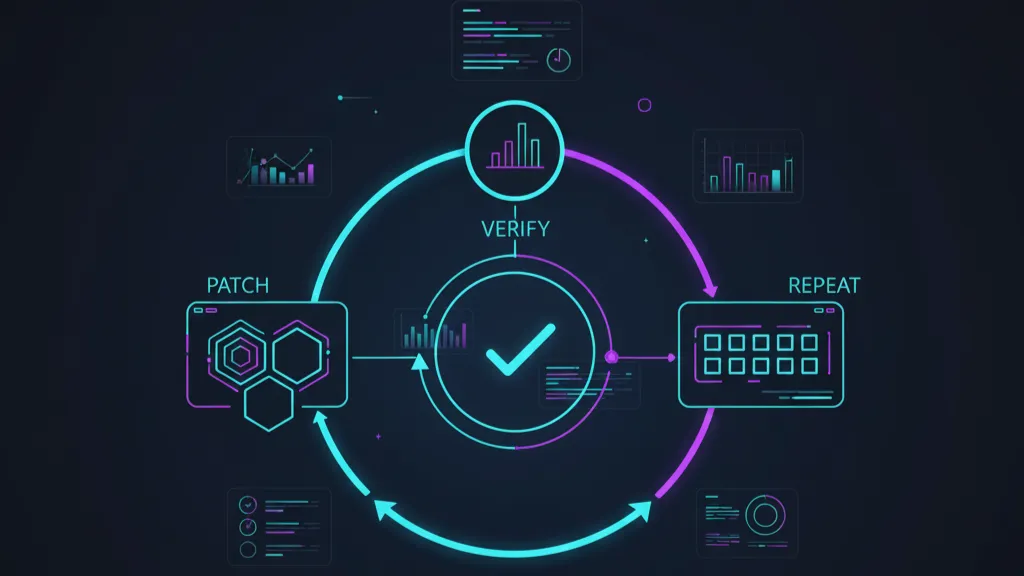
You don’t need a 50‑page policy to get this right. You need precise versions, clean builds, smaller deployments, and receipts. Patch. Verify. Repeat. That’s how you keep shipping when the calendar isn’t on your side.





Comments
Be the first to comment.