
Google March 2026 Core Update: What Changed, How to Recover
The Google March 2026 core update is done. It began rolling out on March 27, 2026 and completed on April 8, 2026 at 06:12 AM PDT—twelve days start to finish. It also arrived on the heels of a lightning-fast March spam update that finished within a day. If your organic traffic chart suddenly looks like a ski slope (or a launch ramp), you’re not imagining it. Let’s talk about what actually shifted, what to ignore, and how to craft a recovery plan that holds up the next time Google turns the knobs.

Google March 2026 core update: the timeline
Here’s the thing about timelines: they’re not trivia, they’re diagnostics. The core update started on March 27, 2026 and finished April 8 (twelve days). Three days earlier, Google pushed a March 2026 spam update that wrapped in under twenty-four hours. If you saw big shifts between March 24–25 that then continued (or reversed) after March 27, segment your analysis by those date windows. Mixing signals from a spam enforcement and a core recalibration leads to wrong conclusions and wasted sprints.
Google’s standing guidance didn’t change: core updates reassess content broadly. Sites that demonstrate expertise, original value, and clear purpose tend to be more resilient. Sites leaning on scaled, low-value content or thin affiliate roundups tend to wobble, sometimes dramatically. The quick spam update before the core release acted like a brush fire—clearing obvious violations—so the core systems could focus on relevance and satisfaction.
What actually changed—and what probably didn’t
Core updates aren’t a single switch. They’re a set of recalibrations that touch relevance understanding, content quality signals, and how Google interprets intent for queries. Based on hundreds of deltas we’ve reviewed across client and industry datasets since April 8, here’s the most defensible read.
1) Scaled content and “sitewide sameness” got less slack
Large sites shipping near-duplicate templates across dozens of subtopics—think AI-spun city pages or 200 cookie-cutter “best X for Y” posts—saw volatility. The pattern wasn’t just deindexation (spam update territory); it was downweighting where the unique value per URL was thin. If you can’t articulate why a specific page deserves to exist beyond capturing a keyword permutation, it’s a liability now.
2) Topical depth beat topic sprawl
We observed wins for properties that cover a defined domain thoroughly (with real demonstrations, data, and maintenance) and losses for blogs that dabble across unrelated niches. Depth here means maintained hub pages, updated walkthroughs, comparative testing, and credible bylines—not just long word counts.
3) Freshness mattered when the topic warranted it
Updates to product compatibility, API changes, pricing, and 2026-relevant screenshots correlated with improvements on recrawls. Stale guides with 2021 visuals and dead outbound links slid, sometimes quietly. If your category moves fast—frameworks, cloud SKUs, platform policies—refresh cadence is a ranking factor by proxy because it aligns with user satisfaction.
4) Technical health didn’t replace quality—but it narrowed the margin for error
Core Web Vitals didn’t become a kingmaker, yet sites with poor INP and CLS scores, heavy client-side rendering, and crawling inefficiencies had fewer “tie-breaker” wins. Think of technical excellence as the floor that keeps your best content discoverable and snappy when Google tightens relevance tolerance.
Did Google target AI content specifically?
No—at least not in the simplistic “AI = penalty” sense. The March spam update enforced policy against scaled content abuse regardless of how it was produced. The Google March 2026 core update then reevaluated usefulness and authority. If AI helped you draft a brilliant, firsthand teardown with original screenshots and data, you were fine. If it pumped out 500 bland listicles, you weren’t.
How long does recovery from a core update take?
Plan for weeks, measure in months. You can usually stabilize in 30–45 days if you diagnose correctly and move decisively, but durable recovery tends to align with Google’s next core or classifier refreshes—often 2–3 months out. The sooner you remove liabilities and reinforce your strongest themes, the sooner crawlers can observe a different site.
The Resilient SEO Framework: 30 / 30 / 40
When core updates shake things up, we use a simple allocation model to avoid thrashing.
- 30% Remove/merge liabilities: Prune thin or duplicative URLs. Consolidate near-duplicates into canonical guides. Noindex pages that can’t be salvaged (e.g., orphaned tag archives).
- 30% Add expert depth: Expand high-intent hubs with demonstrations, screenshots from 2026 versions, cost tables, and step-by-step outcomes. Attribute authors with credentials.
- 40% Technical & architecture: Improve crawl efficiency, internal link flow to hubs, render paths, and INP/CLS. Clean up faceted navigation and query parameters.
It’s opinionated by design. Most teams under-invest in deletion and over-invest in net-new content. The fastest wins often come from subtraction and consolidation.
Let’s get practical: a week-one diagnostic you can run
Block two focused days. Pull these views, make decisions, and ship small but real changes before Friday.
- Segment by date windows: Create three cohorts: March 17–23 (pre-updates baseline), March 24–26 (spam update), March 27–April 8 (core). Compare by landing page and query theme. You’re looking for pages that fell only during the spam window (fix policy issues) vs. those trending down across both (relevance/quality).
- Map to intent: For each dropping query, label it Informational, Transactional, or Comparison. If an informational query is landing on a product page (or vice versa), fix alignment with clearer titles, intros, and internal links to the right format.
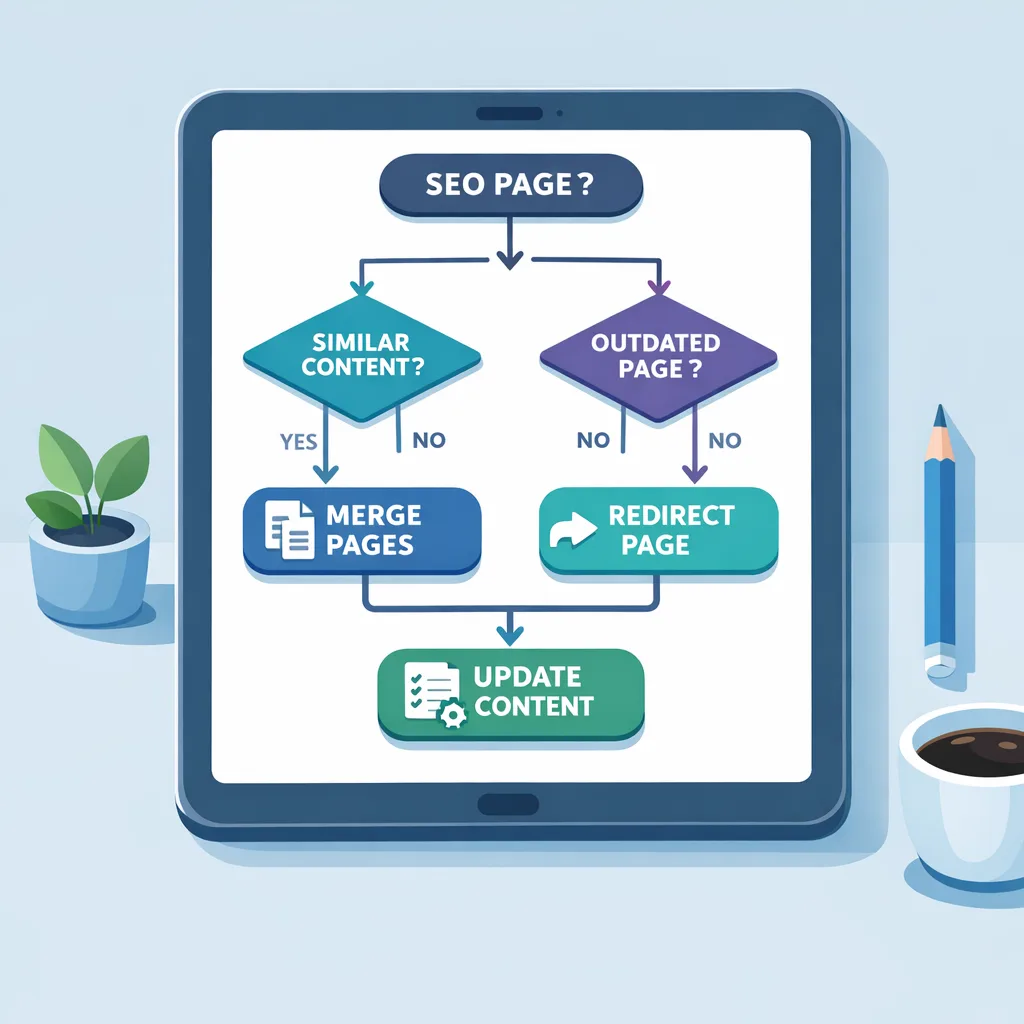
- Assess page uniqueness: Use a quick diff check across sibling URLs targeting similar terms. If five guides are 80% identical, merge into one definitive resource. Redirect the rest.
- Freshness and proof: Flag any page showing old UI, deprecated API calls, or 2023 pricing. Schedule same-week updates. Add source-of-truth references, updated screenshots, and date-stamped notes.
- Technical pass: Crawl for duplicate titles/descriptions, weak headings, missing canonicals, and render-blocking JS. Improve INP by deferring non-critical scripts and reducing long tasks.
If you’re juggling multiple systems or need outside horsepower, our team can help you triage and execute. See our web development services for how we structure SEO-focused rebuilds, or skim our Runtime Upgrade Strategy That Ships in 2026 to avoid regressions while you refactor.
Content decisions that move the needle post-update
Rewrite titles and leads for intent clarity
Users scan. Google does too. If your title promises a tutorial, open with steps and outcomes in the first two sentences. If it’s a comparison, put the decision criteria up top and a quick recommendation after the intro. Clarity reduces pogo-sticking and improves dwell time, which tends to correlate with better positions for the terms that matter.
Show the work: demos, data, and dates
Add 2026 screenshots, code snippets tested against the current API or framework version, and short video clips. Include updated pricing tables if costs changed this year. When a page proves recency and hands-on validation, it wins head-to-head against generic copy—even if the competitor domain is bigger.
Prune the zombie pages
Every site has them: stale press updates, thin tag archives, decades-old “news” with no traffic. Either fold anything worth keeping into your hubs, or noindex/410 it. You’re not just improving quality; you’re focusing crawl budget on pages that deserve it.
Architecture and internal linking: the quiet levers
Core updates magnify how well your site explains itself. If your best content lives three clicks deep behind a weak category page, it can’t compete. Build topic hubs with descriptive, human-readable intros and link them from relevant child articles with varied, natural anchors—not the same keyword every time. Add breadcrumbs, ensure canonicalization is sane, and surface related articles near the fold.
We routinely see 10–20% traffic recovery from nothing more exotic than improved internal linking and hub-page refreshes. It’s not flashy, but it compounds—and it’s resilient through algorithmic turbulence.
Technical guardrails that help in every update
- Improve INP and CLS: Reduce long tasks, preconnect to critical origins, and stabilize layout shifts. Faster, more stable pages help rankings where results are competitive.
- Server-side render critical content: Hybrid or SSR for key templates ensures primary content and links are immediately parseable without brittle client-side hydration issues.
- Canonical discipline: One canonical per intent. Avoid parameter soup and duplicate variants.
- Log-file monitoring: Watch crawl patterns as you remove or merge pages. Validate that Googlebot is re-crawling redirected clusters and indexing the target.
If you’re replatforming to fix structural issues, align your SEO workstream with engineering release trains so you don’t ship regressions. Our write-up on a runtime upgrade strategy that ships explains how we stage upgrades without kneecapping performance.
Common questions we’re getting right now
“Should we rewrite everything that dropped?”
No. Start with consolidation. If three weak posts overlap a strong one, merge them into the strong page, move the best bits, 301 the rest, and resubmit the target URL. Only rewrite when the page remains strategically important and genuinely outdated.
“Do we need new backlinks to recover?”
Sometimes—but chasing links without fixing content and architecture is backwards. After a core update, we see better returns from strengthening hubs, shipping updated demonstrations, and earning natural links from distribution (product updates, case studies, benchmarks). Then, if needed, pursue selective digital PR.
“Our rankings jumped—should we expand fast?”
Carefully. Growth is fragile right after a core update. Double down on your winning themes with depth, not breadth, and maintain update cadences. Publish new pages only where you can deliver original value.
Mini playbook: 30/60/90 days after April 8
Days 1–30
- Ship merges and redirects for duplicative clusters; remove zombie pages.
- Refresh top-10 money pages with 2026 data, screenshots, and outcome-forward intros.
- Fix INP outliers and stabilize CLS for core templates.
- Rebuild internal links to push authority toward hubs.
Days 31–60
- Publish two to four depth pieces in your strongest topic hubs (original testing, benchmarks, or teardown walkthroughs).
- Add author profiles with verifiable credentials; add edit dates to pages with material updates.
- Instrument log-file monitoring and custom crawl dashboards to validate reindexation.
Days 61–90
- Evaluate net movement versus your pre-update baseline by topic, not just overall traffic.
- Plan one structural improvement (navigation simplification, hub page redesign, or SSR rollout for a key template).
- Decide whether to expand a winning theme or sunset a losing one. Be decisive.

What success looks like by late Q2 2026
You won’t control every ranking swing, but you will control the surface area of risk. A healthy post-update site shows fewer near-duplicate URLs, stronger hub pages, fresher screenshots and code, and measurably faster interaction latency. Most important: your analytics should show cleaner alignment between query intent and landing templates, with fewer bounces and more assisted conversions.
If you need a partner to help execute the heavy lifts—content refactors, template rewrites, SSR, or performance tuning—take a look at our portfolio to see how we ship, or contact us to scope an engagement.
What to do next (this week)
- Split your data into the three update windows and identify liability clusters to merge or remove.
- Refresh two top URLs with 2026-accurate screenshots, pricing, and step-by-step outcomes.
- Cut render-cost where INP is worst; defer non-critical JS.
- Rewire internal links so your hub pages are never more than two clicks from home.
- Schedule a monthly freshness sweep for every hub through September 2026.
Zooming out, the sites that win after the Google March 2026 core update look suspiciously like the sites users would recommend to their peers: specific, current, and helpful. Build that—and the next update will feel a lot less scary.
Want a second set of eyes on your plan? Start with our quick explainer on what we do and how we approach resilient SEO within larger product roadmaps.






Comments
Be the first to comment.